How to move your stranded boat by human power
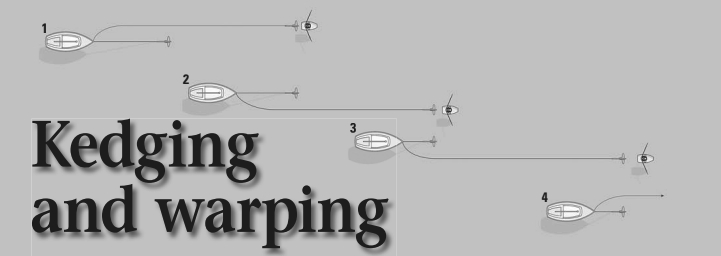
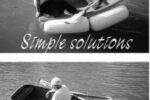
2. The sailboat is pulled ahead to the kedge anchor and the main anchor is hauled aboard. A second kedge anchor is rowed out with the tender and dropped ahead of the first one.
3. The sailboat is pulled ahead once more to the second kedge anchor and the first kedge anchor is retrieved. That first kedge anchor is then rowed out once more to serve in the same capacity.
4. Puff, puff, puff! The process is repeated as the sailboat is hauled up a stream, off a shoal, across a marina, or out of harm’s way in any number of situations.
Issue 46 : Jan/Feb 2006
My edition of the Oxford English Dictionary lists the origin of the word “kedge” as “uncertain” but goes on to describe it as “a verb meaning to move a ship by means of a hawser attached to a kedge (noun), a small anchor for the above purpose.” In The Boat Owner’s Practical Dictionary, Denny Desoutter adds that this secondary anchor to the main, or bower, anchor may be used for temporary stops where security is not a priority, to back up the bower anchor, or to haul a vessel off a mudbank or otherwise move her.
Alan Lucas, in his Encyclopaedia of Boating, gives the only description I have encountered that echoes my own view that two kedge anchors may usefully be carried aboard. The Oxford Companion to Ships and the Sea, edited by Peter Kemp, suggests the word kedge was originally cagger, an early derivative of the verb to catch, as in catch the bottom, dating from the 14th century. This work defines the modern kedge as a secondary anchor aboard a boat and seldom seen nowadays aboard a ship.
The noun “kedge” defines the function, rather than shape, of anchor. The kedge may be any self-setting anchor. Choice of style will be a matter of the skipper’s preference, governed by the nature of the bottom. My boat carries a modest selection of anchor types but my favorite kedge is the Bruce anchor, developed for North Sea oil rigs. This anchor exemplifies what a kedge should be, having excellent ability to dig itself into sand or mud, even fine shingle, and achieving this on a relatively short length of rode. It will often claw onto rock, can even do some limited service as a drogue in deep water, and has two handling features that recommend it: it is easy to grip, so a relatively heavy anchor does not have to be manhandled, and it has no moving parts to jam up on pebbles or mangle fingers. It also breaks out well.
The best answer
Ground tackle is an area in which some modern skippers are remiss. This is remarkable when “Drop the hook!” is the best answer to a multitude of crises. I will not cast off my mooring in our creek and head out over what is a treacherous estuary bar unless the sails are hoisted (or ready for immediate hoist), crew are wearing life vests and harnesses, the auxiliary engine is running sweetly, and two anchors are ready to be let go. The bar channel runs close to the rocks of what is usually a lee shore and seas run steep there. If the engine were to cut out, there would not be time for any action other than getting a hook set at once. That is not the time to reveal that your kedge anchor is light enough to stand in for a missing cuff-link or is buried in a locker.
How many times over the years have I seen smart yachts powering over that bar, not an anchor in sight, sails neatly furled in an impeccable sail cover . . . everything utterly dependent on the continued good health of electric sparks or diesel injectors?
Before engines were reasonably reliable, which was not so long ago, the kedge and warp played a vital auxiliary role in moving the vessel in confined spaces. When my recently purchased vessel came to the creek, she was not in good shape for sea, so I had her hauled in on a trailer, then craned in. The nearest access for the crane was some distance from the refit mooring. Rather than risk her untried diesel, I laid out a continuous system of lines from the crane to the mooring . . . and stopped worrying.
Controlled movement
Warping is a skill much to be desired. In a harbor, warping may permit a controlled means of moving a vessel slowly and deliberately, avoiding the faster, but unsafe, speed necessary to achieve steerage way under power or sail. When a strong line connects you from where you are to where you want to be, you have as near certainty on water as you can hope for. Kedging is one method of warping.
A few years ago I found a local skipper standing on the beach staring balefully at his motor vessel, an open double-ender of around 26 feet. She was aground on a sandbank in the middle of the estuary, the diesel inboard would not start, and the tide had started to come in. He was not a skipper of great experience and did not know what to do. I suggested that we kedge her back to her mooring in one of the little creeks a half or three-quarters mile distant.
We borrowed two anchors from my boat and two long warps. He went aboard his vessel while I worked from my little pram tender. One warp was looped over his samson post and the neatly coiled warp, together with its attached kedge, was passed down to me in the tender. With the Bruce hooked conveniently over the transom, I rowed toward our destination until I ran out of warp. Then I pushed the anchor over the stern with my foot. Returning to the motor vessel, I took the second kedge and warp aboard the dinghy with the bitter end of the warp once again looped over the samson post.
Haul and set
At this point, having pulled on the first warp to set the first kedge, he hauled up his bower anchor. As he hauled in slowly and steadily on warp number one, I rowed ahead letting out warp number two. As he came up to kedge anchor number one, I got to the end of warp two and dropped kedge two, quickly returning to collect kedge one and repeat the operation as many times as necessary. It worked like a charm. At no time was the vessel not secured to a set anchor. If we had been obliged to stop for whatever reason, the vessel would have been safe (see illustration).
In this description, the value of two kedge anchors becomes apparent. The evolution can be achieved using bower and kedge but, since the large bower cannot be taken aboard the tender and is more laborious to handle on board the parent vessel, this is a slower task and much less handy.
An all-chain rode would have been out of the question; a lightweight anchor is essential. But it must set quickly, hold well even on a short scope of cable, break out when required, and not be a hazard to the person handling it. Thus the kedge emerges, not as a poor cousin unfit for the prime duty of bower anchor, but rather as what may be the best designed, most efficient anchor aboard.
This implies that the kedge anchor may be relatively costly, and I therefore deploy mine judiciously, not risking it when it is not needed. When anchoring to brew up a cup of tea, have a picnic, or get out the fishing rod, I use my lunch hook instead. This is the cheapest, nastiest, rustiest, lowest of the low, used only where it would truly not matter much if it dragged. Nor would it break the heart or the bank if it were snagged up and lost.
No dragging
When using the dinghy to lay out the kedge, unless some individual circumstance decrees otherwise, the warp being payed out should be coiled aboard the tender rather than aboard the parent vessel, so the person rowing does not have to drag it through the water or risk its getting caught up beyond his reach on the foredeck of the main vessel. Caution must be exercised when handling even a small kedge anchor aboard the unstable platform of the tender, which is why I like to hook the anchor over the transom and shove it over with a carefully applied foot. An alternative method may be to have a very short line, with a stopper knot a few inches from its end, attached to the tripline eye of the anchor. That way the anchor can hang over the stern with the knot wedged against the transom until you take your foot off the line. One of my kedge anchors is a high-tensile aluminum Fortress type, similar to a Danforth, which works best on a sandy or muddy bottom. That lightweight anchor is a boon on sore-back days.
Note: I don’t have to include a warning not to loop an anchor-attached line around body parts, do I? Your knife should be instantly accessible. And while we’re on the subject of safety, be careful when using a small tender in open water. Tenders cause many fatalities.
Other than duties as stern and backup anchor, probably the most frequent use for the kedge is pulling the boat off after going aground. This may be when the vessel runs her keel too hard onto a shoal to be brought off by sail, engine, or other means. If conditions permit, the kedge may be taken out by tender into deeper water and the parent vessel hauled out to it. It may be possible to use a winch or windlass to make life easier. Bear in mind that your vessel may have sustained damage to her hull, so wrenching her into deeper water may cause further damage.
Heave a line
If conditions are too hazardous for a tender, a larger vessel may be able to assist. One method is to attach a heaving line to the tripline eye of the kedge and send that line to the other vessel so her crew can bring your kedge aboard and take it to deeper water for you. A well-set anchor may get you off when a modest engine fails to, and it may be too late for that anyway if the tide has dropped. One must be aware of relevant regulations since use of another’s vessel may imply legal ramifications such as liability and salvage.
A factor to consider in tidal waters is the possibility of a seiche, what a landsman might term a surge. This is a very long swell that causes the ocean to rise and fall bodily, usually just a few inches where I sail. In tidal inlets, grounding on a falling tide can leave the boat hard aground within seconds, the water several inches below her marks and falling. However, all may not be lost, since a seiche may cause the water to rise again after a few minutes. It has been known for the crew of small boats to jump over the side to get a shoulder under the hull or wade out with the kedge only to find themselves facing the hazard of a rapidly deepening rush of water, despite the fact that the tide is ebbing. The possibility of a seiche is local knowledge well worth having.
Less dramatically, in a crowded anchorage, particularly where vessels are moored stern- or bow-to, as is the practice in the Mediterranean, a kedge taken out by tender or dropped on arrival may facilitate a cleaner departure. However, there may be harbor regulations that forbid this practice. A kedge may be semi-permanently shipped as a stern anchor. This is convenient if required to let go on arrival to allow quick retreat from a tight or uncertain anchorage.
Deploys more quickly
The kedge ordinarily cannot replace the heavier, more secure, bower anchor with its chain. However, since it is lighter and has rope rode, it can be deployed more quickly and, if necessary, remotely from the vessel. This is difficult or impossible for bower anchors. Also, it is much less trouble to set the kedge for a short stay, as long as there is an alert anchor watch. In deep water it may be possible to anchor on the kedge, while recognizing its limitations, whereas the bower, with the entire length of an all-chain rode hanging straight down, would be extremely heavy to lift. A short length of chain attached to the kedge promotes some horizontal pull but principally avoids damage from chafe against the bottom. The expression “to tide over” means to enable someone to withstand a difficulty, such as when you give a friend some money to tide him over until he gets a job.
The expression probably dates from the days of sail when ships heading from mainland Britain out into the western approaches would often be headed by the prevailing southwesterlies. With the wind on the nose, when the tide turned foul they could only sit it out by anchoring until the tide turned in their favor once again. The light and handy kedge was the ideal anchor for the task of tiding over.
Thank you to Sailrite Enterprises, Inc., for providing free access to back issues of Good Old Boat through intellectual property rights. Sailrite.com