Emergency kit saves boat after sailor drills hole in hull
Issue 46 : Jan/Feb 2006
A fellow sailor told me he was installing a new water-tank fill pipe and almost sank his boat. He said he was tired of filling his water tanks from inside the boat and wanted a deck fill for the tanks. He purchased the proper fittings: deck fill, large-diameter fill hose, 90-degree elbow for the tanks, and so on. He started on the starboard tank, routing the fill line from underneath the bunk top, through the space between the settee back and the hull, through the galley locker, and up to the underside of the deck fill pipe. All went well, and in about three hours the project was complete.
On the port side there was a problem. The fill pipe wouldn’t fit between the settee back and the hull. There should be enough space, shouldn’t there? There had been plenty on the starboard side. After studying the matter he determined that the stringer for the settee back had been sloppily installed by the builder and, if cut away, would open up room for the fill pipe to pass between the hull and the settee back. Little did he know how right he was about “open up.”
He selected a hole saw, just bigger than the fill pipe (1 5⁄8 inches). He checked to make sure the hole saw and the drill to power it would fit in the space in which he was working between the hull and the settee back. He calculated the required angle to penetrate the beam and proceeded to cut his hole. He had not gone 3⁄8 inch when he noticed water around the saw. He reversed the drill so he could determine the source of the water and was looking for the water source with a trouble light when the bulb went out.
“No problem,” he thought, “I’ll get a spare bulb.” No spare? He had forgotten that he used the last one the week before. Meanwhile, water was running into the boat in a steady stream.
Large problem
Could it be? Had he drilled a hole through the hull? The boat was floating in its slip. A hole in the hull could be a problem, a large problem. He was sinking. What to do?
Calm down. The bilge pump was coping with the water, but he couldn’t leave the boat like this . . . and oh yes, it was getting dark on a Sunday evening. . . and he was all alone on the pier.
If he had made a hole in the hull he should be able to find it on the outside. He was alone, darkness was falling, and there might be stinging jellyfish in the water. But what choice did he have? He donned a swimsuit and went over the stern. The water was cool but not freezing and, blessing of all blessings, there were no stinging jellyfish. He knew approximately where the hole must be, but he had forgotten his dive mask. Still, he was able to locate the hole by feeling around.
What he had not accounted for in his calculations prior to drilling the hole was that the hull takes a sharp inward turn just below the settee reinforcement. He had drilled parallel to the upper hull and into the lower hull. He had not drilled all the way through, thank goodness, as he would have opened a 1 5⁄8-inch hole. “Calm down and think,” he told himself. He remembered he had some underwater epoxy, but had he actually put it aboard? If so, where was it? And was it any good?
Back on deck, he located the underwater epoxy and quickly mixed some up. He put it on a putty knife, went overboard, and found the hole. He forced as much into the hole as he could and climbed aboard to check the leak. No luck, water was still running in. He thought of using a sponge to fill the hole, but it was too small for that, about the diameter of a pencil. He had already used half of the available underwater epoxy and had only one more shot at filling the hole. This time he had to get it right.
Sandwich bags
He was sitting in the galley in his swim trunks (his wife would kill him for ruining the upholstery) when he realized he was staring at a box of plastic sandwich bags. That was it!
He put the remaining epoxy in the center of one side of the sandwich bag and used the bag to work the epoxy into the hull. The sandwich bag kept the epoxy together and provided a seal between his fingers on the outside and the hull on the inside so that this time when he pulled his fingers away from the hull, he didn’t pull the sticky epoxy back out of the hole with them.
Quickly now, he regained the deck and went below to check his work. No leak. It had worked! He was able to reach into the space between the hull and the settee back and feel the new epoxy from the inside of the hull.
By the time the epoxy had set up it was dark, and he didn’t have a light except for a very powerful 12-volt search-light. He figured he could use this to light the area between the hull and the settee back but forgot the amount of heat generated by such a light. As he told me this tale, his arm was still sore from the burns he received from the light, but at least he had saved his boat.
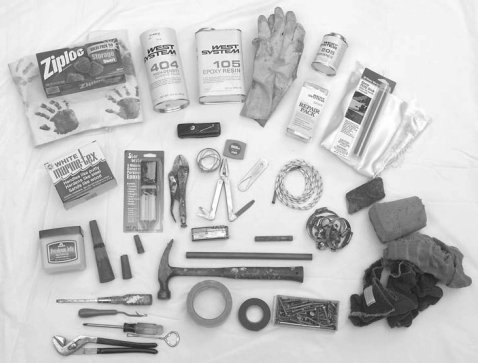
He also had some conventional epoxy and fiberglass cloth in his emergency supply kit and decided to put a patch on the inside of the hull in case the underwater epoxy came loose or wasn’t as strong as he had hoped. He cut some cloth patterns and mixed the epoxy with the fiberglass to create a pre-impregnated patch. By the light of the searchlight he positioned the pre-saturated pieces of fiberglass patch over the area of the hole.
This epoxy, with the heat of the light on it, solidified quickly, and he was satisfied the repair was now strong enough to get through the night. He would check on the boat in the morning. What he would have done if the underwater epoxy had not worked, he is still not sure. He figures he might have gone down with the ship.
The moral of this story is to keep your emergency supply kit aboard at all times. Know where it is located. Consider light bulbs, flashlights, and even sandwich bags as emergency spares. Be sure you have underwater epoxy. Try applying it on a piling or dock ladder, so you have some experience using it. Have a plug or plugs to fill a hole as part of your emergency supplies. If you give careful consideration to what’s in your kit, you may never need it. But being prepared is part of being a sailor.
Thank you to Sailrite Enterprises, Inc., for providing free access to back issues of Good Old Boat through intellectual property rights. Sailrite.com