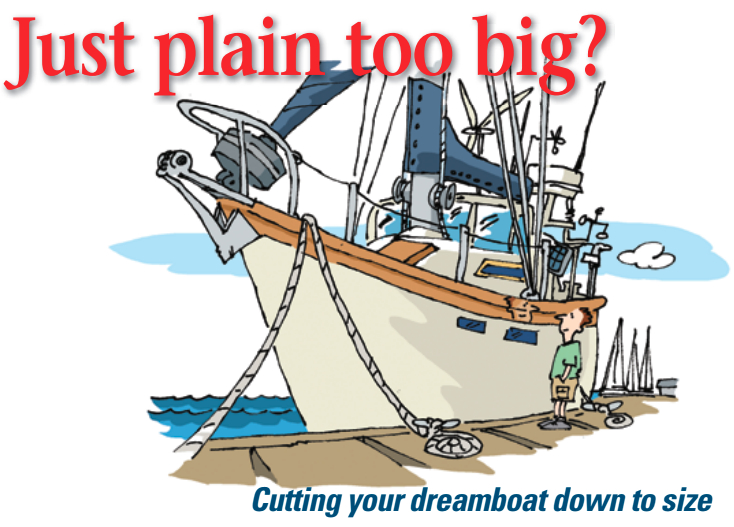
Cutting your dreamboat down to size
Issue 74 : Sept/Oct 2010
Many of us fall victim to the allure of the big boat at the end of the dock. A tear wells up as we sight along the acres of the teak decking that must be 6 inches thick.
As we stare at our bewildered reflection in the 76 coats of exotic varnish on her rail, we’re drawn in . . . into the dream. The wow factor of the 2-ton stainless-steel anchor is lost in the tinted glass and satellite communications antennas. It’s a wonderful dream: having friends or family aboard for the never-ending trip of a lifetime. Just be careful what you wish for; the cost of some dream ships can be the dream itself.
I found myself in this situation a few years ago while cruising along the Mediterranean coast of Spain. I had read all the right books, made all the right choices of boat and equipment, and followed the prescribed course to a cruising life afloat but, somehow, when in 2001 I made the decision to buy a boat, up sticks, and give the cruising life a try, I had become a victim of the great cruising lie.
As a child, I had pored through boat magazines and sailing books, envisioning the life to be had on various boats of merit. By the time I was 12, I had decided the right boat for me would be a 65-foot steel North Sea trawler, as many were available in the United Kingdom and Ireland due to the decline of the fishery there. I could have a huge saloon in the converted hold, a skipper’s bunk in the wheelhouse, and how very nice she would be.
As I matured to, oh, 14 or so, I added a ketch rig, bilge keels, and proper swing-out davits for the launch. My school notebooks looked more like boat-builder’s sketchpads than the academic masterpieces my parents had hoped for. Images of good times aboard my ship and how it would feel, smell, and taste filled my head and decorated countless math workbooks.
In common with most cruising folk, I felt a need to control an entire floating world, a ship of life that — with planning, skill, hard work, and understanding — could withstand anything the charts or Mother Nature could throw at her. With this in mind, the next stage of the right-boat quest began. Only after I found it did the great cruising myths reveal their true selves.
MYTH #1. You will be inundated with guests to fill all those permanent berths, regardless of your personal popularity.
We waterborne souls make some basic assumptions that lead us inexorably astray. The first of these is that very few people would not pay handsomely for a week or two under billowing canvas on a gently rolling ocean. With this in mind, the boat I bought for my odyssey was a full-bodied, long-keeled, 40-foot, aft-cabin, Colin Archer double-ender. Her huge saloon could seat 12 with ease, I know because it did so — once. At the risk of sounding like an antisocial loner, the fact is that, in more than a year spent cruising, I sailed solo for all but 10 weeks. The largest number of guests aboard at one time was three.
MYTH #2. Everything on a boat will break as soon as you head to sea.
A prudent sailor carries whatever he might need to cope with any event that may befall himself and his ship. This is excellent advice and holds as true today as in the days before steam. I would never ever advise against this dictum if you are heading offshore or to remote areas of the globe. But most of us are unaware of how little the sailors of old actually had, and so how few spares they needed to carry.
Being of the belt-and-suspenders type, I carried a huge store of every conceivable spare part and hardware for every imaginable repair. If there was not a second system aboard, there was a full replacement for the broken part. In that year spent cruising, my boat suffered a ruptured water tank (bladder type) and was cursed with the self-blocking head from hell. Both “emergencies” required spares or replacement but, apart from the occasional fuse and anode that needed replacing, that was it.
The best way to carry spares is to prepare the boat ahead of the cruise by making sure every system is perfect and every part exhibiting even the slightest corrosion or weakness is replaced. After that, stick to a short list and your own good sense.
Carrying, in little plastic packets, all the filters and seals — complete with part numbers and bar codes —that might ever be needed to keep the iron topsail happily growling in its cave must, I am sure, make the old-timers wince. I remember sailing on a converted seine netter out of Howth, Ireland, as a kid. The skipper had a canvas bucket with all the spares the old wooden boat needed: a couple of galvanized shackles, a pot of Stockholm tar, seizing twine, and a can of EZE start, used to fire up the diesel drip stove. Not a bad return for effort.
MYTH #3. Your course will be beset by storms.
Our library feeds the worst typhoons of our imagination; in all probability we will never meet extreme weather.
If we go to sea often enough with no regard for weather forecasts, we will eventually find our personal perfect storm. If, like me, you delve into the worst wind-driven maritime-nightmare texts, you undoubtedly will purchase a sea anchor and drogue, a storm jib and trysail in air-sea-rescue orange, and an obscene length of 1-inch high-visibility nylon rode. Your boat will be of 1/2-inch steel designed by the creator of Norwegian sailing lifeboats. It will carry an offshore life raft, EPIRB, DSC, satellite phone, 40 pounds of pyrotechnics guaranteed to be seen from space, and three years’ worth of survival supplies with a swimming pool’s worth of dehydrated water tablets.
Guilty as charged on almost all counts, except the water tablets. Yet the worst weather I was ever caught in was on an inland lake on a hired cruiser. We had 60 to 70 knots of wind and the beer spilled. By comparison, 25-foot waves in the Atlantic are well spaced and much less threatening than 10-footers on Long Island Sound driven by a Nor’easter. In my defense, however, the Bay of Biscay is a hurdle to be crossed before getting to the sunny cruising grounds of the Iberian Peninsula and beyond. That piece of water is never to be taken lightly and I was glad to have my 12-ton gaff cutter for that leg. For ordinary cruising, and even pretty substantial offshore work, though, most well-found production boats are up to the task, with most of the older well-proven designs scoring higher than wide-sterned modern boats for seakindliness and the ability to handle a blow without trauma.
MYTH #4. You can never have too much boat.
It is for good reason that the Pardeys’ two boats have been below 30 feet LOD. There is a length of boat after which the gain in size and space costs too much in terms of work and handling, not to mention finances. After it reaches a certain size, the boat will spend more time in the marina than out sailing, due to the need for crew or increased maintenance. By way of illustration, I found something uniquely terrifying about a 20-foot-long wooden gaff swinging wildly in 30 knots of wind with its steel fitting almost wiping my nose with each super-sonic pass as I tried to get the gasket to hold it into the gallows. So, regardless of the romance or the superior balance of the reefed gaff rig, next time it will be Marconi or Bermudan rig for me. As with most hardships, the gaff rig made me a better sailor: I generally leave oodles of room for any sail-handling or anchoring procedure.
MYTH #5. A boat need not perform to windward to be a worthwhile cruiser.
That safety trumps speed is a long-standing and misguided argument. All well-designed boats should be safe and capable of making good progress on all points of sail. We have been sold on the idea that a super-safe boat, a capable and seaworthy yacht, will have to yield some speed to weight so she will be heavy enough to handle bad conditions at sea. To some extent, this is true. However, any cruising boat must be able to sail well to windward.
Having bashed and crunched my way for 600 miles into the Portuguese Nortada (northerly wind) that, just for my benefit, blew directly from the south, I can say it is imperative that the boat is capable of pointing higher than 55 degrees off the wind.
So what is the truth?
The question remains: which boat is the right boat? As everyone reading this will have a different answer, I will not propose a brand or design. But certain truths are self-evident. You can have too much boat. You can be unrealistic in the probable extent of your cruising, leading you to plan and equip for eventualities that are not going to happen (there’s no need to cruise an icebreaker in the tropics). A sailboat must be able to sail well and be handled by the minimum number of crew you can absolutely depend upon, and that number ultimately will be one. You don’t need to over-equip; two radar sets are too many for a cruising yacht.
Think about your own experiences and the experience of your crew and gear up for sailing, not maintenance. Maintain your boat very well and carry only the spares you need to perform normal service and emergency repairs. There is much to be said for navigation by compass, chart, and star but the simplest GPS gives accurate, reliable, and easy plots. So, after your manual navigation gear is aboard, a GPS is a good addition. If you cruise in sight of the shore, an engine is a must. That being the case, you may as well have electric light (a by-product of the engine). Even with power available, the venerable oil lamp has a special charm.
I offer this cautionary tale with a fine and happy outcome. I eventually tired of the work involved in sailing in the Mediterranean and decided to winter over in Cartagena, Spain. While there, I was accepted into the naval architecture program at SUNY (State University of New York) Maritime. The irony has not been lost on me. I spent days sitting in the cockpit of my dreamboat doing mathematics as a preparation for the studies ahead while, years before, I sat in mathematics class dreaming about sitting in such a place on such a boat while the math teacher pulled his hair out trying to drive algebra into my preoccupied head.
All boats have a certain magic and they lead us on journeys, some of which are measured in miles or years and some in our own development. The boats we choose play into who we are and what we need for whatever reason, even if, like me, we get the whole thing bass ackwards.
Eric Holohan is a Westlawn graduate, naval architect, yacht designer, Lloyds-accredited marine surveyor, and ABYC master technician. You can contact him at www.holohanmarine.com.
Thank you to Sailrite Enterprises, Inc., for providing free access to back issues of Good Old Boat through intellectual property rights. Sailrite.com