What floats your boat
Issue 74 : Sept/Oct 2010
Boats are designed to float. This might seem to be an unnatural act, especially for hulls that are made of aluminum, steel, concrete, or fiberglass. These materials are denser than water and might be expected to sink. Even wooden boats, loaded with gear, ballast, an auxiliary engine, and miscellaneous equipment would head for Davey Jones’ locker if it weren’t for a physical force that causes buoyancy.
In physics, buoyancy is defined as the upward force on an object exerted by the surrounding liquid or gas in which it is fully or partially immersed.
A solid object will sink in a fluid if its density is greater than the fluid’s density, and it will float if its density is less. Both the floating object and the submerged object experience a buoyant force. In the case of the floating object, the buoyant force is equal to that object’s weight.
We don’t ponder this phenomenon often, but why do boats made of materials denser than water float?
If material that is denser than water is formed into a shape — ceramic into a bowl or steel into a ship — with an aggregate density less than that of water, it will float in water. As long as a sufficient proportion of the vessel (bowl or ship) below the surface of the water is less dense than water, then the effective aggregate density of the entire vessel can be less than that of water, regardless of the material of which it’s made.
Archimedes’ principle
Archimedes’ principle is named after Archimedes of Syracuse, Sicily, (287-212 B.C.) who discovered this law of physics while taking a bath. He subsequently published a two-volume work, On Floating Objects, in which he stated the law named for him:
Any object wholly or partly immersed in a fluid is buoyed up by a force equal to the weight of the fl uid displaced by the object.
But what does this mean to sailors? Well, the word “displaced” should ring a bell.
Displacement
The buoyancy of a boat is locked in tightly with its displacement.
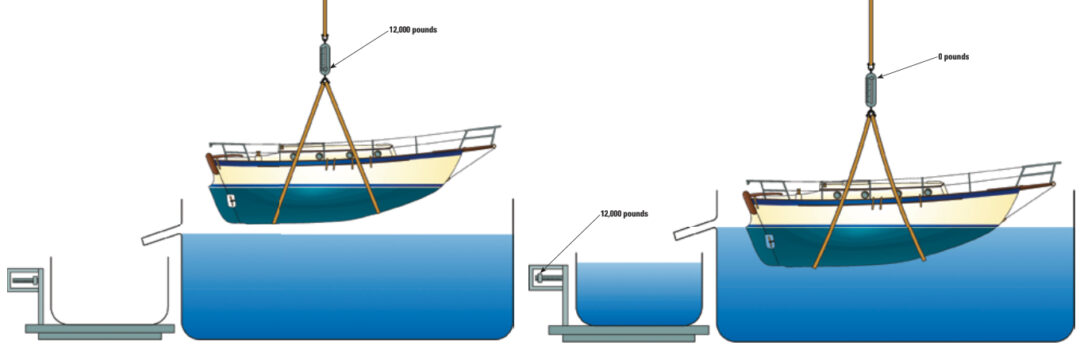
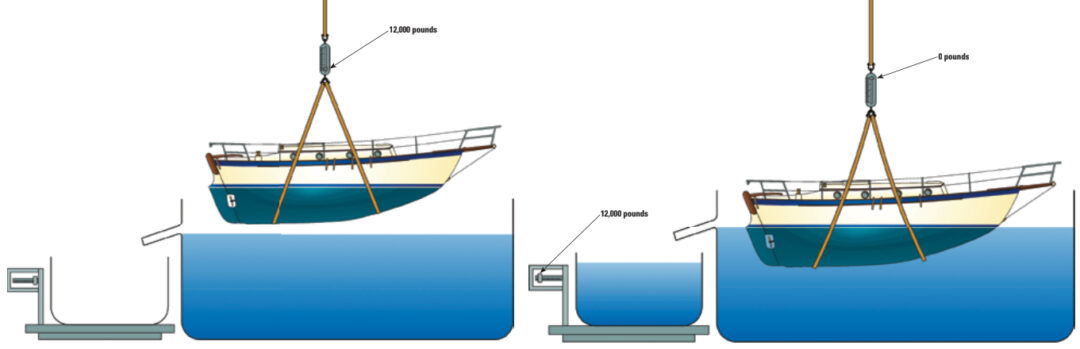
In the illustration above, our test hull is being lowered into a tank of water. As the boat is lowered, water will be displaced and will overflow into the weighing tank until the boat is floating, on facing page. When we weigh the displaced water in the weighing tank, we’ll see that its weight is exactly equal to that of the boat when it was suspended above the tank. The displacement weight (the weight of the water) is the boat’s weight, just as Archimedes said.
In the U.S., this displacement may be expressed in pounds, in long tons (2,240 pounds), or in cubic feet of water (35 cubic feet of seawater at 64 pounds per cubic foot equals one long ton).
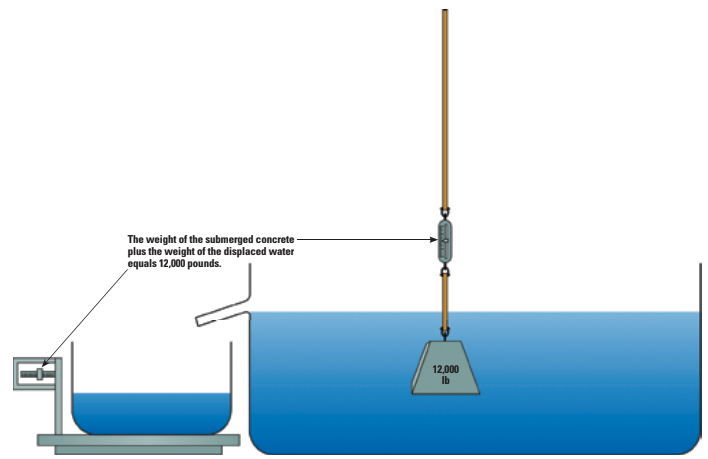
Let’s perform another test with our boat (but don’t try this at home!). We’ll fill our test boat with concrete. Now the boat’s hull will be denser than water and will sink (as we would expect). But it still experiences buoyancy; the boat weighs less submerged than it did when suspended in the air. And, lo and behold, if we weigh the displaced water in the weighing tank, we will find that its weight exactly equals the weight the boat has lost when submerged. Once again, Archimedes hit the nail on the head.
Buoyancy and displacement work equally well in fresh or salt water but, because fresh water is less dense than salt water, the boat will have to sink lower in fresh water than in salt water for the weight of the displaced water to equal the boat’s weight. So, a boat on one of the Great Lakes floats deeper in the water than it would if it were equipped identically and heading for Hawaii.
Don Launer, a Good Old Boat contributing editor, has held a USCG captain’s license for more than 33 years and has sailed the East Coast from Canada to the Caribbean. He built his two-masted schooner, Delphinus, from a bare hull, has written several books, and frequently gives talks on the history of navigation, most recently to the cadets at the U.S. Naval Academy in Annapolis.
Thank you to Sailrite Enterprises, Inc., for providing free access to back issues of Good Old Boat through intellectual property rights. Sailrite.com