The magic combination of plastic and glass that changed boatbuilding
Issue 37 : Jul/Aug 2004
Composite construction in the United States began in the 1940s — during World War II — when a southern California company, Chemold, was contracted by the military to produce molded plastic hulls. It used an acetate resin with a cotton fabric as the reinforcing agent. After the war, the tooling was sold to Wizard Boat Company, which produced a line of small outboard hulls for the recreational boating market. In 1946, the Wizard Company began using polyester resin and eventually switched to a reinforcing material made from glass fibers. In June of that year, the Winner Company, in Trenton, New Jersey, received a Navy contract to develop 28-foot motorboats from this new material. Those early boats were formed over a male mold. Sailboats were first produced by this new process in 1947 by the Glasspar Company.
The original polyester resin was a difficult material to use and required a sunlight cure. Not surprisingly, many of the first companies to use this process were based in southern California. This curing process was soon replaced by curing the polyester resin with a catalyst mixed into the resin before application. This catalyst, methyl-ethyl-ketone-peroxide (MEKP), along with a cobalt accelerator that is usually pre-mixed in the resin, allows the builder a limited amount of layup time, depending on the amount and type of catalyst and the ambient temperature.
It wasn’t long before boatbuilders around the world began using this new technique. However, the word “plastic” was regarded with distrust in the mid-1950s, so manufacturers avoided the term in their advertising. Instead, “fiberglass” became the generic term for this new product. Fiberglass-reinforced plastic, FRP, is the proper name for this material. In Europe it is called GRP, for glass-reinforced plastic.
Low-strength resin
Basic construction of a fiberglass hull uses a relatively low-strength resin, reinforced and made stronger with internal fibers of various types. The most common of these fibers is glass, although Kevlar and graphite fibers are also sometimes used. The plastic, mainly polymers, but sometimes epoxy or vinylesters, is usually of a thermosetting type. Thermosetting is the capability of a substance to become permanently rigid when heated. The thermal agitation of the molecules of the resin aids the chemical process that links the molecules together in a process called polymerization. There are wide variations in the formulations of these resins, depending on the specific requirements of the finished product. Adding fibers to a building product to increase its strength is not a new concept; it goes back thousands of years. Early man mixed straw into mud bricks, and much later steel reinforcing rods were added to concrete to increase the strength of the composite.
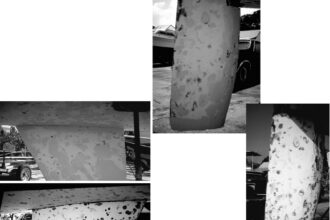
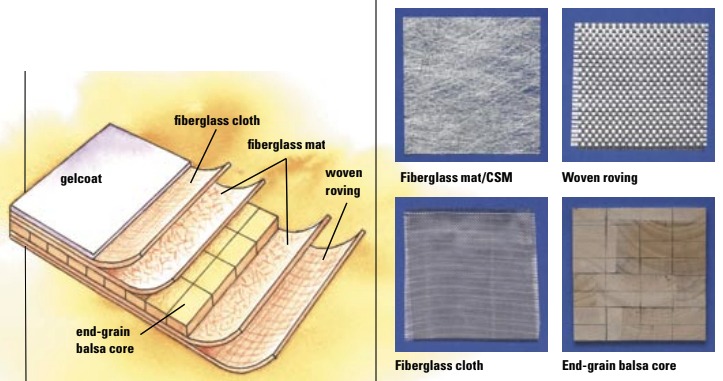
A fiberglass hull usually takes its shape inside a female mold, onto which a special wax with no affinity for the resin is applied. This prevents the layup from sticking to the mold. A gelcoat is then applied, usually by spraying. This is a special thin, pigmented formulation, which contains no reinforcement. It is followed by alternate layers of fiberglass reinforcements, plastic resin, and sometimes core material. These are applied until the desired thickness and strength are obtained.
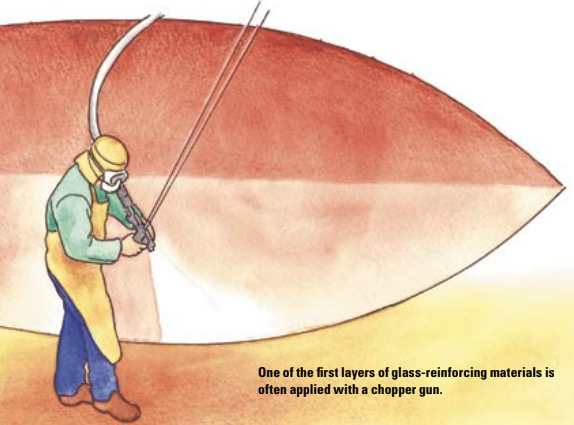
One of the first layers of glass-reinforcing materials is often applied with a chopper gun, which sprays the resin and the catalyzer, in the proper proportions, while simultaneously cutting a loose bundle of continuous glass-fiber strands, or rovings, into short pieces and projecting the composite mix into the mold. It has the advantage of filling the angles and corners in the mold and making the layup of subsequent layers easier. Since these glass fibers are in random orientation, strength will be equal in all directions.
Woven roving
The bundles of fiberglass rovings used in the chopper gun can also be woven together at right angles into a coarse cloth, which has the appropriate name of woven roving; when laid at right angles and stitched together, it is known as stitch mat. These materials are the basis of most laminates, but since they have a coarse texture, chopped stranded mat (CSM) is usually interspersed between layers.
Chopped stranded mat, commonly known as mat, consists of chopped fiberglass fibers, about 2 inches long, that are compressed and loosely bound together in random directions into a mat with a binder that dissolves in the resin. Mat produces a layer similar to that of the chopper gun and is the most used material in fabricating boat hulls.
Fiberglass cloth is a fine and tightly woven fabric made from continuous glass fibers. It gives a nice smooth finish and was widely used in the early days, but because of the expense, it is now seldom used except in places that demand a high strength-to-weight ratio. Cloth, woven roving, and stitch mat have strands at right angles and are said to have bidirectional strength.
Unidirectional fabric consists of fibers that only run in one direction and are held together with a binder. These fabrics are used when strength in only one direction is required.
During hand layup, the resin can be applied by brushing, troweling, rolling, or spraying. The resin penetrates the reinforcing fibers and, when cured, the result is a strong monolith.
Weight-saving stiffeners, or cores, are often incorporated in the layup and can be materials such as plywood, end-grain balsa, or synthetics.
Although fiberglass weighs about 106 pounds per cubic foot — about three times the weight of hardwood — it only needs to be about half the thickness of the hull of a wooden boat and will not require heavy frames, so the entire hull ends up weighing less than a wooden boat of similar size.
Thank you to Sailrite Enterprises, Inc., for providing free access to back issues of Good Old Boat through intellectual property rights. Sailrite.com