A 57-year-old pile of junk turns into a beautiful Johnson racer
Issue 37 : Jul/Aug 2004
I drove 1,100 miles from Montana to Minneapolis after graduation from college. I was anxious to get home as there was a sailboat waiting for me that my father had bought as my college graduation present. But when I pulled into my parent’s driveway, my excitement turned to horror. What I found there was not a sleek little racer, but a hideous pile of wood not fit to burn.
Had my parents moved? Certainly this couldn’t be the boat. No way! Not my college graduation present. This wasn’t a boat at all. This was a pile of junk shaped like a boat. The thing was in such a state of disrepair that if I wagered on its ever floating, the bet would be nominal and definitely not rent money. But Dad was real excited — he did that funny walk that men over 50 do when they’re real happy. Dad quickly tried to invoke some optimism in me. But he shouldn’t have parked the sparkling new trailer next to it. “The trailer cost more than the darned boat did,” he said.
There was a shocker for you. Did he think this would surprise me? My shoes probably cost more than this thing did.
Dad made a few placatory remarks about its sleek shape and stunning erstwhile craftsmanship. I was utterly unmoved, hopelessly unconvinced. Arms crossed, face twisted, I stood there like a brat. I tried to be restrained about expressing my disappointment to my father, but all the shock and horror I felt registered on my face. My dad, who knows me too well, anticipated this reaction and began to explain that the boat was in much better condition than it appeared.
He explained that we needed to do a “little work to make her strong and restore her to her glory.” Clearly the man had lost his mind. And why was it a her? This was a pile of splinters, not a she. Last time I checked, my dad sold computers, and I was an aspiring writer. We didn’t know jack about old wooden-boat restoration.
Dad grabbed some sandpaper and removed some of the paint, looking at me with a big grin on his face. He scratched and scratched at the hull until he found some virgin hardwood beneath.
“This here, son, was the first boat Johnson Boat Works made after the Second World War. Heck, Truman was in office. Johnson halted production for a few years because of the steel shortage during World War II. I was just about 10 years old when they built this; it’s half a century old. Look, there is virtually no dry rot. It’s amazing, more than that, unbelievable . . . and, I don’t mean this is one of the first ones they made after resuming production, I mean this is the actual first one . . . look at that wood,” he said.
It was nice enough wood, as far as wood goes. I went into the house. Mom didn’t even say hello. She told me to get back out there.
“But Mom . . . ”
“Do you want to hurt your father’s feelings?”
“Maybe,” I said.
I went back out. I watched Dad work for a little bit. An hour passed. Dad gave me some sandpaper. I scratched away, still more than a little peeved. After an hour or so, something happened. My mind began to think that this boat had potential. I worked on the mast for a while, becoming more and more convinced that this thing could actually float. The wood was old, sure, but it didn’t look as terrible as I first thought. It even smelled like new timber. And then, as I sanded a little more, it happened. I started to get a smile on my face.
“See? I told you,” said Dad.
Restoration and infatuation
Yes. I did see it. But restoring this boat was not just a matter of carpentry. I would have to sand, patch, paint, scrape, varnish, and epoxy for endless hours if this thing was going to float. Throughout the summer the enterprise became a constant learning process: an assessment of the boat’s physical strength and structural integrity. My work was idiotic at first — dripping epoxy all over the place and getting dirt in the paint. But after a while I got steadier. And after a few weeks I quit referring to her as it. It became she. It dawned on me then that boats were shes because they’re the only thing besides women that men obsess upon endlessly.
At my summer labor job I was infatuated with the thought of her. I hadn’t sailed since high school, and I couldn’t wait to take her out. Days were passed by solving restoration problems in my head. I’d imagine the conditions that had caused the stress fractures. In my dreams I redesigned the jibboom to have the sheets controllable from farther astern. I thought of her as a skeleton now, seeing how everything related to her body.
But each newfound aberration was a link in a chain of endless footnotes to more problems. It was frustrating, to say the least. Dad said some of the non-crucial problems would have to go untreated and that I’d be able to determine which ones those were. How was I qualified to make such decisions?
My relationship with her was simple: she would show me her faults, and I would show her mine. She would see when I messed up. She was witness to my crooked drilling for some of the screws. She knew I wasn’t a real boat-builder. She laughed at me while I kept slathering epoxy, thinking more is better . . . more makes her stronger. These were the moments when physics eluded me, and though it was odd, I began to trust her. Trust myself. I realized that every old boat is somewhat jury-rigged.
At night I would lie in bed thinking about who might have sailed her before. I imagined her on a Minneapolis lake in bygone days, sailing with ghosts at the helm. Seeing these images helped me begin to understand how she flexed, how she behaved, and, most of all, her limitations. She would not be as strong as in her own day. But what did that mean? It meant that I would have to get to know her better than her previous captains. It was I who would have to soothe her aches, put casts on her broken bones, put Band-Aids on her open sores, and hope that my work was enough. When I sailed before I was my father’s first mate. Now I would be captain. But a captain, to be a captain, has to become the boat’s soul mate.
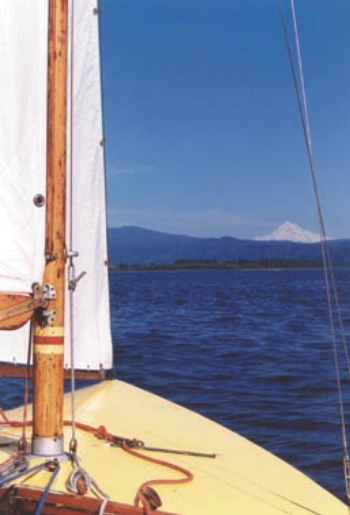
As the summer grew to a close, she started to take on the semblance of a seaworthy vessel. The dark, chipping varnish on the mast and boom were now sleek coats of gold. The hull was sea green, the deck was bright yellow. The only additions in the rigging were a cam cleat for the mainsheet and couple new blocks up front. I wanted to keep as much of her original character as possible.
Eventually she became the talk of the neighborhood. My dad’s old sailing buddies quit thinking he was insane. The boat no longer looked like a shipwreck; she was a beauty. My mother looked at her in disbelief with each passing day. Mom couldn’t believe that Dad and I had brought her back from the dead. My father beamed with satisfaction; he loved this kind of work. Working with his hands was a romance he missed. The boat had become somewhat of an enigma to us. It was the product of a combined effort, beginning to take on something like a spirit. Much to my satisfaction, nobody had a boat like this. She was gorgeous, rare, a diamond out of the rough.
Ready to launch
“When should we launch her?” Dad asked me one day in August. The question took me off-guard. I was sort of waiting for him to tell me when she would be ready.
“I don’t know. What do you think?” I said.
“This is your boat, son,” he said.
He was right. This was my call. I agonized the next few days, reassessing all the work we had done. A few more minor problems were fixed, and at night I lay awake in bed imagining the worst. In twilight sleep, my thoughts went to the absurd: rogue waves, white whales, tsunamis. Choosing Godforsaken Sea as bedtime reading while restoring an old boat is, quite frankly, a terrible idea.
But after a few more days it became clear. It was time to test our work. We planned the maiden voyage. Lake Minnetonka was only a few miles from my parents’ house. Dad and I agreed it would be a good place to give her a spin.
At the launch ramp, which was rather busy, I received many compliments about her. The kind of looks the boat engendered were like the looks I’d get if I were to walk down a street with a pretty girl on my arm. I felt proud to stand next to my boat. Dad, however, wasn’t as giddy as I was. He was worried that she would drop straight to the bottom once off the trailer.
“It’s wood, Dad. She can’t sink,” I said.
“Does epoxy float?” he asked.
He had a point. Dad backed her down the launch ramp, and she slipped off the trailer without difficulty. The moment she was afloat, she was transformed. Suddenly she had what can only be described as grace. She was more than a she, she was a lady. My dad did the happy walk again as he came down from parking the car. Aboard now, we paddled out into open water, hoisted the sails, and felt her become what she unmistakably was: a sailboat.
There was a fleet of A-scows out, having just finished a race. A skipper of one of the boats sailed up on a beat astern and to windward wanting to take a look. He looked at my boat and I looked at his.
“That’s an old Johnson racer, yeah?” he yelled.
“1947 Y-class,” I yelled proudly from the helm.
“She’s beautiful,” he said. He was 10 feet from us. I looked him in the eye, steered a bit to windward and luffed him a bit. He laughed.
“I guess she’s still got a little in her,” I said, shrugging.
“That never dies, but I was mast abeam,” he said.
“Protest?” I replied.
She’s been with me for five years now. We’ve sailed on innumerable lakes in Minnesota, been knocked down in a reservoir in Wyoming, scampered on melted glaciers in Montana. At present she’s stabled in a slip on the mighty Columbia River in Oregon. Each year she spends six months in dry dock, where I constantly find new problems with her. Each year I must learn some new technique to fix her. In the spring, friends will walk by on Saturdays, and they will see her in my driveway. They will see her there covered in sawdust, paint chips, and tarps. They will see power tools, clamps, and paint cans strewn about. And their faces will look suspicious . . . unbelieving. I will endure their looks because they don’t know her. They can’t know what I know. Because she’s mine. And that’s fine with me.
Thank you to Sailrite Enterprises, Inc., for providing free access to back issues of Good Old Boat through intellectual property rights. Sailrite.com