A performance cruiser for the coast and open ocean
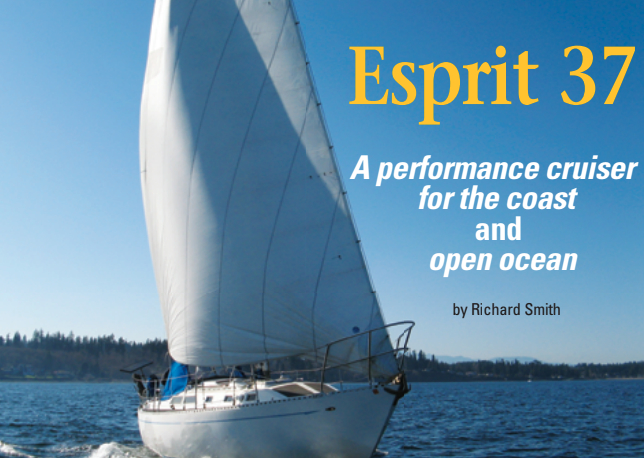
Issue 74 : Sept/Oct 2010
Duane and Barbara Tack have owned Sequester, a 1979 Esprit 37, since 1981. I first learned of Duane and Barbara when I discovered the privately published book they’d written (and handsomely illustrated with Barbara’s watercolors) titled The Voyages of Sequester. The account follows Sequester from her homeport of Kingston, Washington, down the West Coast, into the Caribbean, and across the Atlantic via Bermuda and the Azores to Europe — and back again. Much of Sequester’s equipment and her present character is shaped by that voyage.
Duane likes to keep things simple. He has a Ph.D. in electrical engineering and is used to separating the essential from the unessential. He has resisted altering the boat. In 1989, he conducted Sequester to Lisbon by a combination of piloting, celestial navigation, Sat Nav, and Loran. In addition to the binnacle-mounted compass, the boat is now equipped only with a GPS, VHF, depth sounder, and a minimum of other instruments and aids to navigation. A Monitor windvane and a belt-driven Autohelm provide self-steering.
These days, Duane and Barbara keep her in Puget Sound, where they take advantage of their trusty Wallas kerosene heater and Dickinson solid-fuel stove to make early spring and late-fall cruising comfortable. This cruising couple is apt to sail Sequester across the Strait of Juan de Fuca to Victoria, British Columbia, and from there cruise along the coast of Vancouver Island, over to the Queen Charlotte Islands, and along the Strait of Georgia.
Design
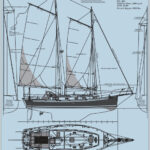
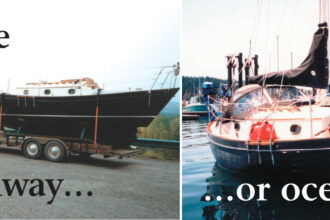
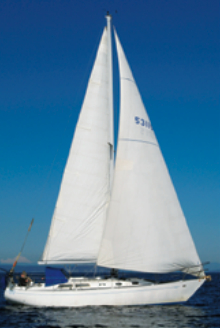
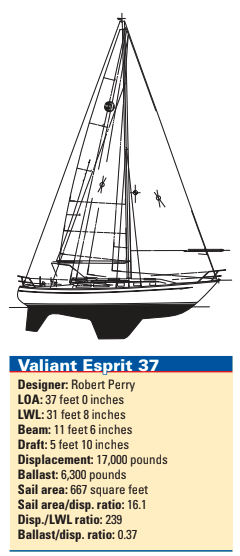
Robert Perry designed the Esprit 37 for Valiant Yachts, drawing on the proven seaworthiness, speed, and comfort of his Valiant 32 and 40 designs. The hull has a traditional profile with a low coachroof and small portlights, low freeboard, and a well-sprung sheer drawn between a raked stem and a canoe stern. Below the long waterline, it has a relatively low wetted surface area and the keel and skeg-hung rudder are designed with NACA foil sections — features that in the 1970s marked fast boats. Bob Perry made important innovations that were married to well-established traditions, leading Sail magazine to name the Valiant 40 the Cruising Boat of the Decade. The Esprit 37 was conceived as a refinement of that tradition.
For a more detailed discussion of design considerations that affect handling, performance, aesthetics, and many other concerns of the designer, see Bob Perry’s series on yacht design in recent issues of Good Old Boat.
Construction
The Esprit 37’s hull is hand-laminated with alternating layers of 24-ounce woven roving and 1.5-ounce mat,
producing a laminate six layers thick at the rail, 12 layers thick at the turn of the bilge, and 24 layers thick at the keel. All bulkheads and berth flats are tabbed to the hull.
The 6,500-pound lead keel is attached with embedded 3⁄4 -inch stainless-steel hook bolts supported on an integral hull structure by heavy backing plates. The lead is faired with epoxy to provide a smooth surface.
The deck laminate is built up of hand-laminated skins of 24-ounce woven roving alternated with 1.5-ounce mat on either side of a balsa core. This type of construction is lightweight and has good sound and thermal properties, but all such decks, especially those advanced in years, must be viewed with suspicion. It’s a good idea to examine carefully the bases of the chainplates to see if water has leaked through tired bedding. A recent survey determined Sequester’s decks to be sound and Duane, with fingers crossed, reports that in almost 30 years he has seen no hull blistering, a problem that plagued Valiants built by Uniflite with a fire-retardant resin called Hetron but apparently none built by Nordic of Bellingham, Washington, the yard that built Sequester.
On deck
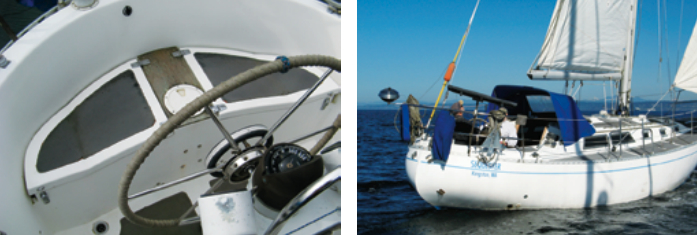
Sequester carries a 9-foot hard dinghy in chocks forward of the mast where it doesn’t interfere with anchoring, sail handling, or other foredeck action.
The Esprit 37 decks are designed for going to sea rather than sunbathing. All working surfaces are covered by a Treadmaster-type cork-rubber composite non-skid sheet material that grabs at sea boots with a vengeance. After 30 years of hard use, the texture is pronounced and sharp and, though frayed a bit at the edges, it’s still firmly attached and provides excellent traction, though it does discourage bare feet. Its appearance and contrast with the white gelcoat is unusual and perhaps distracting to eyes unaccustomed to such assertive non-skid decks.
Cockpit storage is excellent, with room for fenders, mooring lines, and two 2 1⁄2 -gallon gas bottles in a vented compartment. There is a spacious locker beneath unusual gull-wing hatches. The seats are a comfortable depth and height above the sole but moving between the steering wheel and the seats is somewhat difficult.
To form the hull-to-deck joint, the deck is bedded on an inward-turning flange on the hull and attached to it on 3 1⁄4 -inch centers with machine bolts through an extruded aluminum toerail. After assembly, the hull-to-deck joint is bonded on the inside with a layer of 1.5-ounce mat and two layers of 24-ounce woven roving.
The toerail has integral mooring fair-leads and provides multiple attachment points for running rigging. Standard deck fittings include 10 feet of 1 1⁄4 -inch genoa tracks, a roller bearing mainsheet traveler spanning the companionway, and four 10-inch mooring cleats. All of the deck hardware, including pulpits, stanchions, cleats, and blocks, is substantial and well backed.
Sequester carries a 44-pound Bruce anchor in a roller bracket at the bow, forward of an electric Simpson-Lawrence windlass with manual override, which is mounted below a deck hatch in the forepeak. One hundred and fifty feet of 3⁄8-inch chain plus 200 feet of 5⁄8-inch nylon rode is led down and stowed under the V-berth. For head-in mooring and emergencies, Sequester also carries two anchors plus chain and nylon rode on the stern pulpit, ready to let go.
The rig
The Esprit 37’s masthead-sloop sail plan, with its large foretriangle and high-aspect-ratio mainsail, reveals the influence of the IOR on rigs of the time. The mast is stepped on the keel and Sequester’s standing rigging is Navtec rod. Although the various chainplates are placed at different distances from the rail, I found little difficulty making my way past them.
Jib, main, and spinnaker halyards — along with the mainsheet, traveler lines, and topping lift — are led to either side of the companionway. The main outhaul, downhaul, and reefing lines are led to the forward end of the boom. Sheet winches are self-tailing two-speed Lewmars. The main halyard is the original Samson Yacht Braid spliced to 3⁄16-inch 7 x 19 stainless-steel wire.
The sail inventory includes a mainsail, an 80 percent working jib, and a 135 percent genoa. Sequester also carries a storm jib, trysail, and spinnaker. All her headsails are hanked on. She is often sailed singlehanded — a good indication of how easy the boat is to handle.
Belowdecks
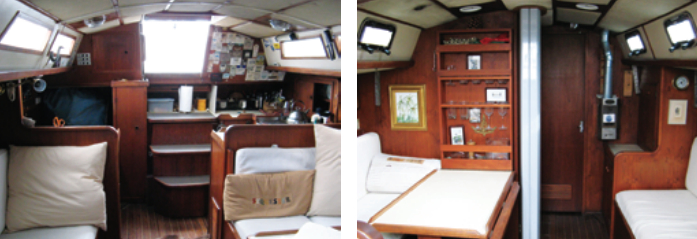
A 6-foot 6-inch V-berth with stowage below is just aft of the forepeak. The head, with a sink, shower seat, and its own locker, is situated to port opposite a large hanging locker aft of the sleeping area. A door opens to the head and another to the V-berth and locker/dressing area. Part of the starboard locker arrangement is a stack of drawers into which Duane has fitted the wood-burning stove. A translucent hatch in the deck lights the area and there are opening portlights near each berth.
The main cabin has a 6-foot 6-inch settee to starboard and a 6-foot 6-inch L-shaped settee around the table to port that converts to a generous double berth. Under each settee is a 65-gallon water tank plus additional storage. The table folds down to reveal several shelves used for wine glasses and other items. Overhead vinyl panels can be removed to provide convenient access to deck hardware. The keel-stepped mast is unobtrusive. Headroom is ample for the 6-foot 2-inch Duane, though he admits to sometimes hitting his head on the large off-center light fittings.
When preparing for the voyage to Europe, Duane replaced the acrylic panes in the fixed portlights with polycarbonate for added strength.
Handrails are located port and starboard under the portlights running the length of the saloon. Duane and Barbara find them adequate, but others might prefer a few more dedicated handholds.
The chart table is at the forward end of the starboard quarter berth and the head of the berth forms the navigator’s seat. Opposite to port, the compact U-shaped galley has a gimbaled three-burner propane stove, a deep double sink close to the boat’s centerline, and an electric refrigerator. An abundance of storage lockers can hold enough provisions for a crew of four for at least three weeks at sea.
Barbara, who is in charge of provisioning and keeping things below shipshape, has no complaints. She reports that the Esprit 37 is a fine boat in which to stow things properly and prepare good seagoing meals. The second companionway step up provides a convenient perch from which the cook can attend to chores while keeping in touch with crew on deck and below.
The accommodation plan is exemplary of good bluewater yacht design, and the boat’s interior is well appointed with lots of teak, both solid and veneer. When compared with some contemporary boats of her size (those with narrow sidedecks that permit voluminous interiors and theoretically sleep seven or eight), the Esprit 37 appears dated, but it provides truly comfortable and sensible arrangements for up to four or five with acceptable levels of privacy. With a small seagoing cockpit and minimal galley, the Esprit 37, for all its proven amenities, isn’t entirely comfortable dockside; rather, it seems to yearn for open water and distant landfalls.
The engine
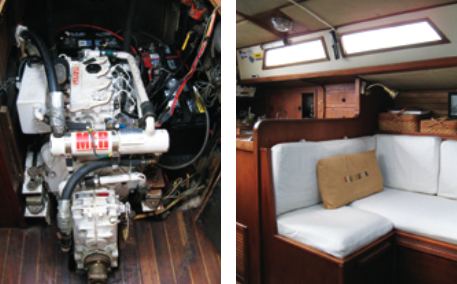
The Esprit 37 was delivered with a 30-hp Westerbeke diesel coupled to a 2:1 reduction V-drive and hydraulic reverse gear. After many years of hard use, recurrent impeller replacements, a faulty fuel pump, and other misfortunes, Duane replaced the original engine with a 3-cylinder, 22-hp Isuzu diesel. This may seem a rather light engine for a 37-footer, but it’s right for the kind of cruising the Tacks do. Duane makes minimal use of the auxiliary because he prefers to sail, and the Esprit 37 moves and handles well.
Four batteries in two banks are kept charged by solar panels. Sequester can spend a week at anchor running the 1.3-amp fridge, making minimum use of lights, and switching banks every other day so they can recover, without running the engine.
Engine access is exceptionally good, once the companionway step enclosure and other panels are removed. The original 40-gallon, 5052-series aluminum-alloy fuel tank still gives good service.
Under way
As Sequester left the slip under power, the three-bladed MaxProp took a good bite on the water. The boat handled well in close quarters, turned sharply for a boat of her length and displacement, backed well, and stopped in good order. Once clear of the breakwater, we made sail.
Under mainsail and working jib, the boat accelerated slowly in 5 to 6 knots of wind and settled into a comfortable groove requiring only the lightest touch on the helm. With Sequester beautifully balanced on the wind, I could take my hands off the wheel for extended periods. Sequester seemed to want to sail herself. She tracked well and came about smoothly and surely.
Entries in The Voyages of Sequester that describe the trek from Miami to Bermuda provide a glimpse of how the Esprit 37 handles conditions more varied than those we encountered on Puget Sound on the day of our test sail: “. . . smooth sailing in 4 to 6 knots of wind, we averaged 100 miles a day for the first six days, beating against light SE winds, flying the 150 percent genoa.”
And, on a passage from Mahon, Minorca, to Barbados, Duane recorded: “Rather than being a fast downwind passage on steady trade winds as promised by the ocean passage guides, these first 1,480 nautical miles have been a mixed bag of calms, minor squalls, and light air. We’ve been ghosting along at about 3.3 knots for the past day and a half, but force 5 to 6 winds are promised for tomorrow. The passage from Puerto Rico, Grand Canaria, started out like gangbusters — two 120-nautical mile days followed by a 146-nautical mile day. Our best yet.”
Duane says Sequester handles a wide range of weather from calms to heavy weather very well. He’s a fan of the canoe stern, claiming she takes a following sea in her stride. “We’ve never been pooped,” he says.
Conclusion
The Esprit 37 is designed and built for cruising, whether close to home or ocean voyaging, and combines a refined traditional appearance with the contemporary underwater shapes that serve the Valiants so well. If all yachts are a compromise, this is an excellent one, but one that favors the requisites of serious cruising rather than those of dockside life. The deck plan is efficient whether the boat is sailed fully crewed or singlehanded. Down below, accommodations are well planned and comfortable. With its sloop rig, the Esprit 37 is a delight to sail in light air and, as wind and seas pipe up, it’s a comfort to know it’s entirely at home in boisterous conditions.
A quick check of the Internet reveals Esprit 37s from the late 1970s for sale from about $70,000 to $90,000.
Richard Smith is a contributing editor with Good Old Boat. As well as sailing and writing about boats, he’s an architect, and he designs and builds very small houses. He and his wife, Beth, live in a house with a 16-foot beam and an LOA just a few feet shorter than their Ericson Cruising 31, Kuma, which they sail on the reaches of Puget Sound.
Thank you to Sailrite Enterprises, Inc., for providing free access to back issues of Good Old Boat through intellectual property rights. Sailrite.com