Simple covers provide closure and containment
Issue 75 : Nov/Dec 2010
For a while, Ken and I each owned a 1986 Pearson 28-2. When these sisterships originally left their Portsmouth, Rhode Island, birthplace, they were virtually identical. Over the years, upgrades and enhancements have been made to the boats that reflected their various owners’ requirements and personalities. Our boats were subtly, yet noticeably, different.
While I concentrated my efforts on system upgrades and cruising ergonomics, Ken directed his talents toward improving dockside creature comforts. Case in point: sleeping. I find the layout, which includes the V-berth, satisfactory. Ken, on the other hand, uses the V-berth strictly for stowage and, through the addition of a plywood extension and the removal/rearrangement of the cushions, converted the starboard settee into a “large” single berth. Like opening Pandora’s box, however, making this modification unleashed further projects.
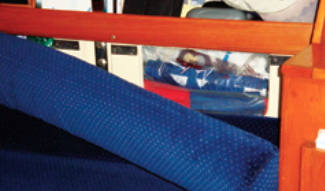
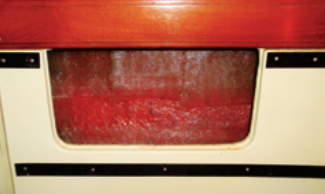
The Pearson 28-2s have shallow open cubbies behind the settees’ back cushions. As long as the back cushions are in place, the cubbies are hidden and their contents fairly well contained. Once Ken removed the settee cushions to create his new sleeping area, he exposed a pair of cubbies. Their contents were now visible and less secure. More disturbing, though, was that, during the night, Ken routinely got his shoulder or elbow uncomfortably lodged in one of the gaping holes.
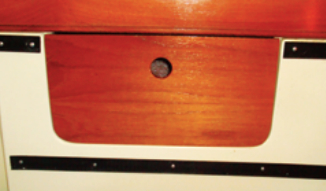
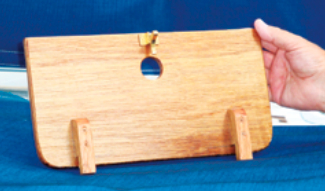
He responded with yet another of his creature-comfort upgrades. After carefully measuring the openings, Ken cut two panels from cherry-veneered plywood. To the bottom edge of each panel he fastened a pair of wooden elbows fabricated of solid cherry. He then drilled a finger hole, centered near the top edge, and mounted a brass elbow catch above and behind the hole. After applying a few coats of varnish, he popped the new cubby doors into place.
Cubby openings no longer interfere with Ken’s good night’s sleep. As an extra benefit, the new covers ensure that what is stowed within the cubbies will stay stowed, even in the roughest seas.
Gregg Nestor, a contributing editor with Good Old Boat, has had a lifelong interest in all things aquatic. This past June, he and his wife, Joyce, took delivery of a 1994 Caliber 35 and spent the next two months refitting, upgrading, and addressing some neglected maintenance issues so they could go sailing.
Thank you to Sailrite Enterprises, Inc., for providing free access to back issues of Good Old Boat through intellectual property rights. Sailrite.com