Issue 15 : Nov/Dec 2000
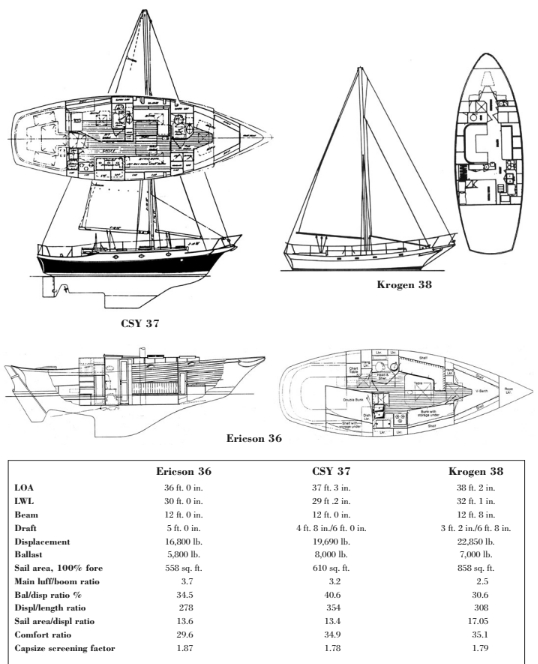
Bruce King’s Ericson 36, with her raised foredeck, is a unique design, so finding contemporary yachts to compare with her was not easy. Peter Schmitt’s CSY 37, also a raised-foredeck style, is very close in many ways, but it seemed a little stretch to put the larger, flush-decked, keel/centerboard Krogen 38 in the same category as the other two. Still, all three are interesting design approaches to the problem of a roomy and comfortable coastal cruiser. In older designs, S. S. Crocker’s beautiful Gardaloo and Macaw would have made a very interesting comparison indeed but, unfortunately, all I have is a photo of these yachts, and no information on their hull lines or layouts. I would appreciate hearing from any reader with drawings of these vessels.
A word about aesthetics. Two of the yachts have clipper bows sporting trailboards but no bowsprit and, as many know, that is a design style that grates on me. The Krogen 38 does have a sprit and has also, far and away, the prettiest clipper bow of the three, so Jim Krogen gets my plaudits on that aspect of the designs. Even the great L. Francis Herreshoff would have approved of the 38’s bow.
When we look over the numbers, it’s obvious that none of these craft will set the world on fire with her performance, yet they are all superb for the way most of us use our yachts. Their roomy accommodations and spacious cockpits make them versatile boats, whether you are daysailing with friends or heading off for a month’s cruise with the family. These are not club racers, and they are not world-girdling Cape Horners, but they certainly are hard to beat for general all-around usefulness and pleasant sailing.
First, I’ll say that I had to do some fudging of the numbers, as usual. We found two quite different displacement figures for the Krogen, so I averaged them to come up with 22,850 pounds. Then, Ericson published two displacement figures, one with empty tanks and one with full tanks, so I worked it up for a half full (or half empty if you’re a pessimist) condition, as that is the way most boats are designed in my experience.
The most surprising thing about the numbers is the very low sail area/displacement ratios of the CSY and the Ericson, and the tall, ribbony mainsail of the latter with its very short boom. The Krogen 38 has reasonably generous sail area but, from the plan view, the hull appears to be rather full forward. This, along with her full keel/centerboard hull form may adversely affect her windward performance, although I expect she would be, far and away, the fastest of the three on a reach if only working sails were set. The low sail area/displacement ratios of the Ericson and the CSY are, truly, well down in the motorsailer range. I would expect either to be a bit of a slug in light air unless an extremely large genoa or reacher was set.
Indeed, after looking over the Ericson sail plan, if I owned one I’d be considering a bowsprit and a longer boom in order to increase the sail area/displacement ratio to 16.5 or better. It would make a very different boat of her in light air. The longer boom would also lower the aspect ratio of that skinny mainsail and could make it easier to trim. In any case, a strong vang will be needed to avoid twist as there is no simple way to install a main sheet traveler. I’d also fit running backstays as there is no intermediate shroud and the aft lower shrouds are in line with the mast. There seems to be very little after support for the spar and a good set of runners would help to keep the staysail taut, as well as reduce mast panting in a stiff breeze.
It would be interesting to study the lines drawings of the three boats but, from what I can see, I believe the Ericson to be the more maneuverable of the bunch due to her short fin and large rudder. I’d also expect her to have the edge to windward as well, although a CSY, with her high ballast ratio and the deeper 6-foot draft keel option, might well be a dark horse. However, none of these craft would be my first choice as a club racer. On the other hand, I would prefer any one of the three for general coastal cruising to many of the cruiser/racers I’ve sailed. The swing-the-cat roominess below afforded by the raised deck, and the spaciousness of the wide cockpit, make these yachts perfect for comfortable family cruising, weekending, and daysailing, from the Bras d’Or Lakes to the Caribbean and from Alaska to the Baja.
P.S.: For those who think I’m cruel to animals because of my remark, I will quickly point out that “room to swing the cat” derives from the cat-o’-nine tails, not the family tabby!
Ted Brewer is one of North America’s best-known yacht designers. He is the man who designed scores of good old boats . . . the ones still sailing after all these years.
Thank you to Sailrite Enterprises, Inc., for providing free access to back issues of Good Old Boat through intellectual property rights. Sailrite.com