Expert or beginner, when you make melodies afloat, you’ll make friends
Issue 15 : Nov/Dec 2000
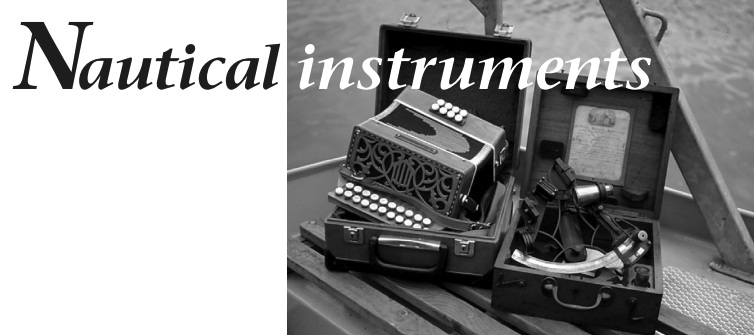
When Sylvia and I lived aboard our 30-year-old Nicholson 26 for a year, the best and driest locker was kept for our two most valuable instruments. The boxes were much the same size, one old and one new, and both beautifully made. In the old box was a vernier sextant, which had once belonged to a merchant seaman who had gone to sea before the days of micrometers and weak eyesight; in the other was a fine new melodeon.
I wouldn’t care to say which instrument we regarded as the more important, any more than a parent would be able to say which child they loved the most.
The famous voyager W. H. Tilman said you should never sign on with a boat that didn’t have a good supply of onions. Or, I would add, a good supply of musical instruments. Taking an instrument with you can bring a great deal of pleasure in several ways.
The first and most obvious is the pleasure of learning to do something for yourself and for its own sake. Any musician will tell you that playing your own music, however badly, is far more enjoyable than listening to someone else’s playing, however good. As with running a Boat of Character, it’s the experience that counts as much as the end result. If you’ve never played before, you may be afraid you’ll make a horrid noise to start with. So did Ashkenazy. But if you’re several miles offshore, there are far fewer people around to annoy than if you start to learn at home.
Then there is the enormous pleasure of playing with other people. Wherever a few yachties are gathered together, you’re sure to find a variety of instruments and skill levels. After a few beers or glasses of wine, the unlikely combination of instruments only adds to the uniqueness of the occasion, and the less skilled noises just merge in with the more skilled noises.
New friendships
What you may not anticipate is the way playing music will lead to new acquaintances and friendships. As we lay at anchor at Baleera, waiting to make the crossing from Portugal to the Azores, we anchored ahead of a French boat. Sylvia sat in our cockpit after supper and started to play her melodeon. After a couple of tunes, we heard music from the French boat — Breton melodeon playing traded for our Cornish tunes. We spoke on the VHF, and they suggested Santa Maria as a destination. Our visit to Santa Maria is another story, but do not visit Azores without going to Santa Maria.
Once in the Azores, the time we had taken to learn some Portuguese folk music paid off. Duarte, a musician and yacht designer, found his way to our berth. He explained that, regrettably, there were no published books of Azorean folk music, though certainly there was a great tradition of it. There were just some manuscripts in the university library. Next day, there was a knock on the deck, and we were presented with voluminous photocopies of the manuscripts. We learned to play some of those tunes, and thereafter we were never without Azoreans recognizing their own tunes and coming up to introduce themselves.
What kind of instruments make suitable shipboard acquaintances? Obviously, small size is quite desirable and preferably something not too delicate. Quite a few boats we met on our year-long cruise had guitars on board, but I wouldn’t have thought they were ideal. They take quite a lot of space, don’t take kindly to being sat on, and I would imagine could be temperamental in hot and moist conditions. The same might be true of banjos, but players of those instruments might have another story. A harmonica must be just about ideal and is not an expensive instrument to buy.
Irish tradition
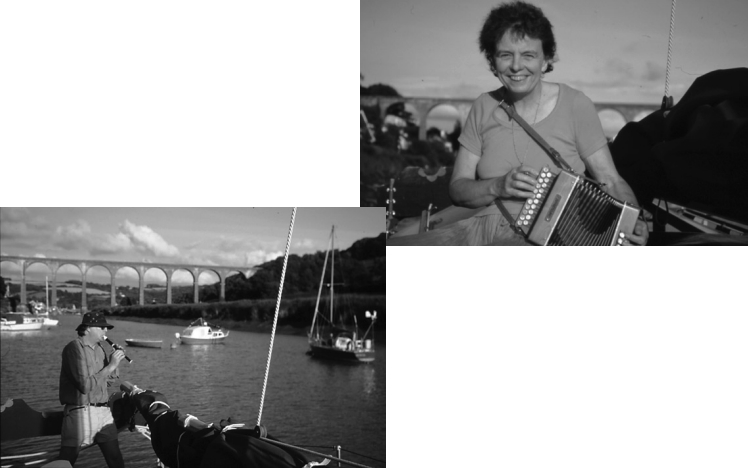
Don’t overlook the tin whistle, which is one of the most common instruments in the Irish tradition and well known in the U.S., of course. You’ll easily find a tin whistle, together with a manual, for less than $10. Don’t imagine, however, that by playing through the lesson book you will be able to play Irish music. You may play the notes of Irish tunes, but that’s a very different matter. The only way to play Irish music that sounds like Irish music is to listen to a great deal of it and try to play by ear. The only foolproof way is to be seven years old and live in Ireland.
Recorders have a lot going for them. Whereas the whistle is designed to play in only one key, the recorder is fully chromatic and can play in any key. Again, not expensive to buy, it may be slightly more than a whistle but only slightly. Get a plastic one, at least until you become very good. Wooden recorders may sound better in a concert hall but aren’t so good at having beer spilled on them in the early hours of the morning. You can wash plastic, dry it, and start again. The same applies when you’re playing in the cockpit and a sneaky wave catches you unaware. This has happened to all of us with boats that are long in the tooth, and low in the freeboard. The most common recorder is the descant (sometimes called soprano), which is in C. My personal favorite is the treble, which is five notes lower and has a far rounder sound.
Then there are accordions, melodeons, and concertinas. The difference between an accordion and a melodeon is that when you press a key on the accordion you get the same note whether you pull or push the bellows. On the melodeon you get two notes per key, one on the push and one on the pull. In this respect, the melodeon is like the harmonica, and if you’re used to the harmonica sequence, you will easily adapt to the melodeon. It might appear that the accordion is therefore the easier instrument to play, and when Sylvia is fighting the melodeon keys, she might sometimes agree.
More grunt
The great advantage of the melodeon, however, is its smaller size; two notes per key means half the number of keys and half the space for a given number of notes. A melodeon also has more “grunt” than an accordion, and for traditional music that can be very useful. The accordion, however, is a fully chromatic instrument and can play in any key, while the melodeon is often (but not always) in G/D. Since folk music is usually in G/D or related keys, this is a help rather than a hindrance and leads to a far more compact instrument with a case no larger than a sextant’s. We simply could not have found the space on our Nic 26 for an accordion.
Concertinas are nice instruments and come in three main kinds. The English concertina mirrors the accordion and gives the same note either way. The Anglo gives different notes on the push and pull, like melodeons, and the Duet has tune notes on one side and chords on the other. Apart from being a nice instrument in its own right, and very compact, the concertina is far the best of the three to accompany singing.
This brings us to the free instrument you carry around with you all the time: your voice. Even if you were bawled out at school for singing out of tune, don’t worry. You probably weren’t — and anyway, do you suppose the shantymen of the days of sail were all operatically trained tenors? There is a fine tradition of sea shanties, of course, both in the U.S. and Europe. The great advantage of shanties is that they were designed for sailors, not singers. As long as the leader of the shanty knows the words and the tune, all anyone else has to do is to follow that leader. The bible for shanty singing is Shanties from the Seven Seas, collected by Stan Hugill and published by Mystic Seaport Museum. Nobody with the slightest interest in the traditional music of the sea should be without this book.
The piano boat
I can’t go through all the instruments you might want to take to sea with you. Fiddles for example have a fine nautical heritage. A full cathedral pipe organ might cause difficulty, but most instruments can be managed one way or another, so don’t leave behind whatever you play already. I know of one boat built around a piano. If you don’t believe me, and you see an appropriately named, Belgian-flagged Bowman 45 sharing your anchorage, call on the owners and ask after the boat’s name.
I know of two boats that carried bagpipes. Steve was a piper trained by the Black Watch, one of the crack Scottish regiments. He stood on the foredeck of the boat he was crewing on as she left Alcantara docks, and brought the entire business of that part of Lisbon to a standstill until he was out of earshot. And my friend Nick, who plays Breton and Irish music on Spanish pipes, was out one day, a little south of Plymouth, England. Remarkably the English Channel was, for once, showing a benign face. The day was hot, the sun was out, the wind was light and from astern. Nick stood on his foredeck too, five miles offshore wearing his bagpipes and not a lot else, except maybe his watch. Sandra was at the helm. The overtaking boat came up on them quietly, and Nick only became aware of it as it came alongside.
If finding yourself stark naked in public, playing the bagpipes, sounds like the stuff of nightmares, you may like to know what to do: keep right on playing. Your audience may have to listen, but if they choose to watch, that’s their problem.
Buying an Instrument
The best way to find an instrument is to visit your local music shop. See what they have, and try it. It’s almost meaningless to try to give “typical” prices. In my catalog, bagpipes vary from $184 to $3,920. Melodeons vary from $264 to $3,192. There are many websites that will help.
Peter and Sylvia live in the Tamar Valley of Cornwall. He says he’s not exactly retired, but he isn’t exactly working either. In 1995-96 he and Sylvia cruised to southern Portugal and the Azores where they learned new tunes. On the trip they decided that cruising was for them, but their Nicholson 26 was a bit small. Since then they have been building a Nick Skeates-designed Wylo 11 32-foot gaff cutter. Can Pyran is now in the water and will go looking for new tunes next spring.
Thank you to Sailrite Enterprises, Inc., for providing free access to back issues of Good Old Boat through intellectual property rights. Sailrite.com