Issue 15 : Nov/Dec 2000
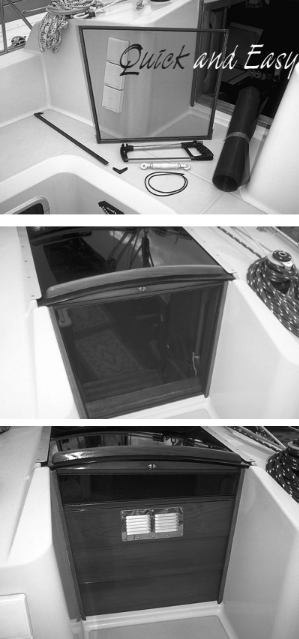
It’s amazing that sailboats don’t come with screens for the companionway hatch. Whether you spend $2,500 or $250,000 on your boat, if you want to keep bugs out without putting in the drop boards, you’re on your own.
The default approach has always been to get a piece of bug netting large enough to cover the opening and to weight the perimeter with chain or rope. But this is rarely satisfactory, as it leaves gaps around the edge. A screen fastened around the inside rim of the hatch with Velcro that opens with a zipper is much better. I’ve seen some nice screens made this way, but I never liked working a zipper each time I left the cabin. The most elegant solution is a screen with a teak frame that fits in place of the drop boards. These are difficult to make, however, and can be expensive to have custom-fit.
When it came time to build a screen for our boat, I wanted something effective and easy to make, preferably with no fancy woodworking required. What I came up with is based on the aluminum screen molding you can find in any home-improvement store. This aluminum extrusion comes in 8-foot lengths, and is held together with simple corner fittings. The screen is then held to the frame with a rubber bead that fits within the narrow inside channel.
You need a length of molding, a hacksaw, corner fittings, a rubber bead, a screen tool (to press the bead in place), and some aluminum screen. (Fiberglass screen is also available, but I have found the aluminum type to be more durable.) Use your drop boards as templates, and cut the molding to the proper lengths. The corner fittings have plenty of play in them, so it’s easy to form the acute and obtuse corner angles of the drop boards. With a little trial and error, you should be able to match the dimensions of your hatch pretty closely.
I recommend making the screen frame a little taller than the combined drop boards, so the top seal is made by sliding the hatch up to the back edge of the frame, rather than over the top bar — but either approach will work. Finally, cut a piece of screen larger than the frame, and press the molding into place with the screen tool. Be careful when installing the bead not to distort the shape of the frame. (If installing the screen gives you trouble, you can have your local hardware store do it for a few dollars.) Trim off the excess screen, add some weather stripping around the edge, and you’re done.
You can also use this approach to make a screen the size of just one drop board for those nights when you want just a little added ventilation.
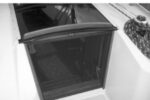
The resulting companionway hatch screen is light, strong, and — unlike wood — maintenance free. It fits the opening snugly and is easy to reposition when you come and go.
Steve is a research chemist who moved from Utah to Michigan and took up sailing to replace skiing. He and his wife, Beth, sail Rag Doll, an Ericson 38, on Lake Huron. They spend each August cruising the waters of the North Channel and dream of retirement as liveaboards someplace warm.
Thank you to Sailrite Enterprises, Inc., for providing free access to back issues of Good Old Boat through intellectual property rights. Sailrite.com