Accepting the limitations set this sailor free
Issue 78 : May/Jun 2011
Many of the boats owned and loved by subscribers to this magazine came with the Universal Atomic 4 gasoline engine. That so many of these engines, now venerable, are still in service is a tribute to their design, but our good old boats are beginning to outlast their good old engines.
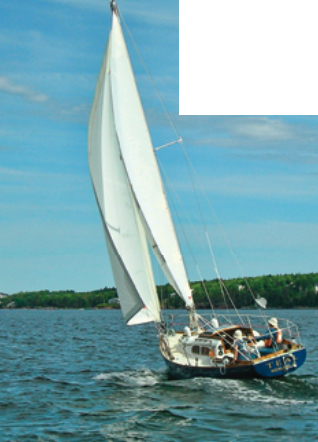
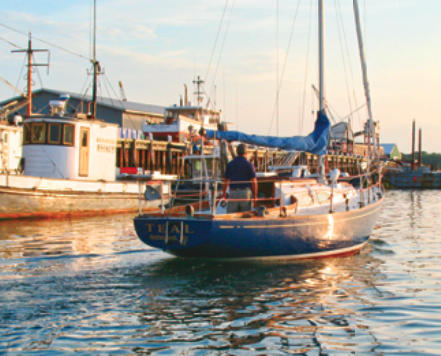
My own boat, Teal, a Bill Tripp-designed Tripp/Lentsch 29 built in 1962, came with the original, but now dead, Atomic 4. This was a factor that helped keep the price within my reach. I considered replacing the Atomic 4 with a diesel, but the cost of a new diesel would have been more than I paid for the boat. I also considered doing without an engine altogether. I was certainly ready to do without the rusty iron and the oil. Besides, I pride myself on being an experienced sailor who does not need an engine to get where he wants to go.
Still, the boat was designed for an inboard auxiliary and had a perfectly good propeller and shaft. And it’s not such a bad thing to have a little help now and then, especially when getting alongside docks, past a dead spot behind a steep shore, or into harbor after the wind has died in the evening.
An electric motor, some large batteries, and a solar panel seemed a promising compromise. The system was relatively easy and inexpensive to install, it was lightweight, and it was clean. After two seasons, I can say that it has worked well for me. Before I describe my installation, though, let me be very clear about the basic limitation of electric auxiliary power.
Battery reality
Many of today’s sailors rely heavily on their engines. They go on a cruise with set destinations and planned arrival times. When the wind does not cooperate, they motor . . . and they do it at a good clip. Many sailors drop their sails and motor when the wind is too strong and their planned destination is to windward. All these practices are impossible with electric auxiliary power.
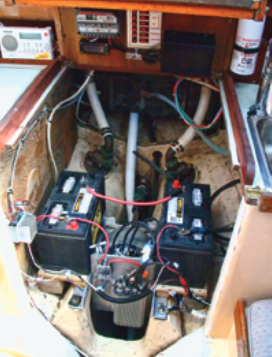
Lead-acid batteries of the type normally used in automobiles and boats remain by far the least expensive electric storage system. Newer battery technologies come at vastly increased cost. In the future there may well be a cost-effective alternative, but I use four large deep-cycle marine lead-acid batteries. They each weigh about 50 pounds and together provide, realistically, about 100 amp-hours of power at a nominal 48 volts.
One hundred amps at 50 volts for one hour is 5 kilowatt hours, or the same amount of energy as 14,000 Btu. One gallon of diesel fuel contains about 140,000 Btu, or 10 times what my batteries can hold. An electric motor is about twice as efficient as a diesel engine but, even taking this into account, my four big batteries are equivalent to less than a quart of diesel fuel, or about 1 percent of the energy capacity of the typical sailboat fuel tank.
People think of engine capacity in terms of horsepower but, with electric auxiliary power, the real issue is energy storage capacity. Electric motors come in all sizes — you could fit 100 horsepower or more in your engine compartment — but you would not have a source of energy to feed all those horses for more than a few minutes.
Tom Colvin, an experienced designer of serious boats, has said that one horse-power per long ton is adequate auxiliary power on a sailboat. That would be three horsepower on Teal, which is what I have in my electric motor. Using just one of those horses (750 watts), it can power Teal at 3 knots for 3 hours without running the batteries down below half. Using two of the horses, I can go 4 knots for half that time. This is good enough for me. If it would be good enough for you, you will find many advantages in electric auxiliary power.
Charging choices
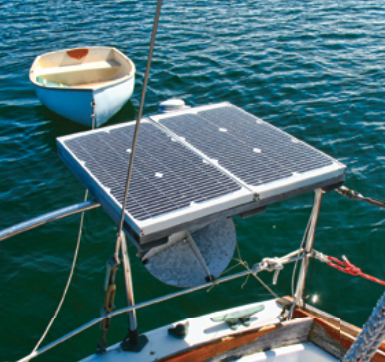
One big advantage is that your source of energy is renewable, not only in the save-the-earth sense but also in the practical sense that you never need to fill your tank — the sun can do it for you. Again, though, there is a significant limitation. Sailboats do not have a lot of room for solar panels. I have two panels, a total of 40 watts, hung out over my stern rail on one side of the backstay. In Maine, it takes a week to fully recharge the batteries after those 3 hours at 3 knots. You could do better with more panels and a sunnier location or with a wind generator in a windy location, but it will still be very limited.
There is another source of renewable energy to recharge your batteries. Your propeller and motor can generate electricity when you’re sailing at speed. How effective this can be will depend on your sailing habits. For long passages in good winds this “regeneration” could be very effective in keeping batteries charged.
Of course, there is the option of topping up your batteries with shorepower whenever you spend a few hours at the dock.
As a new father, my sailing has been limited to daysails and a few overnight trips. I have used the motor for occasional visits to the dock and to negotiate some tricky entrances to anchorages among the islands. The sun has proved quite sufficient to keep my batteries charged. It has kept them fully charged all winter in the boatyard too, a big plus.
Ease of operation
Another big plus is ease and readiness of use. Starting a gas engine safely is a ritual of a few minutes; even diesels require a bit of ritual and do not always start reliably. Electric motors are extremely reliable and can be started instantly at the turn of a knob. Also, since electric motors can run equally well in either direction, there is no need to change gears for forward and reverse; just a flick of a switch will do.
Not storing fuel aboard the boat is another big plus, and electric motors need neither oil nor grease. Your boat will be safer and smell better, and your engine compartment and bilge can be squeaky clean.
Finally, there is no annual maintenance with electric power. Just turn it off when you haul out and turn it on when you launch. You can leave everything aboard, even the batteries, since your solar panels will keep them charged.
So there is one huge minus and a lot of pluses. Where the scales rest will depend on how you sail and perhaps also on the condition of your current engine and on how much money you have to spend. If my boat had come with a sound diesel engine, I would not have ripped it out. I was forced to deal with a dead engine and I had a limited budget.
Controlling cost
The total cost of Teal’s electric motor conversion was $2,000 (see the sidebar for a breakdown). It is possible to spend much more, but spending more will not necessarily result in improved performance. If the added weight and bulk is an acceptable trade-off, increased battery capacity is possible and a larger motor too, but you eventually push against the line where a diesel might make more sense.
Another way one can spend money is on a gearbox or on a belt-and-pulley arrangement. Good gearboxes are expensive and belts and pulleys have significant friction losses. I chose a slow-turning motor that is reasonably well matched to the Atomic 4 propeller and has bearings designed to take the thrust. A faster-turning motor will need a reduction gear to work properly and some motors may need the thrust bearing a gearbox will provide. There are now some fine-geared electric-drive packages on the market, but they come at more than twice the price of my simple system.
Assembling the system
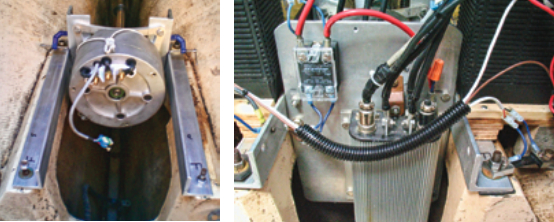
I chose a Mars motor that allowed me to use the prop and shaft I already had and connect it directly to the motor. (Note: Mars Electric has since changed its name to Motenergy. –Eds.) This inexpensive and elegant solution has worked well for me. Another advantage of the Mars motor is that it is totally enclosed. Because brushless motors have all their windings in the stator, they can be designed to dissipate their heat without the need to blow air through the interior. This is an obvious advantage in the marine environment.
Brushless motors require a motor controller; they cannot be run directly from your batteries. The controller provides three-phase alternating current matched to the desired motor speed and torque, giving a relatively wide range of efficient operating parameters.
Installing the motor on the old engine bed was the biggest job, but it was made easier by the fact that the motor weighs less than 30 pounds.
The Mars motor is face-mounted with four bolts. The TeamDelta mounting plate made this easy and allowed flexibility for final exact alignment. To connect from there to the engine beds I used 2-inch x 1⁄4 -inch aluminum angle. I used “structural” angle, but “architectural” angle is plenty strong and would allow more flexibility for bolt placement. The aluminum can easily be cut and drilled with woodworking tools and the pieces are easy to bolt together. The trick is to use oversized holes to allow flexibility for final alignment. With 3⁄8-inch stainless-steel bolts and lock washers, it’s possible to clamp the parts together so they will never move.
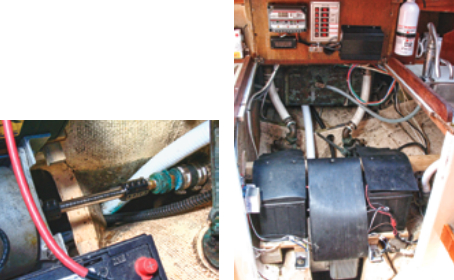
The motor shaft and my propeller shaft are both 7⁄8 inch, a convenient coincidence, but it is easy to match different sizes with couplings from McMaster-Carr. My installation required a 9-inch shaft extension, so I needed two couplings. It is essential to use clamping type couplings: in reverse the prop may otherwise pull the shafts apart — a fact I learned the hard way.
Where you place the batteries depends on your boat. Mine had compartments for two big batteries under the V-berth and there were two huge cables already in place to run the power aft. I placed the other two batteries on either side of the motor in the engine compartment, taking care to secure them well.
Good electrical connections are essential. It is important also to appreciate that 48 volts can be dangerous. Normally, I can touch the 48-volt terminal and feel nothing, but with one saltwater-wet hand grabbing the motor mounts and the other grabbing the battery terminal, death could be a possibility. There is also danger of injury and fire from short circuits. I have made a point of insulating the battery connections from casual contact and of switching off the power when working in the engine compartment.
Designing the controls is a pleasure, since electronic control is much easier than mechanical control. I used a rotary switch for forward and reverse and a potentiometer for speed control. I located these in the traditional place on the side of the cockpit footwell. I may move them to a more convenient location, perhaps on the cabin trunk. It would be nice to be able to keep an eye out when approaching the dock without having to bend down and grope for the controls.
There are many details to be attended to and many choices to be made. Much information is available from the manufacturers of the various components. And much will depend on your own preferences and requirements.
Installing my electric motor has been an easy and pleasant experience. It would have been easier yet if I had known at the start what you know now. If you are willing to accept the limitations, I think you, too, will enjoy the process and the result.
Joe Steinberger got his fi rst boat when he was 13, a Blue Jay he raced on Long Island’s Great South Bay. He took time off to study law at Columbia, then moved to Maine, where he has practiced law when not too busy cruising the coast in a succession of good old boats. He writes a weekly column, “We the Six Billion,” which can be read at www.freepressonline.com.
Thank you to Sailrite Enterprises, Inc., for providing free access to back issues of Good Old Boat through intellectual property rights. Sailrite.com