Stop fuel from frothing overboard at fill time
Issue 109 : Jul/Aug 2016
I was lucky when I discovered my fuel tank was leaking. After all, it was early spring and Pelorus, my 1980 Paceship PY26, wasn’t yet splashed. I was tightening the prop shaft seal and almost didn’t notice the drip, which was small but, “Oh my!” as they said when David met Goliath. It had evidently just started, as there wasn’t more than a tablespoon or two in the bilge. I knew it would get worse.
The fuel tank, a 14-gallon stainless steel box that lived on a platform under the cockpit and just over the prop shaft, had been out of sight and out of mind for more than 35 years. It had reached the end of its life.
It wasn’t all bad news. Increasing amounts of gunk in the Racor filter had warned me there was sludge in the bottom of this old tank, and I’d also been thinking for some time about how to stop fuel from blowing out the vent as the tank fills. Diesel aerates when agitated, so a gallon or two of some- thing resembling soapsuds might form at the top of the tank as it’s being filled. (Using a filter — as I do when filling from a jerrycan — slows down the fill rate and reduces frothing.) These diesel suds are what typically burps out of the vent. Because the law forbids any visible sheen of oil — no matter how little — and provides for a hefty fine for those who cause a sheen, it seemed like a good idea to find a way to prevent this from happening. Replacing my tank was an excuse to finally tackle this problem.
Online, for about $200 with shipping, I found a fuel tank of about the same size and capacity but made of plastic. With a little pulling and shoving, the old tank came out through the quarter berth and the new one went in by the same route.
I soon discovered a great advantage of a translucent plastic tank. I’d had a series of problems with inaccurate fuel gauges, but to determine the precise amount of fuel in the new tank, I had only to open the cockpit seat, stick my head in with a flashlight, and have a look. That’s easy enough to do when I’m filling the tank.
Catching the burp
Of course, I still hadn’t solved the problem of frothy fuel escaping from the fuel tank vent when filling, but the answer came to me when I was doing a little plumbing job in my basement.
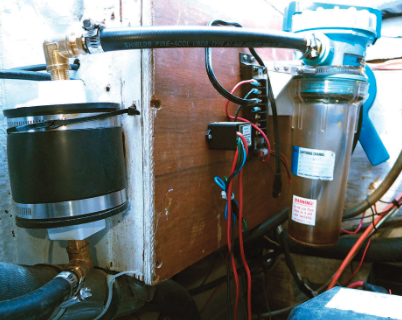
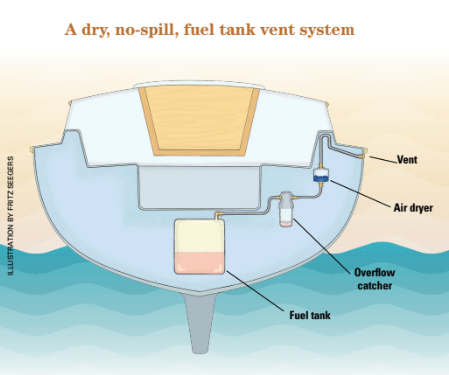
I was removing and discarding an inline household water filter. The more I looked at it, the more I realized I could put it to good use aboard my boat. With the filter cartridge removed, I was left with a closed clear-plastic housing with a standard 3⁄4-inch inlet and outlet. The inside of the filter housing was baffled and I thought, if it were plumbed into the fuel tank vent line, any diesel fuel in that line heading for the vent would be directed by the baffle into the clear plastic housing. (Note: this solution is not acceptable in a gasoline system, and the plastic filter housing must be compatible with diesel fuel –Eds.)
The housing has a capacity of about a quart and a half, which is way more diesel fuel than I’ve ever lost overboard. I used a reducing bushing so the 3⁄4-inch threads would accept the 1⁄2-inch vent hose. I made a bracket and installed the unit out of the way, but easily accessible, just under the cockpit seat, the same one I lift to check the fuel level in the tank. That way I can check both at the same time.
Now, I have a new tank filled with clean fuel and I’ve yet to discharge any of it overboard. It’s great when a simple fix can have such a great impact — or as we say in Jersey: Bada bing, bada boom!
Air dryer for the vent
Another benefit of forever preventing fuel from discharging out the tank vent is that I was able to implement another vent line solution, one I learned about in the November 2013 issue of Good Old Boat (see “Keeping Diesel Dry”). This one prevents moisture in the air from finding its way into the fuel tank via the vent. Keeping water vapor out of the tank makes it unlikely condensation will form on the inside tank walls (and promote the growth of filter-clogging microbes).
I cut the vent hose between the vent and my new anti-discharge solution and installed inline a container filled with silica gel. This desiccant absorbs moisture from the air that is drawn into the tank as the fuel is consumed.
For the container, I bought a 4-inch rubber coupling designed to connect two pieces of 4-inch PVC pipe. I closed the open ends of the coupling with 4-inch PVC end caps secured with hose clamps, after drilling and tapping the center of each cap to accept 1⁄2-inch threaded brass elbows with nipples that fit my vent hose. Inside the container, screens at each end keep the desiccant from escaping, either out the vent or into the tank.
Once a year, usually in April after the long wet winter months have passed, I recharge the silica gel granules by pouring them onto a cookie sheet and drying them in the oven at 250oF for 45 minutes. The granules change color from pink (when moisture-filled and ineffective) to blue (when dry). If seawater should ever make it past the vent loop (it hasn’t yet) and into the dryer, I would recharge the silica gel in the same way.
Cliff Moore is a Good Old Boat contributing editor. His first boat was a Kool cigarettes foam dinghy with no rudder or sail. Many years and many boats later, he’s sailing Pelorus, a 26-foot AMF Paceship 26 he acquired and rebuilt after Hurricane Bob trashed it in 1991. He is the editor of a community newspaper.
Thank you to Sailrite Enterprises, Inc., for providing free access to back issues of Good Old Boat through intellectual property rights. Sailrite.com