Say goodbye to sheet hang-ups on mast winches
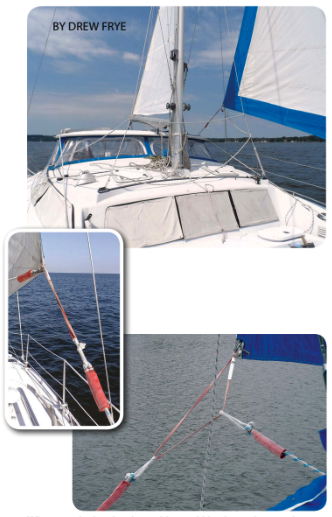
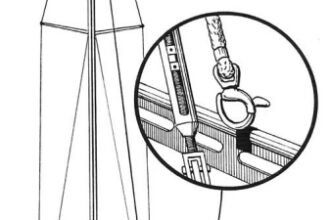
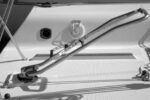
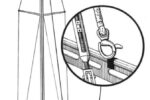
When attached to the clew with a webbing loop, above and left, the sheets don’t pull the clew patch hard against the sheet deflector (or any other snag hazard) but allow it to float forward.
Issue 109 : Jul/Aug 2016
Snagging the lazy (windward) genoa sheet on mast-mounted winches was my curse since the day we added a genoa to Shoal Survivor, our 1997 PDQ 32 Altair catamaran. The clew is just higher than the winch and perfectly positioned to loop over the winch when the sail slides across the mast as we tack. Our practice of running double sheets (we have tracks inside and outside the shrouds) only made the problem worse. Often, the boat fell into irons before anyone could get forward to free the hung-up sheet.
I tried bungees rigged this way and that to cover the winches. No luck. I tried improving my technique, keeping the slack out of the sheet. This approach worked just fine when the wind was light, but was not reliable in a blow, particularly when I was singlehanding. I tried rigging a deflector line from the spreaders forward to the trampoline, but that made it too hard to get the sail around the line when tacking.
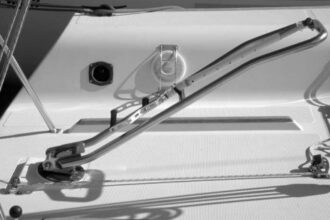
The deflectors
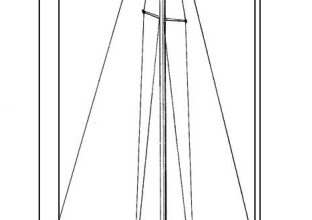
My solution was to run a 40-foot length of 1⁄4-inch Spectra double-braid from one end of the self-tacking jib’s traveler track to the other by way of the lazy-jack pad-eye at the spreaders, and lightly tensioning the line with a trucker’s hitch. As well as preventing the sheets from snagging on the mast-mounted winches, it keeps them away from the saloon deck hatches, allowing us to leave them open when sailing. I feared my sheet deflectors might get in the way when I have to go forward on deck, but in fact they make nice handholds in an otherwise precarious area.
On boats without a handy self-tacking-jib track, another pair of attachment points forward of the mast might be made to work. Non-stretch line is best for the deflectors; nylon would result in a comical bungee cord effect. I also recommend chafe protection for the line at the spreader eye. After several years, the Spectra cover chafed through at this point (the core was undamaged). To prevent this from happening again, I slid a 4-inch length of 9⁄16-inch tubular webbing over the line where it passes through the lazy-jack pad-eye.
A sheet bridle
I soon realized that in solving one problem I had created another: a significant tendency for the clew eye to jam against the new sheet deflectors. I tried several different knots and splices, but it made no difference; the side of the clew eye and reinforcement would often catch.
An 18-inch Spectra climbing sling did the trick. The climbing sling is a loop, so I “luggage tagged” it to the clew by slipping an end of the sling through the clew and back through itself. I then attached each sheet separately to the sling with a soft shackle. With even the lightest tension on the lazy sheet, the sling opens up into a triangle and the clew eye is free to float forward, away from the sheet deflector. Also, the shackles or knots are not required to pass all at once but in succession, further reducing the likelihood they will hang up.
We now have no more sheet snags in any wind conditions, from ghosting to 25 knots. Why does it take so long to learn such simple things?
Drew Frye cruises Chesapeake Bay and the mid-Atlantic coast aboard his 32-foot catamaran, Shoal Survivor, searching for out-of-the-way corners known only by locals. A chemical engineer by training, and a 40-year climber and 30-year sailor by inclination, he brings a mix of experiences to solving boating problems and writing about them.
Thank you to Sailrite Enterprises, Inc., for providing free access to back issues of Good Old Boat through intellectual property rights. Sailrite.com