A versatile ’80s-era racer/cruiser from the world’s largest builder of sailboats
Issue 109 : Jul/Aug 2016
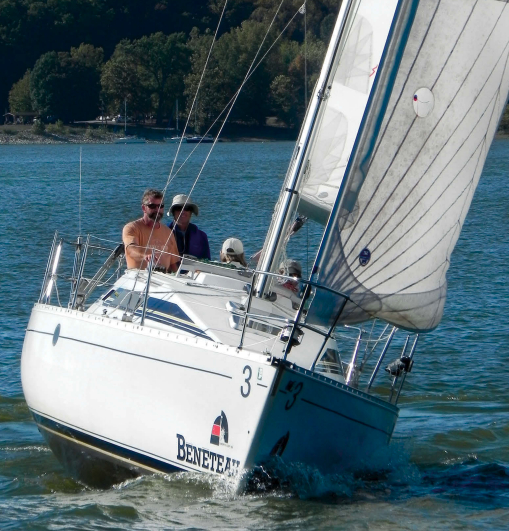
A classy car and a boat with a storied history say a lot about Wayne Barnard and his wife, Mary Ellen Stacy, owners of Wings, a 1989 Beneteau First 285 Liberty Cup Edition #3.
Wayne’s daily driver is a black 1965 Ford Mustang fastback with factory chrome wheels that he has owned for 40 years (he was 17 when he bought it). It’s a nearly bone-stock, pure basic, old muscle car with a 289-cubic-inch V-8 engine and a four-speed manual transmission. I mention this because more than a few of us good old boaters are car nuts too. It is not often a car story accompanies a boat story. On weekends, it’s the Mustang that gets Wayne and Mary Ellen from their home in Terre Haute, Indiana, to Lake Monroe near Bloomington, Indiana, where Wings delivers the thrills.
Once you’ve sailed the wing-keel Beneteau First 285, it is not hard to imagine racing one. Beneteaus with the First designation are intended to be racer/cruisers and this boat is no exception. It’s a sporty boat, just as the Mustang is a sporty car: good handling and performance with everyday utility in one package.
Wayne taught himself to sail on a Sunfish, progressed through several boats, and delivered a Sabre 28 from Chesapeake Bay to the Bay of Fundy. Along the way he developed a real passion for sailing. He met Mary Ellen at the Lake Monroe Sailing Association picnic shelter. They’ve since enjoyed eight years of sailing and togetherness.
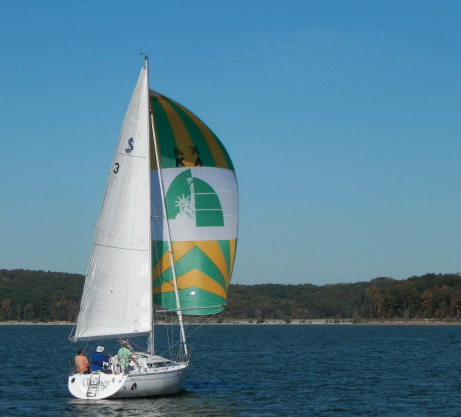
Wings has a history too. She was one of 10 Beneteau First 285s built to compete in the 1989 Liberty Cup, an eight-boat international match-racing event that took place in New York Harbor. Once the racing was over, the boats were sold. Wings was boat #3. Wayne, very proud of his boat’s heritage, had all the elaborate graphics redone. Wings still flies the Liberty Cup spinnaker.
Design
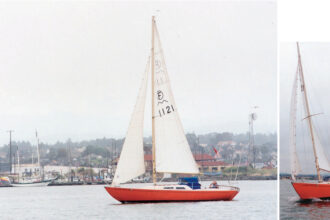
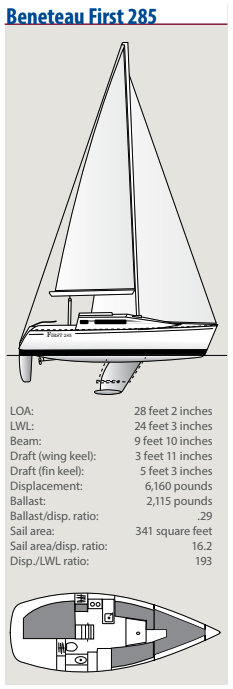
Designed more than 30 years ago by Groupe Finot, the First 285 still catches the eye with its sharp lines. It has a powerful 7⁄8 fractional rig and a partially balanced spade rudder. As with many models, Beneteau offered two keel options on the 285, a bulb keel that draws 5 feet 3 inches or, as Wings has, a wing keel that draws 3 feet 10 inches. In both cases, the ballast is cast iron. A generous 9-foot 10-inch beam provides good form stability.
A displacement/LWL ratio of 193 puts the boat toward the lighter side for its era, so I was somewhat surprised that some owners responding to our request for comments reported performance as only average and that the boat is easily overpowered. Nevertheless, it handles well if sail is reduced early. The sail area/displacement ratio is a modest 16.2.
Construction
Beneteau sailboats are constructed using four basic components: hull, deck, interior pan, and overhead liner. Like most Beneteaus, past and present, the 285 has a solid fiberglass hull and the decks are cored with end-grain balsa. The molded interior pan incorporates berth flats and other furniture elements in the cabin as well as a grid that, bonded to the hull with a proprietary adhesive, stiffens the hull structurally. Many production builders use this system as it saves many man-hours compared to a “stick-built” interior. The downside is that fiberglass doesn’t absorb sound as well as wood, condenses moisture more readily, and makes modifications more difficult.
Beneteau employs many other efficiencies in its eight worldwide plants, including robotic cutting and coating of interior plywood furniture panels. Hull-to-deck joints are generally not through-bolted but are fastened with rivets and/or screws, which require only one worker to drive home.
Many portlights, fixed and opening, begin to leak at some time in their service life. On the First 285, this can result in water collecting at the base of a bulkhead, which might lead to the plywood bulkhead delaminating.
Deck
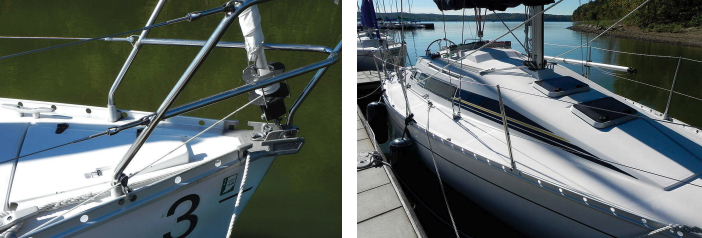
Great non-skid, inboard shrouds, and teak handrails set into pockets molded into the corners of the cabintop make moving about on the wide sidedecks easy. Stanchions bolted to the slotted toerail support double lifelines that run between the bow and stern pulpits. Four big aluminum cleats provide secure attachment points for docklines. Two large Lewmar hatches are mounted on the centerline of the wedge-shaped cabintop where it slopes toward the foredeck. The stemhead fitting includes an anchor roller, and the anchor rode is stowed in a deep self-draining anchor locker with a latched lid on deck.
At the stern, the sugar scoop transom is a great platform for boarding and disembarking from the dinghy and for swimming. The swim ladder can be grabbed and deployed from the water — a good safety feature. An opening portlight in the transom adds ventilation and light to the aft cabin.
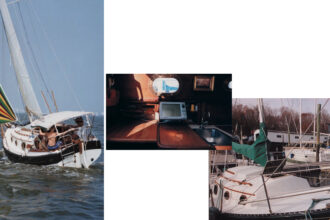
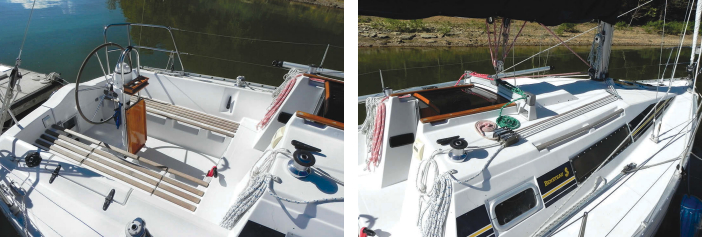
The First 285 was offered with tiller or wheel steering. Wings has wheel steering and a pedestal-mounted table. Aft of the wheel, the tiller head for the emergency tiller is under a hinged cover in the cockpit sole. The single-lever engine/shift control is aft to starboard. Two scuppers drain the somewhat shallow cockpit. A little standing water tends to remain when the boat is level but drains out when the boat heels on either tack.
Five teak slats add grip for feet on the cockpit seats, and those at the inner edge also serve as handholds. The seats are OK on your bottom (better with cushions), but not so on your back, as the coamings are a bit low (again, cushions are the cure). The seating rates only a 4 out of 5 on my Penticoff Napability Index (PNI) for being long enough but a bit too narrow for a comfy nap. The seats are also a tad far apart for comfortable bracing while heeled. The starboard seat is a hinged cover that can be opened to access a large storage area aft of the head.
An opening portlight at the forward end of the footwell lets additional light into the aft cabin, and also provides some ventilation in the right conditions. A manual bilge pump is mounted in the starboard coaming.
The smoke-tinted acrylic companionway hatch slides into a full sea hood. The companionway opening is recessed forward into the cabin trunk, so going below requires stepping onto the high bridge deck before descending the ladder. Teak handrails on either side aid in this maneuver. The two plywood dropboards slide in aluminum tracks and can be locked from inside.
Rig
The 285’s single-spreader fractionally rigged mast is deck-stepped, supported beneath the deck by a compression post seated on the structural grid in the hull. Upper and lower shrouds tie to single chainplates mounted on each sidedeck close to the cabin trunk. The split backstay is adjustable. On Wings, the headsail is a roller-furled genoa.
The mainsail sheets to a short traveler on the cabintop and is trimmed with a winch and a rope clutch. Eight lines lead aft to two #8 Lewmar winches on the cabintop, and the headsail sheets lead to #30 Lewmar self-tailing winches mounted on the cockpit coamings. Two jam cleats recessed into the cockpit seatbacks permit quick line adjustments. A small winch is mounted on the aft side of the mast. Two jiffy-reefing lines ease the workload of shortening the mainsail. Wings flies asymmetrical and symmetrical spinnakers.
Accommodations
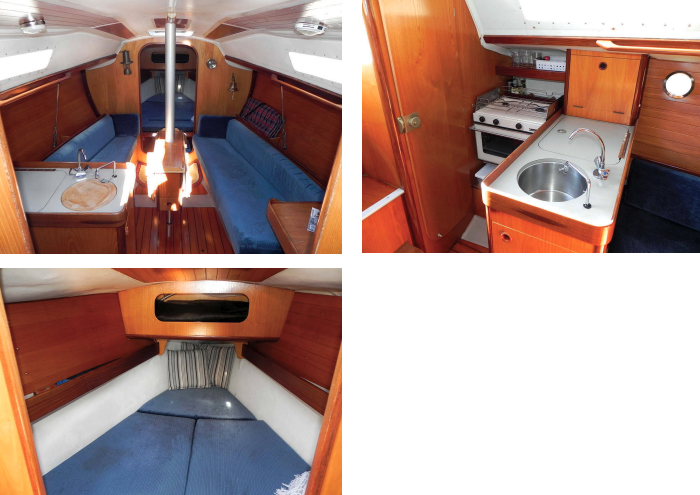
Belowdecks, although parts of the fiberglass furniture pan are visible, the saloon appears filled with wood trim and paneling, including tongue-and-groove ceiling on the hull sides. Vinyl padding covers the hull sides in the sleeping quarters and some areas of the fiberglass overhead liner. A fully enclosed head is to starboard, adjacent to the companionway ladder. The compact galley is to port and is equipped with a propane stove/oven and a deep top-access icebox. A removable cutting board top covers a round stainless-steel sink.
Long teak handrails outboard beneath the sidedecks are a great help for crew moving about while under way. Light below is plentiful, let into the cabin through fixed portlights in the cabin sides. Round fixed portlights in the topsides provide a peek outside from the settees. The only opening portlights are those in the head and aft stateroom, but the two forward hatches and the companionway guarantee lots of fore-to-aft airflow in the main cabin.
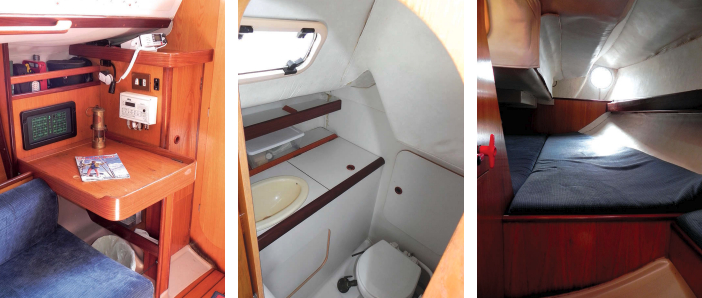
The berth in the aft stateroom is a double, half of it under the cockpit sole where there is no sitting headroom. It will sleep two, but the inboard sleeper is going to have a tough time crawling out over the outboard sleeper. For that reason, Wayne and Mary Ellen sleep separately, one in the V-berth and one in the aft cabin. This allows them to stow gear on the unused sides of the two berths. Three opening portlights admit light and air, and the outward-swinging door permits enough standing space for dressing while standing up. Large storage shelves with fiddles abound throughout the aft cabin.
In the main cabin, the centerline table has storage drawers and bins in the center and folding leaves with removable fiddles. The chart table and electronics are to starboard at the aft end of the settee. The starboard settee is long enough for napping but the port-side one is not.
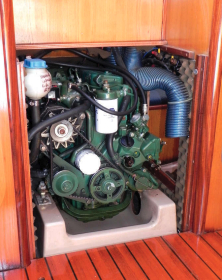
The V-berth can be closed off using either bi-fold doors (as on Wings before Wayne removed them) or a single solid door. The floorboards are a simulated teak-and-caulking laminate and lift out when access to the shallow bilge is needed. Access to the engine is excellent from both sides and the front.
Pressurized fresh water from a 10-gallon tank is standard on the Beneteau First 285. A foot pump at the galley sink has a two-way valve that allows water to be drawn from either the icebox sump or a through-hull to help conserve fresh water. A nice feature seldom seen in a boat this size is the 6-gallon water heater. Waste tankage is 10 gallons.
Under way
I found the Beneteau First 285 tracks very straight, with little wheel input needed, no matter the point of sail. The helm needs only a very light touch, but the rack-and-pinion steering provides no feedback, which means the helmsman needs to watch, rather than feel, what the boat is doing. Because steering demands little effort, the helmsman has a choice of places to sit, for comfort or for the best view.
Wings tacks with ease in light air. Furling the genoa in light air does not much alter how she handles. A large number of lines run across the cabintop from the mast to the cockpit and pose a foot-rolling hazard to anyone handing the mainsail and stowing it on the boom.
There is nothing unusual to report about this boat’s performance under way when powered by its 18-horse-power Volvo and its folding propeller. Some owners, as one would expect, report better maneuverability and performance after installing a bigger three-bladed feathering propeller. With all 7 gallons of fuel in the tank, the thrifty diesel will push the 285 along for more than 10 hours at half a gallon per hour. The engine control is located low and out of the way but is still easy to use. The engine gauges are essentially out of sight at the aft end of the cockpit, but the alarms for water temperature and oil pressure should call attention to any problem that might arise.
Conclusion
Complaints by owners seem limited to deteriorating headliners and cracked portlights that eventually leak. A shower that drains into the shallow bilge is not desirable either. But the Beneteau 285 is a well-built boat overall and, if sailed with a well-tuned rig, will perform moderately well. A number of owners say they had difficulty sailing to the base PHRF of 183 to 186 seconds per mile for the bulb keel and 192 for the wing keel. For non-racers, she is adept at providing good fun in comfort on a roomy, attractive, sweet-handling boat. For comparison, the Sabre 28 has a PHRF of 192 to 210 seconds per mile, depending on fleet, and the faster J/28 rates 174.
Since Beneteau built 451 285s from 1985 to 1993, a good number are usually on the market. Current U.S. prices found online range from $17,900 for a 1987 model to $30,500 for a 1991 model, with the average price in the region of $20,000. Parts are available from Beneteau dealers and most of the hardware is common to other boats of similar vintage.
Allen Penticoff, a Good Old Boat contributing editor, is a freelance writer, sailor, and longtime aviator. He has trailer-sailed on every Great Lake and on many inland waters and has had keelboat adventures on fresh and salt water. He owns an American 14.5, a MacGregor 26D, and a 1955 Beister 42-foot steel cutter that he stores as a “someday project.”
Thank you to Sailrite Enterprises, Inc., for providing free access to back issues of Good Old Boat through intellectual property rights. Sailrite.com