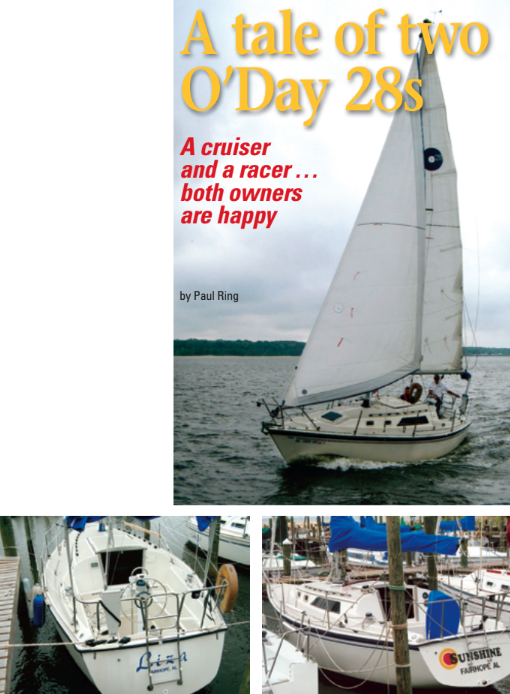
A cruiser and a racer . . . both owners are happy
Issue 64 : Jan/Feb 2009
From 1978 to 1986, Bangor Punta Marine produced 507 O’Day 28s; two of them are kept at the docks of Fairhope Yacht Club in Fairhope, Alabama, on the eastern shore of Mobile Bay. Liza, a 1984 model, is owned by David and Mary Lucas, and Sunshine, a 1987 model, belongs to Ralph and Joan Peterson. Each couple bought their boat for quite different reasons.
When I caught up with David, he was preparing his boat for a two-month cruise along Florida’s Gulf Coast as far as the Dry Tortugas. While I helped him move his boat to the marina across the creek for a quick haulout to clean and inspect the bottom, we talked about his boat; it’s his first, and he’s owned it for seven years.
While the O’Day 28 is considered a racer/cruiser (or cruiser/racer), for David and his wife, Mary, it is a cruiser, for they have little, if any, interest in racing. Budget was their first consideration, so they shopped for boats of the approximate size and vintage of the O’Day 28. To avoid delivery costs and inconvenience, they also looked for a boat located within a reasonably short sail from home.
Their interest in cruising made interior accommodations very important. David says Mary insisted on a boat with a “real head.” For David, a boat of manageable size for singlehanding — both sailing and maneuvering in a harbor — was important. Mast height was also important because, along the northern Gulf coast, there are several 50-foot bridges. After looking at a number of boats, they kept returning to the O’Day 28. It was in better-than-average condition and David was impressed with its overall quality. He says it felt like a “solid boat.” He still thinks so.
Ralph and Joan Peterson lost their Ranger 30 to Hurricane Katrina and their 1987 O’Day 28 is its replacement. Not precisely an even trade, perhaps, but close in many ways. Both the Ranger and the O’Day were designed by C. Raymond Hunt Associates, New Bedford, Massachusetts, and built by Bangor Punta Marine, Fall River, Massachusetts.
Although the O’Day is smaller, interior arrangements are similar. For Ralph, the interior is primarily for stowage, since his interest is exclusively club racing and the occasional daysail. Already familiar with the quality of Bangor Punta Marine products, Ralph felt comfortable when shopping brought him and Joan to the O’Day 28. Like David Lucas, Ralph cites the O’Day 28’s ease of handling. He doesn’t singlehand, but he often races shorthanded.
Design
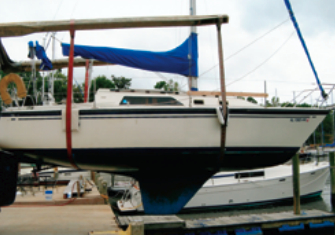
The O’Day 28 is quite modern looking, even though the design is 30 years old. A flat sheer joins the raked stem and counter transom. Freeboard and beam are generous, creating ample interior volume for accommodations; however, the fine bow means the couple occupying the V-berth will be playing “toesies.”
The cabin trunk is fairly long and low enough to nicely complement the hull profile, which does, however, somewhat compromise headroom, which is about 6 feet. Even though I’m 6 feet 2 inches, in my view, the small loss of headroom is worth the improved appearance.
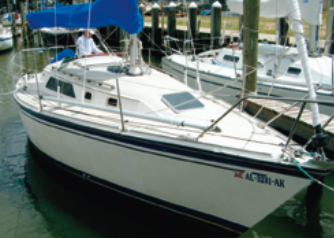
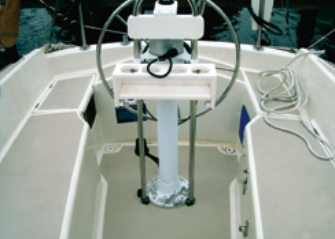
The cockpit is sufficiently large and the coamings are raked about right for comfortable seating. The modified T-shape makes it possible to get past the steering wheel without stepping up on the seats — an important safety feature. However, there are only two undersized cockpit scuppers. These would drain slowly if pooped.
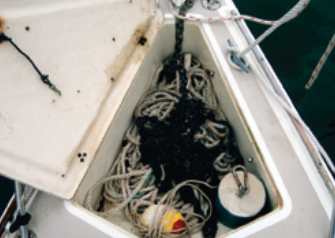
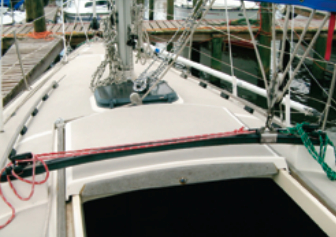
The side decks are wide enough for comfortable movement from the cockpit to the foredeck, where there is an anchor locker and a single anchor roller. A second, lightweight Danforth-type anchor could be carried in the locker. Altogether, it’s a reasonable arrangement for coastal cruising.
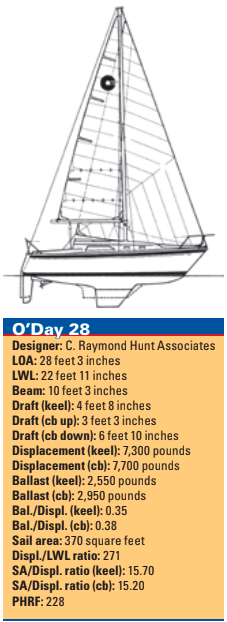
Underwater, the entry is fine at the bow, and the bottom gradually widens to well-rounded sections farther aft. The fin keel is of moderate aspect ratio with a sharply raked leading edge. The spade rudder is hung all the way aft. Draft is 4 feet 8 inches, which is shallow enough for those who regularly sail in thin water. A less popular centerboard version also was produced, which drew 3 feet 3 inches board up, and 6 feet 10 inches board down.
Interior
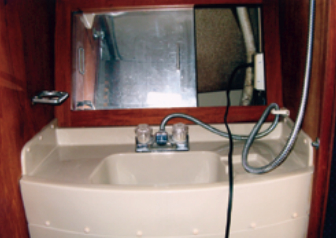
The interior layout of the O’Day 28 is conventional. As mentioned earlier, the V-berth is narrow at the foot. Forward of the V-berth is bin storage under the anchor locker, with additional storage under the berth. The head, immediately aft of the V-berth, extends completely across the boat and fulfills Mary Lucas’ requirement for a spacious, enclosed head. Especially appealing is the large fiberglass lavatory unit with generous storage under and behind it. Showering is done with a hand-held unit while using the commode as a seat. The holding tank has a capacity of 15 gallons.
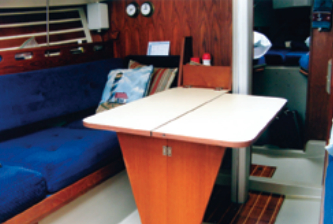
The main cabin has settees port and starboard, with the port settee convertible to a double. The dining table is attached to, and folds up against, the forward bulkhead — a good arrangement in a boat this size. However, once underway it should be stowed; otherwise, stumbling into it would likely tear it away from the bulkhead.
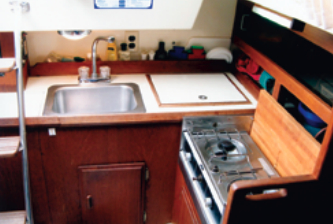
The L-shaped galley is aft and small, but adequate. Both David’s and Ralph’s boats have the original two-burner pressurized alcohol stovetops. While these stoves are out of favor because of the potential for flare-ups when lighting, David and Mary find theirs satisfactory, and Ralph doesn’t use his at all. The small 4-cubic foot icebox is barely adequate and could benefit from adding insulation, where possible, between the box and the surrounding cabinetry. David and Mary supplement theirs with a 12-volt portable refrigerator/freezer chest stowed in the quarter berth. The sink partially tucks under the cockpit, which makes dishwashing a little awkward. Galley stowage is well thought-out and adequate for coastal cruising.
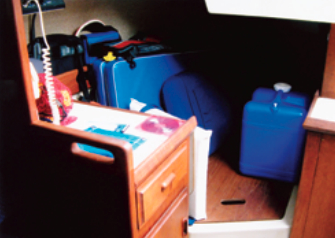
On the starboard side is a cabinet with built-in drawers. A hinged extension converts it to a small chart table. Immediately aft is the quarter berth. As is so common, David and Mary use theirs as a place to stow bulky items.
Stowage in the main cabin is quite good, aided by the boat’s generous beam. Shelves with fiddles are above and behind the seatbacks with bin stowage behind. Half of the space under the starboard settee is taken up by the 25-gallon water tank.
When I helped David with a valve adjustment, I found access to his Universal diesel to be better than average. A portion of the front and top of the galley cabinet are part of the engine compartment enclosure and completely open up. Additional access is through a quarter berth panel and cockpit seat locker.
The overall appearance of the interior is attractive. Teak-faced plywood is used for bulkheads and cabinetry, with solid teak for trim. A white fiberglass headliner keeps the interior from being gloomy. The joinery is above average for a boat in this price range. The upholstery fabric in both boats is an attractive dark blue and still looks new.
Construction
The hull is a one-piece solid fiberglass laminate. David’s 1984 boat has a minor blistering problem (many very small shallow blisters), while Ralph’s 1987 model has had none. A “unified grid pan” is bonded to the interior of the hull for stiffness. The cast-lead keel is attached to the hull with stainless-steel bolts.
The deck, cabin, and cockpit were molded as a single unit, with balsa or plywood used as the core material, wherever each was appropriate. The molded-in non-skid provides good traction. On neither boat did I discern any deck flexing. The deck turns down over the hull shoebox style. The joint is bedded and then mechanically fastened. It is covered with a two-piece vinyl gunwale guard. A fiberglass headliner is bonded to the underside of the cabin and deck.
The rig
The conventional masthead rig is a keel-stepped mast held up with double lower and single upper shrouds, a single forestay, and a split backstay. Both boats have roller-furling head- sails, although hanked-on headsails were standard. On Ralph’s boat, the traveler is mounted just forward of the companionway hatch and the mainsheet is led to the aft end of the cabintop, but out of reach of the helmsman. David’s traveler is mounted on the bridge deck (the standard arrangement) and is not line-controlled, although it’s adequate for cruising. Jibsheets are controlled by self-tailing winches on Ralph’s boat, while David’s are the standard non-self-tailers. The optional cabintop traveler and self-tailing winches enhance Ralph’s sail-handling capabilities — a boon for his racing interest.
Performance
It was a gray, blustery morning when I test-sailed David’s boat. The wind was offshore at about 8 to 10 knots. In the lee of the shore it was smooth sailing. When close reaching, we made between 5 and 51/2 knots, which I felt was reasonable, considering that David has only a smallish 125 percent genoa on his roller furler. Acceleration out of tacks was good, steering was precise, and the helm was light. More sail area in these conditions would have induced more heel, causing the submerged hull shape to be more asymmetrical, with a resultant increase in weather helm. However, with the sails we were flying, this O’Day 28 was a pleasure to sail.
With a sail area/displacement ratio of 15.7, the O’Day 28 is not going to be a greyhound on the racecourse, and Sunshine’s PHRF rating of 228 reflects that. Other fleets rate the boat 192 to 216. But that’s not to say that it can’t be a successful and fun club racer. I’ve sailed against Ralph and have observed that his boat points well, and with his 155 percent genoa poled out, gives a good turn of speed downwind. Well-sailed, the O’Day 28 can sail to its rating and bring home some silver. A Cal 28 rates similarly: 207 to 213, depending on the fleet. The heavier, full-keel Cape Dory 28 rates between 228 and 246.
The engine is a 10-hp, 2-cylinder Universal diesel that is a little undersized by today’s standards. (Some early models were fitted with an Atomic 4 gas engine.) However, as with many of today’s automobiles, the standard is oversized. Fuel capacity is 18 gallons. I found that the boat moved along just fine with the engine giving us about 5 knots at 2,000 rpm. David reports that he gets 5 1/2 knots in smooth water, while the little engine sips fuel. The fin keel/spade rudder underbody gives excellent maneuverability under power. In reverse there is some prop-walk, but just a little speed gives the rudder sufficient bite for predictable steerage.
Conclusion
The O’Day 28, in my view, is a good-looking, fun racer/cruiser. David and Ralph are both pleased with theirboats, even though one uses his exclusively as a cruiser, while the other races his and doesn’t cruise at all. When asked, both said they would probably buy the same boat all over again.
Ideal cruising accommodations will not fit inside a 28-foot boat; however, the compromises made to create the O’Day 28’s interior were made intelligently. A couple or a family with one or two small children can cruise on this boat and enjoy it.
The O’Day 28 offers a good opportunity for budget-minded sailors to get into cruising or racing, or both, for a modest amount of money. An online survey found seven O’Day 28s for sale. The average asking price was about $14,900, with a low around $10,500 for an older gasoline-powered model and a high of $19,500 for a 1985 model with a diesel engine.
Paul Ring is a contributing editor with Good Old Boat. He has sailed, repaired, modified, restored, and built boats for the past 42 years. Magnolia, his restored Cheoy Lee Offshore 27, graced the cover of Don Casey’s book, This Old Boat. Paul currently sails his Nonsuch 260 with first mate, Barbara Brown, on Mobile Bay. He has written many how-to articles for sailing publications.
Thank you to Sailrite Enterprises, Inc., for providing free access to back issues of Good Old Boat through intellectual property rights. Sailrite.com