For lifetime sailors Gerry and Joanie Cotter, this Dave Autry classic, only 18 feet 6 inches on deck, is all the boat they figure they’ll ever need
Issue 4 : Jan/Feb 1999
As I write this account, a brand-new mega-yacht, named Mari-Cha III, has just shattered the transatlantic record for monohull sailboats, crossing in just under nine days — more than two and a half days inside the previous mark. This all-carbon marvel is 147 feet long, can set up to 17,000 square feet of sail, and carries a racing crew of 22 who enjoy gourmet meals and hot showers on demand. Construction costs? Astronomical, considering that the luxurious, yet ultra-light, interior alone consumed 80,000 hours of production time. Is it any wonder that so many non-sailors regard our sport as extravagant and elitist?
Unfortunately, the flip side of the coin — countless thousands of folks who putter around happily in modest, affordable boats — just don’t make the news like a record crossing or disaster at sea. All the same, it’s stories like the following account of two active retirees and the salty little cruiser they’ve lovingly upgraded which represent the real heart and soul of pleasure boating. In this respect, things have changed little since early 1903 when Erskine Childers published The Riddle of the Sands, a brilliant tale of small craft seamanship and espionage.
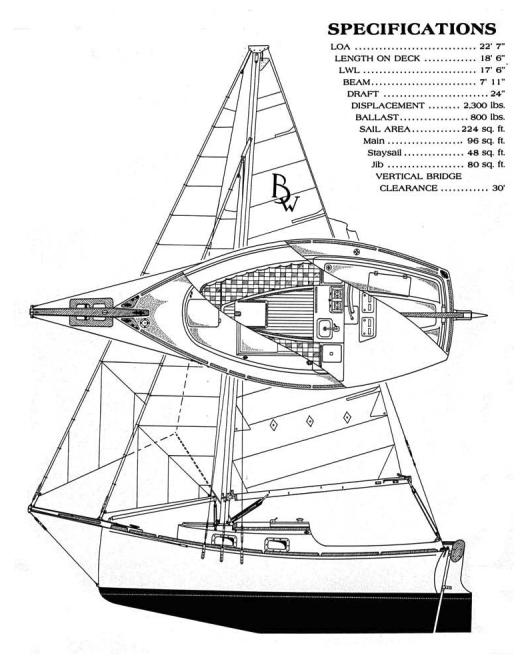
By most standards, the Blackwatch is pretty darned small for a serious cruising boat — a bit over 17 feet on the waterline and around 23 feet overall including a substantial bowsprit. From plumb stem and deeply hollowed bows to graceful, wineglass transom, she looks as though she’s sailed straight out of a bygone era — a junior sister to the fictional Dulcibella from Childers’ famous novel. But the appeal of boats like these goes beyond nostalgia; their “antiquated” hull shapes will often deliver a remarkable blend of seaworthiness and performance. Just consider the globe-girding cruises of the Carrs aboard Curlew, the Pardeys with Seraffyn, or John Guzzwell’s adventures with Trekka. No question, there’s more to these “old-fashioned” designs than meets the eye.
Homespun boatbuilding
The Blackwatch itself has an unusual pedigree. Designer/builder Dave Autry is a West Texan and a printer by trade, who got into the marine biz in 1976 when he started on a sturdy, homebuilt 14-footer that his kids could use safely on the rough, windy expanses of Lake Meredith. Before his cold-molded hull was even finished, several neighbors wanted sisterships, so Dave decided to turn the unfinished hull into a plug, used it to make a mold and started turning out fiberglass BlueWater 14s. These sturdy gaff-rigged cats featured spruce spars, a traditional barn door rudder, a ballasted swing keel, and a large, self-bailing cockpit. Despite their chunky looks, they offered a decent turn of speed and, for a while, were even raced as a local one-design class. A total of 44 were built.
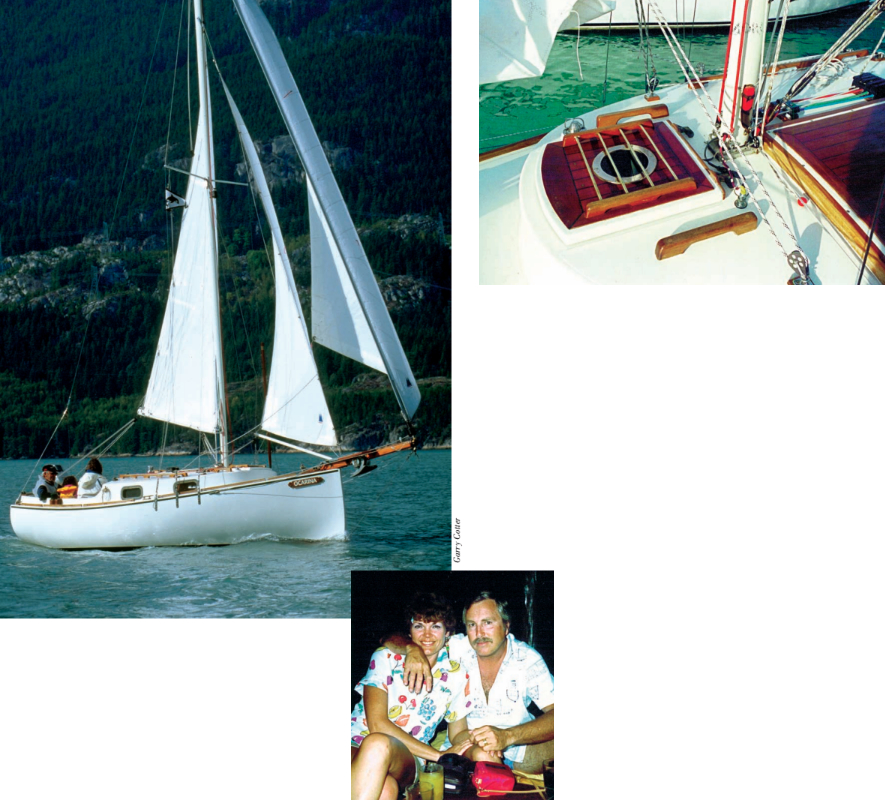
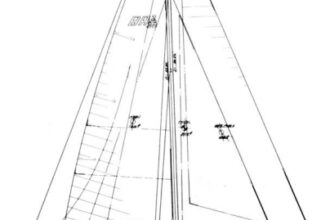
The unexpected success of the BlueWater 14 prompted Autry and his friends to tackle a larger boat. The 18-foot Blackwatch incorporated a long, shallow, fixed keel that extended aft to meet the transom-hung rudder. Some 800 pounds of internal ballast, as well as a 15-gallon freshwater tank, were housed in the keel, yet the overall draft of the boat was only 24 inches. An unstayed cat ketch rig was tested on the first Blackwatch, but all boats were eventually equipped as conventional Marconi cutters, using a conservative single-spreader alloy mast and double lower shrouds.
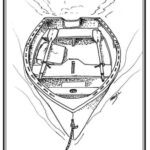
Dave Autry designed his boats in his mind’s eye; no line drawings were ever prepared! The Blackwatch bears a close resemblance to such well-known classics as the Cape Cod Catboats and would not have looked out of place in a Down East harbor back in the 1900s. The plumb bow, round-nosed deck-house and wrap-around cockpit coamings add character and time-tested practical benefits. Lean, concave waterlines toward the bow flair outward amidships to a fairly firm-bilged shape which provides good form stability, then falls away smoothly to a graceful wineglass transom. The maximum beam of 7 feet 11 inches is wide enough to allow for a snug, but livable, cabin without creating sidedecks too narrow to be practical.
Although neither the most spacious, nor the quickest micro-cruiser on the water, the Blackwatch clearly struck a chord with quite a few sailors, mostly in the southern and eastern states. Over a two-year span beginning in 1979, BlueWater Boatworks built 81 Blackwatches, and sold them through a growing network of dealers. Sadly, an economic downturn and serious difficulties obtaining suitable hardware prompted Autry to phase out of boatbuilding in 1981. The last few Blackwatches listed for $15,000 — a fairly steep price back then for such a small boat, but one which reflected the sturdy construction and good quality of the equipment supplied.
A perfect fit
Gerry Cotter knew nothing of Dave Autry and BlueWater Boatworks when he spotted an intriguing photo ad in the classified section of a Los Angeles paper during a trip to California. But he certainly liked the look of the salty, little Blackwatch and immediately contacted the broker for more information.
Gerry grew up boating in Nova Scotia and is something of a nautical history buff who thrives on marine museums, tall ships, and the like. So it’s no surprise that a “pocket classic” like the Blackwatch would appeal to him. But just as importantly, a small, yet “serious” cruiser was exactly the sort of boat that fitted the retirement plans that Gerry and his wife, Joanie, had made for themselves.
Home for the Cotters is the Pacific Northwest — a small town in coastal British Columbia called Squamish, situated at the head of a glacial inlet near the famous Whistler Mountain Ski Resort. Recently retired from demanding careers — air traffic control and physical/occupational therapy, respectively — the two were tackling their retirement with energy and enthusiasm. Gerry and Joanie love boating and have previously owned a range of sailboats ranging from dinghies to a C&C 27.
However, other keen interests occupy much of their time: travel, music, hiking, skiing, and volunteer work as alpine guides. So in contemplating their “ultimate boat,” the Cotters wanted something small enough to trailer and work on at home, yet comfortable and seaworthy enough for serious coastal voyaging.
There was no need to ramp-launch on a regular basis, because convenient wet moorage is available at the Squamish Yacht Club, but the Cotters agreed they didn’t want to become slaves to a large yacht with major maintenance requirements.
Blackwatch hull #73 was up for sale following the death of her owner and surveyed in basically sound condition, although she’d suffered a bit from several years of neglect. The Cotters bought the boat, trailered her home, and set up a boatshop outside the garage of their suburban home. The boat remained there for nearly four years, eventually to emerge transformed, like a butterfly after metamorphosis.
Reconstruction
Gerry freely admits to going “a bit overboard” on the refit, but regards the 3,500-plus hours he and Joanie put into the project as time well spent. Gerry treated work on the little boat as a new and compelling hobby, learning various aspects of the shipwright’s trade as he progressed. Joanie showcased her sewing expertise making new interior cushions, coordinated bedding, cockpit cushions, and portlight curtains. She also constructed new covers for the sails, hatches, and other exterior woodwork, as well as a full cockpit tent that provides standing headroom while at anchor and converts to a Bimini with removable side curtains.
To begin the refit, Gerry stripped out almost every scrap of interior woodwork and prepared to start afresh. The standard Blackwatch incorporates injected foam (for insulation and floatation) between the hull and interior liner as well as under the aft decks and cockpit. The robust single-skin hull and ply-cored deck and cabintop were in excellent condition — no upgrading required. Priority was given to strengthening each potentially weak link in the “rigging chain,” including chainplates, inner forestay tang, bowsprit fittings, and ultimately, a complete new bowsprit. Likewise the spars were upgraded with a stronger gooseneck, toggles throughout, internal halyards, reinforced spreader roots, and a gleaming polyurethane paint job.
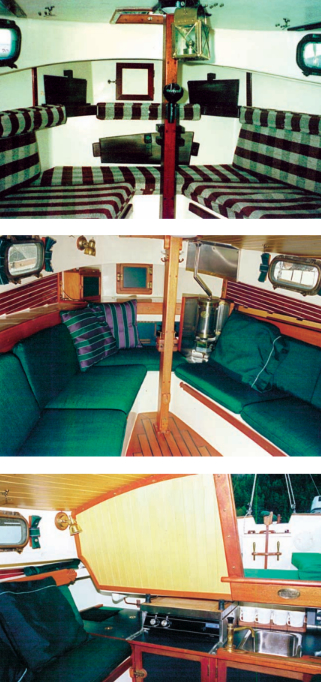
The Blackwatch was completely rewired to high standards, including a new main panel plus a subpanel, lighting, VHF radio, depth sounder, tape deck, and provisions for future additions such as a compact autopilot. New plumbing, too, was part of the refit: a larger stainless steel sink, a brass hand pump with in-line water filter, and a small holding tank to catch drain water from the sink and icebox. The toilet is a basic Porta Potti which slides into a cabinet beneath the sink. There are no potentially vulnerable seacocks; instead, gray water from the holding tank is pumped out through an above-water transom drain.
Cabin heat is essential for off-season cruising in the rainy Northwest, so Gerry fitted a Force 10 propane heater into a small space at the front of the starboard settee. There’s a new, two-burner Force 10 stove on a slide-away mount to starboard of the sink, with a heavily insulated top-loading icebox opposite.
Beneath the cockpit, Gerry squeezed in a custom-built aluminum fuel tank holding 9.9 gallons — enough for a range of about 150 nautical miles, powering at 5 knots with an 8-hp Honda four-stroke outboard. At the back of the cockpit, he installed a propane locker with overboard drainage, complete with planked teak lid and hitching rail with belaying pins for an added nautical touch.
A key stage in the restoration was a complete exterior paint job using Awlgrip two-part polyurethane. This was done prior to the reinstallation of deck hardware, new hatches, etc., but after the new propane locker had been carefully faired into the remainder of the cockpit. The Cotters did most of the laborious preparation — 22 days’ worth — under the watchful eye of professional shipwright Clint Currie, who applied the final spray coats. The result is superb.
The original Blackwatch interior, judging by the Cotter’s “before” photographs, was practical and far from unattractive. It offered settees port and starboard with in-fill cushions to make up a large double berth, a galley module beneath the offset companionway, and a nifty portable table which mounted on the mast compression post. However, the Cotters envisioned something extraordinary and, in the end, achieved it.
The first step was a new cabin sole planked from 3⁄8-inch Honduras mahogany set in epoxy and caulked with polysufide. Gerry actually milled much of his own timber for the interior woodwork, including yellow cedar headliners and rear bulkhead liners, plus mahogany shelving and strip planking to cover the stark fiberglass interior liners. A self-taught, “recreational” woodworker, he clearly delights in this part of the work, putting extra effort into finishing details such as hand-carved feathering at the ends of some joinery. His removable drop-leaf table — a larger, more intricate version of the Autry original — is also a minor work of art.
At the same time, the practical necessities of life aboard a pint-sized boat demand that stowage provisions be a top priority. Gerry has addressed this need by building cabinets, drawers, racks, and cubby holes into every corner of the interior. Many of these stowage spaces are dedicated to particular items. For example, the original bow locker (which once stored the ground tackle) has become a surprisingly capacious hanging locker that accommodates not only garment bags, but bedding, too. The anchor hawse pipe was relocated to the starboard side, allowing 300 feet of nylon rode and chain to occupy a previously under-utilized space. Incidentally, the primary anchor — a 20-pound CQR — might seem like overkill for a boat that displaces less than 1.5 tons, but the northern inlets of British Columbia are known for violent squalls, making good ground tackle a must.
Scrounging for “antique” marine equipment is par for the course when restoring a traditional boat like the Blackwatch. The boat’s bronze cabin portlights were original equipment, but Gerry scored numerous hardware items at nautical swapmeets and bargain stores, including a magnificent round portlight for the new forehatch. For a few items, i.e., the unique double anchor roller, he constructed wood patterns, so a custom fitting could be cast in bronze — again, just part of the fun.
By land or by sea
The Cotter’s “better-than-new” Blackwatch deserved, and got, a new dual-axle road trailer to replace the rather marginal single-axle one that had brought the boat home from California. The rig totals about 3,500 lb and tows easily behind a mid-sized sport utility vehicle. One real virtue of a trailerable cruiser is being able to live aboard while travelling by road — something the Cotters expect to do on some of their jaunts.
Ramp launching is facilitated by a 10-foot telescoping extension on the trailer frame. To raise the mast, Gerry devised a bridle system which attaches to the chainplates for lateral support while the spar is pulled upright using the cockpit winches. A launch or recovery takes several hours — not ideal for a daysail perhaps, but certainly nothing that would discourage road trips to new cruising grounds.
After seeing the numerous additions the Cotters had made, I frankly wondered whether the boat might have gotten just a bit overweight — something that can easily happen with projects of this sort. Gerry was very conscious of this risk during the refit and strove to trim weight at every opportunity — replacing thick plywood components with thinner ones, eliminating some panels, and substituting a single battery for two. By his estimation, he removed 150 pounds and added just 100. I’m not entirely convinced, but the boat appears to float very much as she did in the “before” pictures, and hull shapes like this one are known to carry a few extra pounds with good grace.
There’s no doubt the Blackwatch is a sweet sailing boat. Squamish is an unusually breezy site — popular with the sailboarding crowd — so I had the chance to test the boat in fairly rough water with winds ranging from 10 to 22 knots. In anything much over 12 knots, she goes to windward best under staysail with the Yankee jib rolled up on the furling gear. The little boat felt surprisingly powerful, and it wasn’t difficult to average speeds a bit over 5 knots as measured by GPS.
Interestingly, the Blackwatch also pointed quite respectably, tacking through about 90 degrees and making only modest leeway (as judged by the wake). Folks who swear by deep-fin keels may find this hard to credit, but the fact remains that a long shallow keel can deliver surprising upwind performance provided it’s built with square-cut lower corners rather than rounded ones. It works because a sharp-edged keel promotes eddy formation as water flows diagonally beneath the hull, and the extra turbulence translates into lateral resistance. Classic boat designers, as well as more recent disciples such as Dave Autry, either understood this intuitively or discovered it through trial and error.
Beam reaching under the larger headsail in 15 knots, the little Blackwatch loped along at around 6 knots, attaining a high of 6.4 knots during a short stretch. For a boat with just 18 feet of effective sailing length and a displacement/length ratio over 200, this is excellent performance.
The ride in a 2-foot chop was fairly controlled, and only an occasional dollop of spray reached the cockpit. All in all, I was favorably impressed and concluded that the Blackwatch makes a very capable coastal cruiser. A few owners have reputedly taken their boats offshore, across the Gulf of Mexico and the like. In my opinion, this is pushing the limits, because any boat this short and wide will be vulnerable to wave-induced capsizes. But for someone determined to go bluewater cruising in a really small boat, it would certainly be easy to choose a lot worse.
A worthwhile project?
There are doubtlessly some who will question the wisdom of pouring 3,500 hours and considerable out-of-pocket expense into a middle-aged fiberglass sailboat just 18 feet long. This sort of thinking doesn’t trouble Gerry Cotter; the pleasure he and Joanie have obtained from working on the project and kibitzing with friends about it has easily made these expenditures worthwhile.
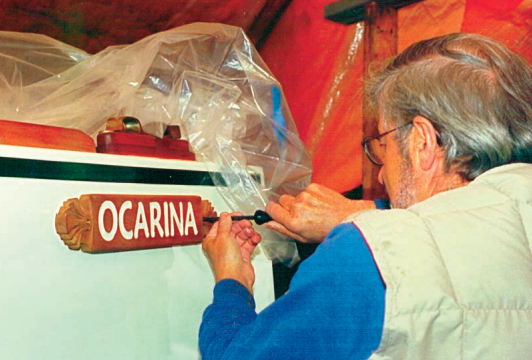
Naturally, a boat this cute is a guaranteed head-turner, and now that the Cotters have started their cruising, the compliments keep rolling in. She’s a good old boat of course, but new enough in so many ways that a name change seemed appropriate. With four years to think about it, the Cotters finally decided to call her Ocarina — the name of a small wind instrument from the Peruvian Andes. For a creative, adventuresome couple who love both the mountains and the sea, it’s difficult to imagine a better choice.
Thank you to Sailrite Enterprises, Inc., for providing free access to back issues of Good Old Boat through intellectual property rights. Sailrite.com