For offshore or coastal cruising, this Mark Ellis design is still popular eight years after the last one rolled off the line
Issue 3 : Nov/Dec 1998

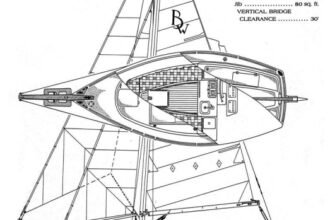
The original Niagara 35 design, the “Mark I Model,” was intended for offshore use. The galley and head are positioned amidships near the companionway ladder. The layout has port and starboard quarter-berths. This non-traditional arrangement allows for two cabins with shared head access and moves the saloon farther forward. The traditional saloon area becomes the second cabin, and the V-berth is optional and usually eliminated, making way for a small workroom or sail storage area at the bow.
Later in the life of the design, Mark Ellis was asked to provide a coastal cruiser version of the 35. Fineen III is the “Encore Model,” with a more traditional layout. This boat has a spacious V-berth, with a head and adjoining shower stall to port. The central passageway through the boat is offset to starboard and lines up with an offset companionway hatch. A catalytic propane heater is mounted on the starboard bulkhead near the settee, and the drop leaf table and a U-shaped galley are in the larger area to port. A nav station is nestled forward of the quarterberth and companionway ladder on the starboard side. The port quarterberth of the “Mark I Model” gives way to a cockpit lazarette in the “Encore Model.” Mark Ellis is also known as the designer of the Nonsuch boats, the Limestone series of deep V-shaped powerboats, the Niagara 42 (but not the smaller Niagara 31 which was designed by German Frers), and the North East 37+ made by Cabo Rico Yachts.
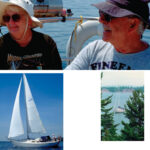
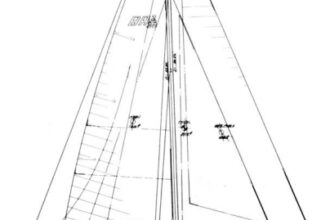
The Niagara 35 has an end-grain balsa-cored hull and deck, modified fin keel, and moderate bow and stern overhangs. The hull has moderate sheer and balanced ends. The J-dimension, at 16 feet, is quite long. This makes even the standard 140-percent genoa a large sail with 360 square feet of sail area. The large J-dimension is enhanced by the novel bowsprit made of robust stainless steel tubes supported by a bobstay. (See photo with Pat on the bow on Page 32.) This unique fitting holds two anchors and provides a forestay mounting place well forward of the hull. The bow hardware is altogether a very robust and sensible arrangement.
The main tackle is sheeted to mid-boom and, instead of having a traveler, two separate mainsheet tackles are mounted to the deckhouse port and starboard. We watched Ken work this system and agreed that it is a good arrangement.
With a roller furler on the bow, Ken and Pat are able to set, strike, and reef sails — all from the cockpit with a minimum of fuss. While at anchor during our day with the O’Driscolls, Ken identified a rapidly building storm cloud. He predicted that within a short time the storm would reach us, and decided to get under way. Pat raised the anchor and, without leaving the cockpit, Ken had the main up and reefed in less than a minute.
The boat is rigged with rod rigging and single spreaders. Ken says he uses a 100-percent genoa in spring and fall and the 140-percent genoa for their summers and cruising vacations. Fineen III carries enough sail to move well in light air. At our request, the O’Driscolls put us out in their inflatable dinghy to get some photos of the Niagara 35 under sail. Winds of 5-7 knots kept the sailboat moving so briskly that we ran the dinghy’s 3-hp motor full out in order to stay up with them. Several times we were unable to catch them at all.
Fineen III easily makes 6 knots under power with the Universal M35D 35-hp four-cylinder diesel. Engine power is transmitted via a V-drive in an arrangement whereby the propeller shaft passes underneath the engine and is connected to a transmission coupling forward of the engine and transmission. This arrangement has not been entirely trouble free, according to the O’Driscolls. The propeller shaft is connected to the coupling with a keyway and set screw. Ken says he lost two keys into the bilge when the set screw sheared while in the North Channel. A new coupling that doesn’t rely on set screws, plus clamping the key in the propeller shaft with a hose clamp, has solved that problem.
Good access is provided to the engine and transmission by tipping the entire galley sink and cabinet console forward into the cabin.
The boat has good soundproofing, but while Fineen III’s engine is quiet, a great deal of vibration is transmitted through the hull for a four-cylinder engine.
In summary, the Niagara 35 is a comfortable, sensible boat with a good balance of features for coastal cruising. It can be sailed by two persons, and it reinforces the high opinion we have of Mark Ellis and Canadian sailboat builders. It fits with the O’Driscolls’ philosophy of sailing.
Thank you to Sailrite Enterprises, Inc., for providing free access to back issues of Good Old Boat through intellectual property rights. Sailrite.com