Does the “new” form of reefing, the reefing/furling unit, make more sense? These systems have certainly been one of the most successful “fix-all” products
Issue 3 : Nov/Dec 1998
Cruisers are always looking for ideas which will make sailing easier, and there are a multitude of products on the market to do just that. It is interesting how often we lose sight of simple solutions when a new “fix-all” product hits the market. For instance, today when we want to reduce headsail size, we automatically think of using an elaborate reefing/furling unit instead of simply installing a line of reefs in the sail. Let’s compare the merits of both methods.
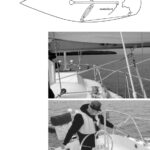
The simple solution to reducing headsail size is to add a line of reefing points. Reefing points are grommets spaced about 12 to 30 inches apart on a line roughly parallel to the sail’s foot edge. The row of grommets is placed high enough to remove from 15 to 25 percent of the overall sail area. To reduce sail area, the foot of the sail is rolled and tied, and the grommet holes are used to secure the roll.
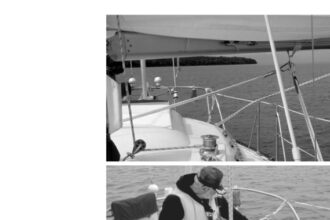
This is not unlike reefing a mainsail. In fact, the installation and use of reef points in a main and headsail are practically the same. The one notable difference is that with a mainsail, the boom can be used to attach blocks and cleats to allow for single or dual line reefing which can usually be accomplished from a cockpit location. With a headsail, the foot must either be tied up before bending the sail on or the headsail must be lowered and shortened under sail. The difficulty of the latter method is in direct correlation with wind and sea conditions. Weather conditions may require several trips to the foredeck to set or shake out the reef.
In addition, this form of manual reefing does not look too good and, when you’re done sailing, the sail must be lowered and bagged to protect it from ultraviolet and wind damage.
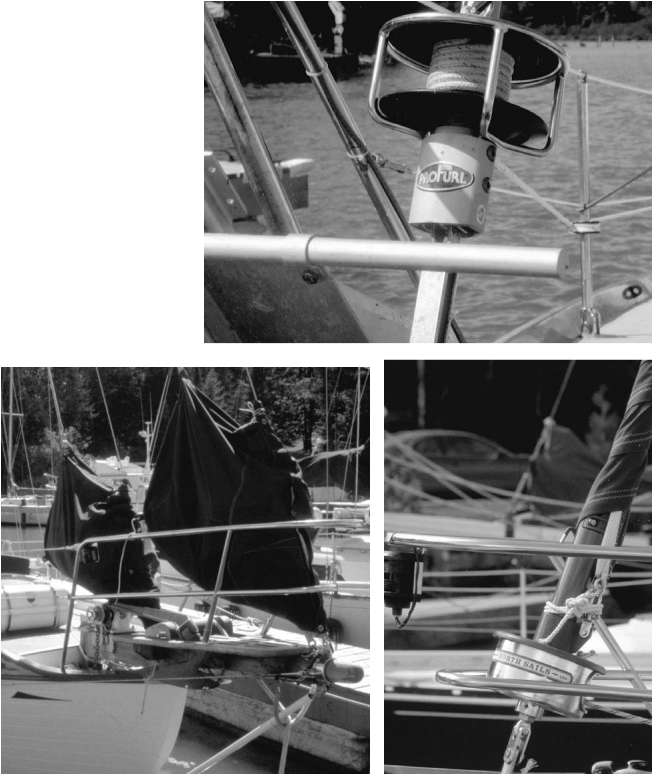
So does the “new” form of reefing, the reefing/furling unit, make more sense? Reefing/furling systems feature an extrusion to which the sail is attached. The extrusion is made from a plastic or aluminum tube that has a small slot on the aft edge into which a taped rope, placed on the forward edge of the sail, is fed. There are no hanks on the sail’s edge, just this small line that feeds into the slot. Once fed into the slot, the reefing/furling unit is made to roll causing the sail to wrap or roll up.
These systems are certainly popular. From a reefing standpoint the amount of sail reduction is variable and easily accomplished from the safety of the cockpit. And it is neat: nothing can come loose to flap in the wind. At the end of the day the entire sail can be rolled onto the headstay and stored that way, as long as the leech and the foot have been protected with a sacrificial cover.
Reefing/furling units sound great but they do have some disadvantages. The wraps taken in reefing tend to “bulk up” (because of hems and patches) at the top and the bottom of the extrusion and, thus, the sail becomes fuller in the middle (the opposite of what is desired).
Several methods of improving this situation are promoted. One of these is adding a foam luff (essentially a pad of foam along the luff in the middle part of the sail). A foam luff helps to “bulk up” and decrease the fullness in the middle of the sail. But it adds cost and its effect varies depending on how much the sail is furled. Even when the sail is not reefed, boat performance may be affected since sail designers tend to make furling sails flatter than normal in order to help the sail roll onto the extrusion without creases. And a furling sacrificial cover adds a good deal of weight to the sail, making it less effective in light air.
Other issues to consider have to do with the use of the reefing/furling unit itself. These units are complicated by comparison to the standard wire and hank arrangement. Maintenance can be an issue. Some systems require lubrication and replacement of ball bearings from time to time. The reefing/furling systems can make trailering more difficult for smaller boats and yearly mast stepping and unstepping more complicated for larger boats.
The units are also expensive. The price range for a 30-foot boat can be from $600 to $2,000. And in most cases, furling line and deck hardware must be purchased and installed.
Cost considerations include more than the reefing/furling unit itself. Any sail to be used on the unit must have that small taped rope edge installed. If the boat has an extensive headsail inventory and all will be used, they must all be modified.
The process is further complicated if each sail is also to have a sacrificial cover to protect the exposed sail edges when the sail is fully rolled. These conversions are expensive and add weight to the sails. An average sail conversion for a 30-foot boat will run around $375.
Costs are low with simple headsail reefing points. Adding reefs to an existing headsail can cost as little as $40. And there is no cost in making the boat ready for use of the newly modified sail.
Sail versatility is maintained. Indeed a sail with one or more rows of reefing points can be thought of as a replacement for two or more sails. And all headsails in the boat’s inventory can still be used since no rigging modifications have been made (of course they cannot be reefed unless reef points are added).
But, perhaps the biggest advantage of the simple headsail reef is that the intended shape of the sail need not be compromised. The sail can be designed for its best performance instead of flattening it to allow for roller reefing.
There is no really right or wrong way to go. The issue is what makes the most sense on each individual boat. The reefing/furling unit certainly does a lot to make sailing easier and safer, but if reefing and sail performance are the primary concerns, take a second look at the downsides. Often a simple, elegant, and inexpensive row of reefing points is the perfect solution to reefing a headsail.
Thank you to Sailrite Enterprises, Inc., for providing free access to back issues of Good Old Boat through intellectual property rights. Sailrite.com