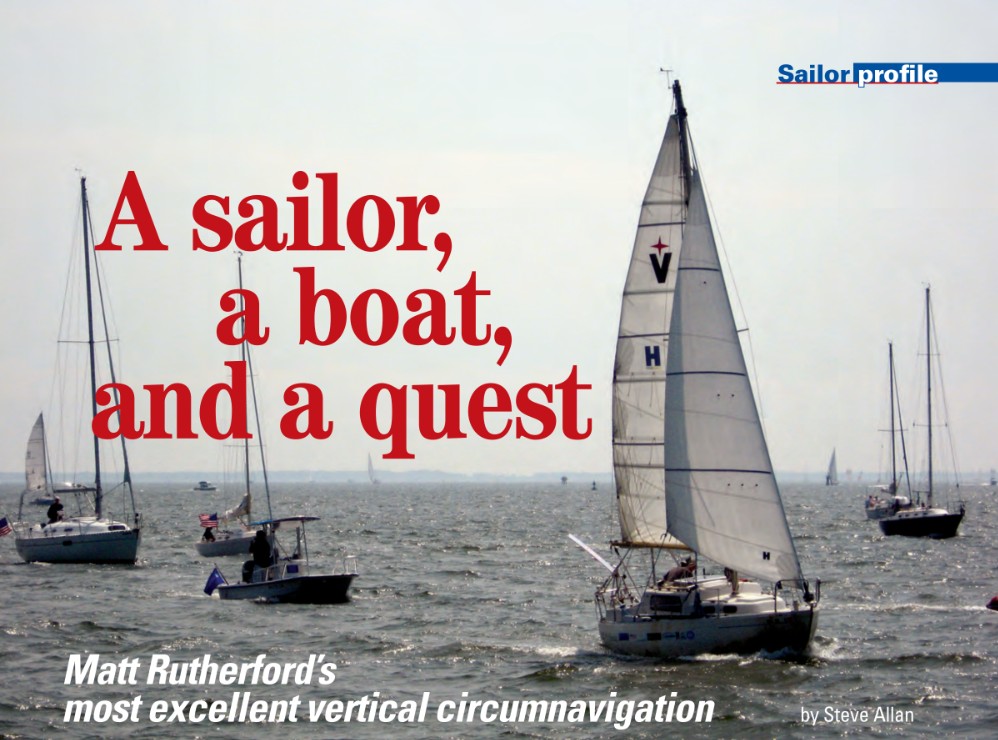
Matt Rutherford’s most excellent vertical circumnavigation
Issue 86: Sept/Oct 2012
The last three weeks were the worst — cold air, boarding seas, and stubborn winds on the nose. He was in a beat-up boat, the engine dead for the last 7,000 miles, and in a battle against 35-knot winds before he could put astern the notorious maritime graveyard that is Cape Hatteras. Then, incredibly, Chesapeake Bay wouldn’t let him in, pushing him with a foul current and a strong northerly 16 miles back out to sea.
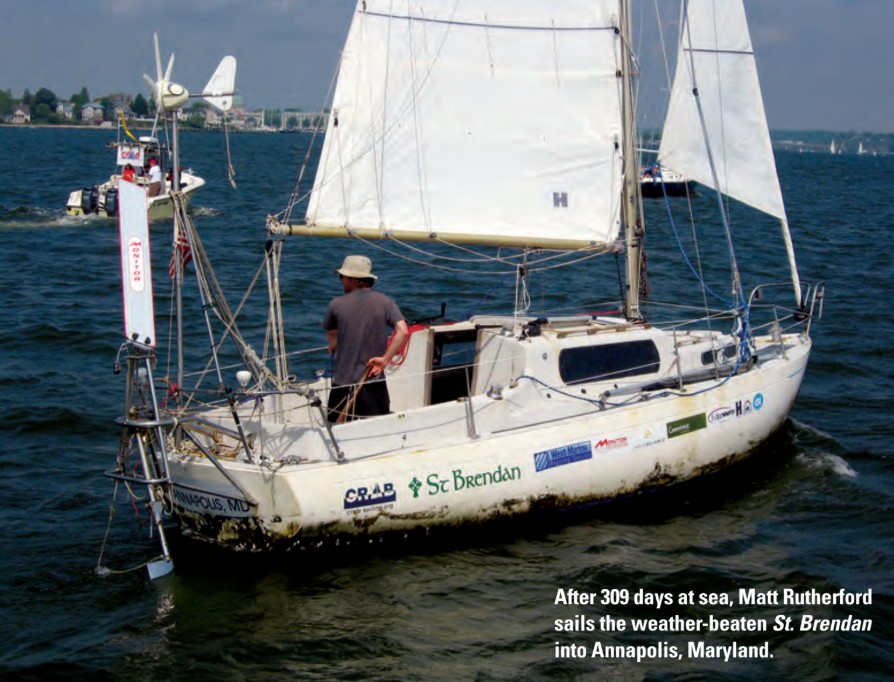
Finally, Matt Rutherford crossed his outbound track and the voyage, as far as he was concerned, was a success. A few days later, as the band played “It’s a Small World After All,” in Annapolis, Maryland, on a sunny afternoon in April, 31-year-old Matt stepped off the boat for the first time in 309 days after sailing nonstop for 27,000 miles. He was greeted by a media horde, a crowd of dignitaries, well-wishers, and family. Also present were some of sailing’s brightest stars, including Gary Jobson, president of US Sailing, who emceed the welcoming ceremonies near the National Sailing Hall of Fame.
As the media boat drew alongside Matt’s St. Brendan, several of us commented, “The sails look terrific!” No patches, tears, or even major stains were apparent. The #3 jib looked whiter than the main, suggesting that it had perhaps spent a lot of time furled or stowed. Matt would later say simply that he sailed conservatively. He never equaled his best day’s run of 164 miles, helped along by South America’s Guiana Current, but he wasn’t trying to top that. “I’m not into going fast,” he says. “I don’t want to break anything.”
This is good advice for all of us. A veteran of boat deliveries, Matt is the guy you want looking after old Serendipity on her return trip from the Caribbean in the spring. “I’m a defensive sailor,” he says. Cruisers are, or should be, defensive sailors. Out of necessity and for self-preservation, Matt Rutherford had to be.
An extraordinary feat
To report that Matt had successfully transited the Northwest Passage on the smallest singlehanded boat to date would be story enough. But he did it in a good old fiberglass production boat, a donated 41-year-old Albin Vega 27. But that’s not all. After he was done with the passage and cleared Alaska, Matt kept going back to Annapolis . . . via Cape Horn. One more thing: he did it nonstop. According to the way the rules are written by the U.S. State Department, St. Brendan circumnavigated the Americas but never left the jurisdiction of the United States because Matt didn’t make port, didn’t drop anchor, and didn’t clear into any country along the way.
He did, however, slow down for three critical resupply efforts along the way. The first was off Newfoundland when his watermaker broke. The next was in Alaska’s Aleutian Islands, where he received a water purifier, stove fuel, pizza, and beer. The final resupply contact was off the coast of Brazil, where he took on new solar panels, a hand-held VHF, a hand crank for the engine, fuel, water, and grog. For the integrity of the quest, Matt made each contact without dropping anchor, making fast, or letting anyone board St. Brendan. Nor did he disembark at any point of the voyage.
If you can forgive modern communications technology, advances in food preservation, and a shore-based support team, Matt Rutherford is a true adventurer of the old-school spirit, who might belong now with Joshua Slocum, Howard Blackburn, and Sir Francis Chichester among singlehanders, and perhaps with Ernest Shackleton and Captain William Bligh among fearless and gifted sailor-adventurers. Even before this solo around the Americas, Matt had racked up a salty resume that included singlehanded Atlantic crossings, braving the Bay of Biscay, running down the coast of Africa, and a Caribbean shipwreck during a hurricane.
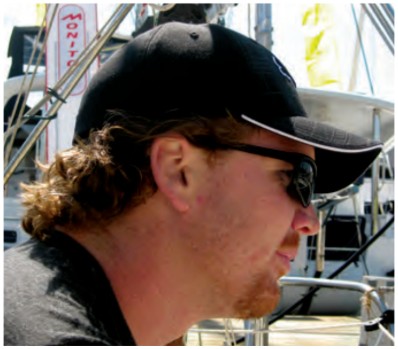
Most important is what motivated him to undertake this voyage in the first place. Through it all, Matt never forgot that his quest wasn’t about him. It was about raising money and awareness for Chesapeake Region Accessible Boating (CRAB), founded in 1991 by Don Backe after he was paralyzed in a devastating car accident. CRAB provides opportunities for the disabled to go sailing, but the organization was experiencing a decline in funding and Don has been trying to keep it afloat. Matt, who had been drawn to CRAB as a volunteer, suggested transiting the Northwest Passage as a way to raise money. The rest, as the saying goes, is history.
A few close calls
To hear him tell it, none of what Matt did seemed particularly extreme. On the other hand, at no point was his voyage a pleasure cruise. Approaching the U.S. coast meant being in the shipping lanes and, with foul weather, too, Matt says he didn’t sleep for a week. Neither did he sleep while transiting the Northwest Passage, knowing as he did that ice and fiberglass are not compatible. In spite of his vigilance, he says a huge berg almost got him in Baffin Bay.
Once he was safely through the Northwest Passage, and following his on-the-water resupply contact in Alaska, Cape Horn lay at the end of the long Pacific leg. It was during this longest of passages that St. Brendan’s mast finally exacted revenge on the boat’s weakest link. The bulkhead shifted, the oak compression arch sank from above, and a splintered warp appeared on the deck just to starboard of the mast step. For the rest of the trip, Matt feared dismasting. Since it wouldn’t take much more to bring the rig down, conservative sailing became a necessity for the survival of the boat and the success of the voyage.
Approaching the Horn was nerve-wracking, but the passage itself was relatively calm and uneventful. Off French Guyana, a freighter passed so close he could only see its red and green running lights on a collision course. With only a moment to spare, he untied the tiller and threw it hard-a-starboard just in time for the bow wave to smack St. Brendan clear before the black hull disappeared unaware into the night. And finally, there was the dirty weather off the Carolinas while beating to windward toward home.
The boat
At the risk of encouraging 16-year-olds to scour the Internet for used Albin Vegas and to then put to sea with caution thrown to the wind, it must be said that Matt had himself a particularly solid little boat in St. Brendan. Vegas are cherished by their owners, the more fanatical among them saying they wouldn’t trust any other boat at sea. During his voyage, Matt was cheered on by many stalwart fans ashore, but none keener than members of the Vega Association of Great Britain.
Ray Steele, the organization’s technical officer, had this to say: “We Vega owners are all thrilled with what Matt has achieved in the class of boat that we love and sail. We are sure he will gain the recognition he deserves and, without detracting from the real star of this event, give the Albin Vega its deserved acceptance as a true classic that will help to inspire confidence to present and future owners.”
A seagoing Checker cab
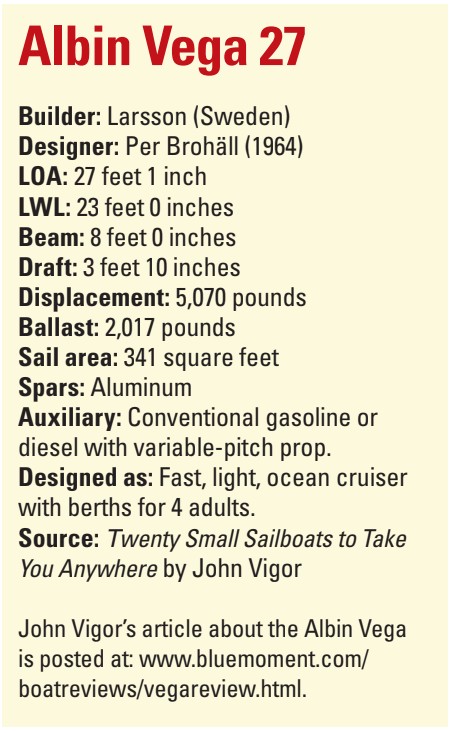
On the face of it, St. Brendan isn’t much bigger than my sheltered-water Laguna 26 sloop. A foot and a half more on the waterline, 9 more inches of draft, 4 inches less of beam . . . but 1,000 more pounds of displacement. My Laguna is finished nicely with lots of teak trim and standing headroom. But, as when comparing a Chevy Corvair to a Checker cab, that’s where the comparison ends.
Albin Vegas are bulletproof, tough little boats built to withstand punishing conditions, and Matt agrees. A Vega wasn’t his first choice for the voyage but, once this one fell into the hands of CRAB, it didn’t take much to convince him that this boat would, given limited resources and not much time to prepare or raise money, deliver him safely back to Annapolis.
Upgrades
Once Matt and Karl Guerra, CRAB’s fleet master, settled on the Vega, they set to work readying the boat for whatever the sea might throw at it. Extensive research brought a couple of known design shortcomings to their attention. They covered the big ports, potentially dangerous at sea, with Lexan panels that they through-bolted and then cemented for an extra measure of safety. They hoped to remedy the compression-point deficiency by sistering a hefty oak brace to the bulkhead athwartships beneath the mast and through-bolting it, in the hope of absorbing some of the downward thrust of the rig at this critical point where one would normally find a compression post. Curiously, the Vega, for all its salty pedigree, lacks this important design feature.
They beefed up the standing rigging and turnbuckles by one size larger than stock and changed out all the running rigging. They installed an LED bulb in the tricolor masthead light. A new suit of sails included a 150 percent genoa, an asymmetrical spinnaker, a #3 jib, and a full-battened main with two sets of reef points.
In addition, they fastened solar panels to the foredeck and installed a Harken Mk III roller furler. A Monitor windvane and a chartplotter were the only other obvious upgrades. With all this accomplished in about a month, Matt was ready to go. He took on 700 pounds of freeze-dried food and a 200-gallon bladder full of diesel fuel. This combination lowered St. Brendan’s waterline considerably. The diesel fuel alone added more than 1,400 pounds, but the extra weight was necessary to ensure enough fuel to transit the Northwest Passage should the winds be unfavorable. Casting off with little fanfare in June 2011, St. Brendan wallowed heavily out of Annapolis, cleared the Virginia Capes, and headed north to the Arctic.
Ten months later
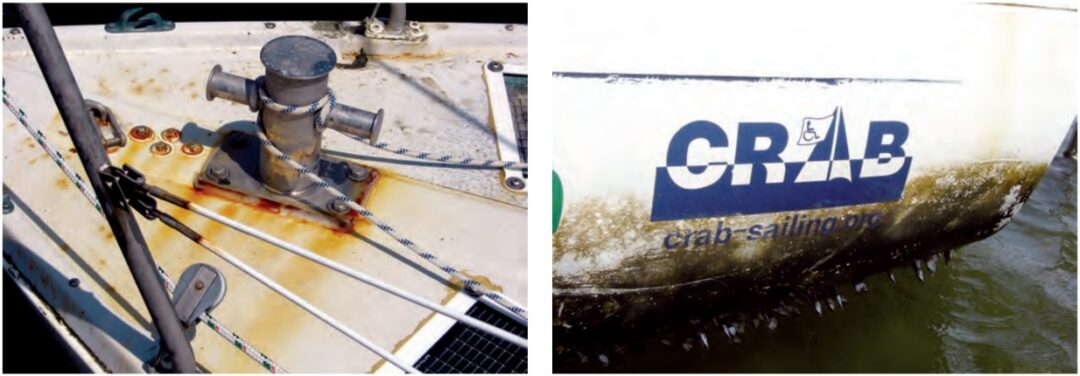
Easily the gnarliest boat in Annapolis’ famed Ego Alley, St. Brendan was, I thought, the star of the inaugural Annapolis Spring Sailboat Show. People gawked at her rust-stained deck fittings, her beard of slime at the bow, and a healthy colony of probably the biggest barnacles ever to disgrace a boat show at her stern. Matt, standing in the cockpit that had provided his only standing headroom for 10 months, answered any and all questions thrown his way.
But on closer inspection, the adventure became even more awe-inspiring. Taking care not to intrude in what had been Matt’s home for 10 months, I was struck by how spare and spartan St. Brendan was, even for a 1960s production boat.
What went wrong
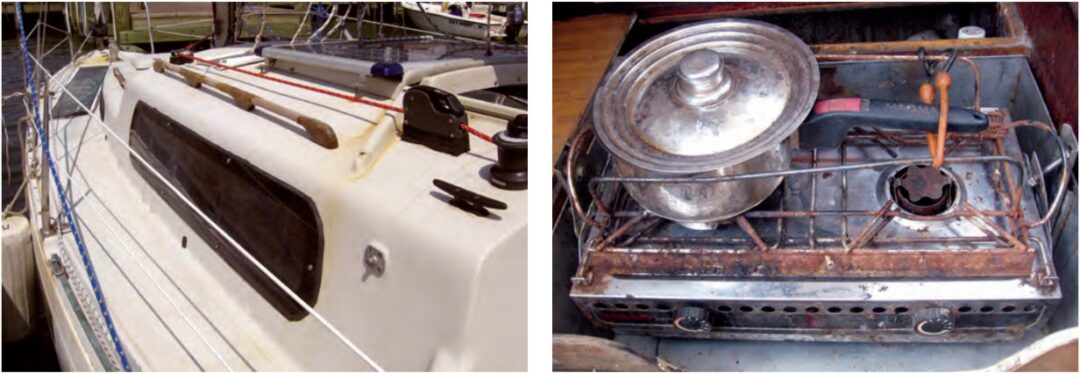
Just a week after landfall, the cabin was still dank and smelled of the sea. With no opening ports and a forward hatch dogged shut, airflow had to have been an issue. Matt pointed to the small plates on the deck where ventilators had once stood: “I covered them over,” he said. “Ventilators always leak.” Perhaps, but without ventilation, black mold blanketed everything during his Arctic leg. His books, his clothes . . . nothing escaped the mold. As a result, everything metal rusted, including the stove and his shotgun.
Aside from compression problems under the mast and the failed starter that disabled the engine for the final 7,000 miles, leaks were a constant annoyance. The bolts in the hull-to-deck joint leaked. After a transducer started leaking somewhere along the way, several gallons of seawater accumulated in the bilge every 24 hours. Lesser sailors would have hit alarm buttons with these setbacks, but Matt took it all in stride. He was, by his own admission (and that of people who know him), a determined man on a mission.
What went right
Matt says the hull was fine, the Hyde sails “still crispy,” the Monitor windvane still going strong, and Matt swears by the Harken Mk III furler. Even the Volvo 2002 engine, before the starter packed up, “ran like a champ,” he says. (It wasn’t the one with the troublesome variable-pitch prop, so no worries there.) When asked what he might say to designer Per Brohäll (who died in 1989), Matt said he’d buy him a beer.
Once the voyage was completed, Matt didn’t confess to having developed a special bond with St. Brendan. The Albin Vega did the job and now its business is done, except as a tangible and now-famous centerpiece for CRAB’s ongoing efforts to raise the money to meet Matt’s goal of $250,000. (At press time, about $175,000 had been raised.) Contact CRAB for further information about donations or to add yours.
Don’t try this at home
Few among the rest of us breathe the same air as Matt Rutherford. Most of us shouldn’t even think about undertaking such a voyage. Speaking for myself at least, sailing on home waters is excitement enough. Coming across the Chesapeake Bay in a thunderstorm and telling about it is worthy of much satisfaction and back-slapping on the docks. But what do you ask of a sailing legend who has conquered the Northwest Passage and rounded Cape Horn?
“I sail boats. It’s what I do,” Matt responded, but upon reflection added that he would possibly venture “back to the Arctic, after I write a book.”
He won’t be making his next voyage aboard St. Brendan. That boat had one purpose, one mission, one job. It will likely be sold after it is displayed in the Annapolis sailboat show in October. Chances are good, however, that another good old boat will fill the bill for Matt Rutherford’s next great adventure.
Steve Allan sails Annie’s Rose, a good old Laguna 26 sloop, out of Frog Mortar Creek on the upper Chesapeake Bay. He writes about sailing, culture, and history on the bay and the Great Lakes. A native of Toronto, he lives in Baltimore.
Thank you to Sailrite Enterprises, Inc., for providing free access to back issues of Good Old Boat through intellectual property rights. Sailrite.com