A captain of fantasy puts to sea at last
Issue 80 : Sept/Oct 2011
In the summer of 2007, I would not have been able to tell you the difference between a bowline and a reef knot. Flash forward one year and I had tied my share of both knots while sailing about 1,800 miles in a 20-foot auxiliary inboard from Florida to my home port, about 50 miles shy of the Canadian border on Lake Champlain in Vermont.
Along the passage, I experienced my share of issues: fresh gales and hailstorms, seas that wanted to swallow the bow, groundings, dragging anchors, fuel leaks, engine failures, electrical problems, swimming sails, and even a galley fire. I found myself approaching a late-night anchoring routine when the transmission cable unexpectedly snapped and my boat throttled forward, edging dangerously close to a rocky shore and other anchored cruisers. I spent a few anxious moments one hazy afternoon frantically removing my autopilot (it was the first time I employed it) to avoid being crushed by the bow of a freighter that had suddenly turned hard to starboard and was blasting its horn in a Delaware Bay shipping channel.
But if you asked me then or now, I would do it all again in a heartbeat . . . not just for those rare crossings of large bays under full main and jib at a steady 6 knots, nor for those profound sunsets or the soft sway of marshes at dawn, nor for those canals and inlets brimming with life . . . but rather for all the little and no-so-little problems as well.
A lifelong dream
Since I was a boy, I had dreamed of owning a sailboat, of setting off across the oceans of the world, of palm-fringed lagoons, and of leisurely nights drinking rum with expatriate poets and girls lifted from Gauguin oils. For years, I satisfied my water passions with canoes, sea kayaks, and camping gear. Still, I knew that not one of the various kayaks I had paddled over two decades, however seaworthy, could get me to those distant shores without an accompanying ticket on an airplane or an ocean liner.
For the better part of five years, I devoured books about cruising boats, about living aboard, about surviving storms and pirates, and about the peculiarities of dealing with customs officials and harbormasters. I surfed the Internet and pored over dozens of magazines filled with information about sailing and sailboats, reading reviews and articles advising first this and then that.
The more I read, the more contradictions I encountered. Every type of rig, keel, engine, electronic device, paint, and polish ever invented had its advocates and detractors, often in equal number and with equally convincing arguments. It was enough to make a dreamer throw his hands up and look for a cozy cabin by a mountain stream.
While living in Vermont, I had already built that cozy cabin in the woods — I am sitting in it right now glancing at a river swollen with rain as I write this article — but something about sailing, about coastal inlets and open horizons kept calling me. Among all the lines I read, one phrase had rooted deeply in my mind: “Go small, go simple, go now.”
Like many other captains of fantasy, I went to a lot of boat shows. In Boston, New York, Maine, and Annapolis I drooled over craft I would never be able to afford on a public college professor’s pay. The reality is that my job affords months of unstructured time per year — far more than most American workers — but between a Civil War era house (read: constant repairs), kids in college, an aging parent, and aging cars, that lovely Gozzard, classic Hinckley, or fine Morris would always be one lottery ticket away. My boat would have to be small and simple, and affordable.
The philosophy of small
It was not just price and the lower long-term upkeep costs that attracted me to pocket cruisers, there was also an aesthetic and philosophical aspect. In my fantasy, a cruising sailboat would be the modern floating equivalent of Thoreau’s cabin on Walden Pond, not a fashionably overdressed condominium on pontoons. It would be a place to contemplate the world by wind speed and current flow, a place where my imagination could take flight by the glow of an oil lamp while I enjoyed the comforts of an uncomplicated berth. And it would be a place where my body would age by growing stronger and more agile with the tasks of tending tiller, sail, and anchor.
The more I read, the more I surfed the Internet, and the more I went to boat shows and drove around boatyards, the more convinced I was about small, simple, and now . . . especially the “now.”
Fortunately, my spouse, Dawn, shared much of my enthusiasm for this venture. She had already spent several months traveling around the world teaching for Semester at Sea, and she yearned for more adventures. Much of our pillow-talk revolved around selling the house, buying a true liveaboard cruiser after the kids finish college, taking early retirement, and setting off for — well — wherever we so desire.
As good as this plan was on paper, there was a problem: neither of us knew how to sail. Well, I had been on sailboats, my father’s (bought when I was already an adult living several states away) and a few times as crew (read: passenger) with friends, but I had never even raised a sail on my own. It was all just talk; good talk, but fantasy talk nontheless. I felt a little like a boy in high school boasting in the locker room with the voice of false experience.
Since we are both in our 50s and have long hoped to set off while we are still young enough to handle the day-to-day tasks and problems of cruising, it was time to get a start on this dream. We assessed our finances to see what we could change in our lifestyle in order to afford a good seaworthy pocket cruiser and began our real search for a boat during the summer of 2007.
Drawn to the Flicka
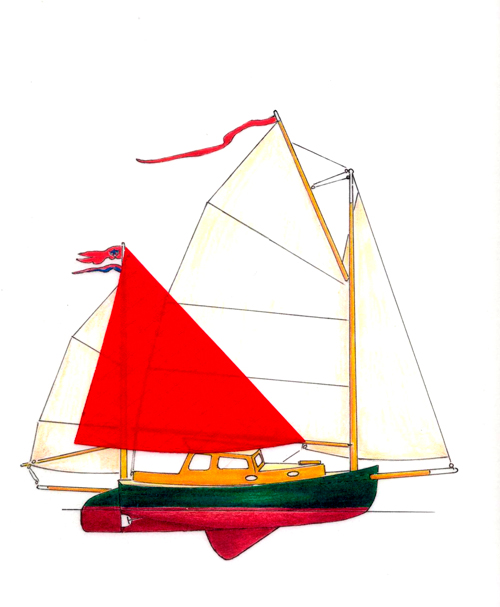
A number of years earlier, I had read an article about a boat purchased by folk singer Burl Ives. He had sold his larger boat and purchased a little Pacific Seacraft Flicka. The boat is only 20 feet long, but people had crossed oceans in these craft and a number of people even lived aboard for long periods of time. I had fallen for the boat when I first read about it and saw the pictures. The research I did on the Internet convinced me this was the boat of my dreams. Granted, I’d never actually been aboard one.
Although I did not discount other small cruising sailboats, the Flicka became a passion. I knew this was a cult boat and priced well above most other boats of its size, class, and age, but that did not give me pause. I watched the Flicka websitereligiously for boats coming on the market, occasionally communicating with the sellers via email.
Attracted by a price that seemed below the market price, I drove to Maine and finally stepped aboard my first Flicka at her harbor mooring in early fall 2007. Though this boat was not in the best of condition — it would need substantial work, including major engine work — Dawn and I agreed that the Flicka design exceeded our expectations and felt “right.” We spent the next few months looking at Flickas, some of which were priced well above our planned budget. We convinced ourselves that we could afford more, especially if we waited another year or two to buy one.
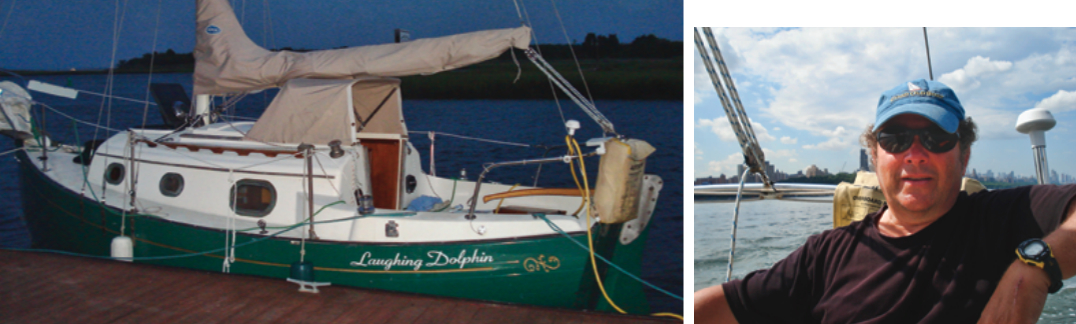
There’s an old saying that good things come to people who wait, but sometimes not waiting can be a good thing. In November 2007, a Flicka came on the market at a price within our range. The owner — a professional delivery skipper — had recently restored the boat and was sailing it from Maine to Florida, so we assumed it was seaworthy. Personal circumstances had forced him to price the boat low for a quick sale. By December, the boat was docked just a town away from where my then 80-year-old mother lived in Florida. After a couple of phone conversations with the owner and some emailed pictures, Dawn and I flew down to take a look at the little green boat. I was armed with Don Casey’s book on inspecting aging sailboats and several pounds of literature on the Flicka. If the boat turned out to be more of a project than we were looking for, I rationalized that we would, at least, simply have made a long-overdue family visit.
Love at first sight
Almost as soon as we stepped aboard Laughing Dolphin, we knew we had found our boat. She had the enclosed-head layout we preferred, the interior teak was well restored, the inboard diesel was clean and sound, the sails and rigging were in good shape, and we were assured her bottom was blister free and freshly painted. Although some cosmetic work was in order, she was as near perfect for the price as we were likely to find.
A few days later, after an easygoing telephone negotiation with the owner (then off in Mexico delivering a 50-foot Beneteau), I arranged for a professional marine survey. The boat checked out as “above average.” Within a matter of days, we became the proud owners of s/v Laughing Dolphin, a 1982 Pacific Seacraft Flicka, hull #218.
We took a few moments to toast our new boat and then reality hit us: how would we get her back to Vermont? I assumed we would hire a boat hauler. I got several estimates, but all amounted to a third or more of the price we had paid for the boat. Actually, that was probably reasonable, given fuel costs and the three-ton-plus heft of the Flicka. We considered buying a trailer, but the cost was also about one third our purchase price for the boat and would require us to rent a sizeable vehicle (my Mini Cooper was hardly up to the task). Add in the fuel costs and tolls, and we were getting into substantial cash to tow her home ourselves.
At some moment along the way, I started thinking about just putting the boat on the hard for a few months and coming down in May at the end of the semester to sail her to Vermont via the Intracoastal Waterway, the Hudson River, and Lake Champlain Canal system. With Dawn’s encouragement, I went from thinking about it to seriously planning it, even though my lack of sailing experience made the possibility seem daunting.
An education begins
Experience be damned, I was committed (some of my friends and family certainly thought I should have been committed). I returned to Florida during my spring break, dry-docked Laughing Dolphin, and took a one-week ASA course in basic keelboat sailing and coastal cruising at the Chapman School of Seamanship. By the end of the week, I was more convinced then ever that I could, indeed, sail our boat to Vermont.
Sure, I was a novice, but I was a quick learner. Sure, I would have to teach my video-game-addicted son, who would crew with me from Florida to New York City, how to handle a boat in the real world. And sure, I would need to find a way to instruct and assign duties to my often headstrong wife, who would crew the final week of the journey north from New York City, without risking a marital mutiny. Ah, but it would all be one grand adventure.
And indeed an adventure it was, one in which the stuff of dreams met the reality of salt spray, the vagaries of too much or too little wind, the numbing hum of the diesel, the draining of the bank account, and the rise and fall of both the crew’s and the skipper’s spirits — and yet the dream managed to stay afloat and perhaps even surface stronger than ever.
I’ve always felt that the true sign of maturity is when you realize how little you really know, how much you have to learn, and how long it will take you. Well, I knew then, and still believe, that I have only scratched the surface of what I need to know to call myself “captain” with real confidence and authority. That is as it should be. I also know there is little substitute for experience, but sometimes you need to swallow your fears, face the horizon, and raise the sail.
When Roy Vestrich is not sailing and otherwise exploring the world, he teaches film studies and scriptwriting at Castleton State College in Vermont. In the summer of 2010, he and his wife, Dawn Saunders, cruised their Flicka from Vermont to New Bern, North Carolina. Sadly, a gale-force squall, a dragging anchor, and a derelict bridge conspired to cut short their winter 2011 cruise in the Florida Keys. And that’s another story.
Thank you to Sailrite Enterprises, Inc., for providing free access to back issues of Good Old Boat through intellectual property rights. Sailrite.com