A homemade sentinel is cheap reassurance
Issue 80 : Sept/Oct 2011
Anchoring is a lot like sailing: 95 percent relaxing and fun and 5 percent hassle, if not outright terror. At the end of the summer, the pleasant anchorages may blur together, but the nightmare anchorages never fade entirely away.
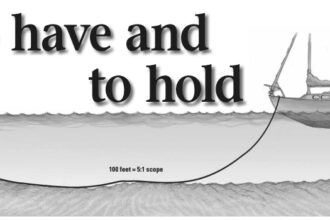
We’ve had our share of anchoring problems on Catamount, our Caliber 38. We carry a big anchor (44-pound Bruce) and all-chain rode (120 feet of 5⁄16-inch chain), but few things make us feel more secure than when we add our 16-pound kellet (or sentinel) to the ground tackle.
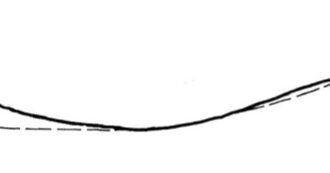
Forget about vectors and catenary curves. Here’s all you need to know about a kellet: 16 pounds of lead in one spot is about the same weight as 20 feet of chain. When our chain starts to lift in strong winds, the fi rst thing to absorb energy is the weight of the kellet.
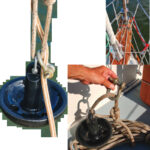
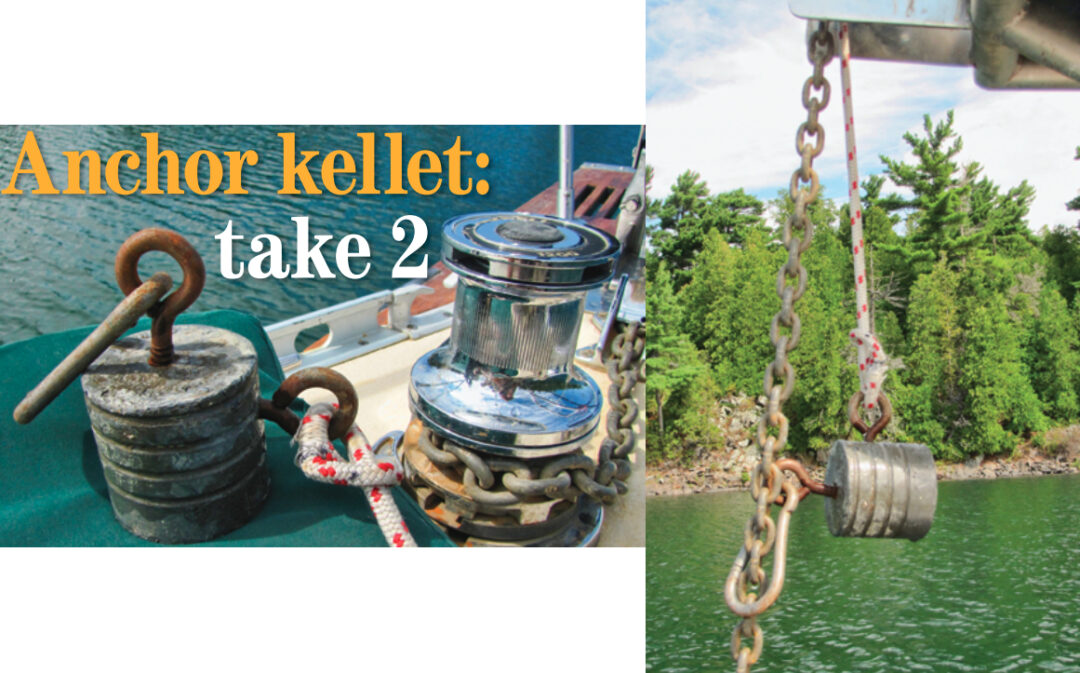
We made our kellet ourselves, as the few commercial versions seemed expensive and awkward. We drilled a hole in the side of a Maxwell House coffee can (this seemed fitting since we have a Maxwell windlass) and inserted an eyebolt with the threaded end spanning the width of the can. To prevent it from slipping out, we added several washers and nuts to the eyebolt. A friend who had given up duck hunting donated a bag of old lead shot. Another friend with a small foundry (don’t try this at home) melted the lead shot and poured it into the can, enveloping the sideways eyebolt. He then inserted another upright eyebolt in the pool of molten lead. Five minutes later, he peeled off the scorched can and the kellet was complete. Total cost: $5 and a few beers shared with the foundry owner.
A sinker with hook and line
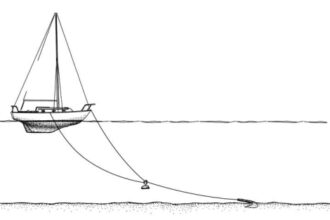
To deploy our kellet, we attach a large carabiner to the top eyebolt and a 40-foot line to the eyebolt on the side. We clip the carabiner hook over our chain and let it slide down the length of the chain while checking its depth with the attached line. Generally, we let out enough line to equal the depth of water we’ve anchored in plus 6 or 7 feet. We can do this as soon as we drop the anchor, or add it later.
It can be hard to slip a kellet down a taut rope rode, as there is too much friction from the line. If you need to add the kellet to an already deployed rope rode, you might have to move the boat forward and jostle the kellet down the slackened vertical rode to get sufficient depth. You could also attach the kellet directly to the junction of chain and rope when the anchor is first deployed. No matter how far down the rode you position it, any kellet is better than none.
We use our kellet in three situations. The first of these is when we want to reduce our swinging radius at anchor. Say we’re in 15 feet of water and would ordinarily deploy 60 feet of chain for the wind and sea conditions. When the wind pipes up we may want to put out 20 more feet of chain, but if we increase our swinging room we’ll be too close to the boat on our left or the shore on our right. Instead, we put down the kellet. The concentrated weight will reduce the amplitude of our swing and the kellet will drag across the bottom, slowing the rate of swing as well.
The second situation is when we need more scope. Say we’re anchored in 30 feet of water and nearing the end of our chain, but we don’t think we need to deploy our attached 5⁄8-inch nylon rode. We will slide the kellet down first and see if that keeps us comfortable.
In the third situation, we’ll use the kellet to dampen the rocking-horse motion of our bow in a heavy surge.
It should be noted that the kellet can be a problem in some situations. If the kellet encounters a log and gets caught, it can be more problematic than if chain or rope slides over the log. Sometimes a harmonic can develop between the kellet bouncing up and down and our bow following suit. In that case, we just slide the kellet up or down a bit until the two motions cancel each other out. Also, if Catamount makes a few 360s at anchor, the kellet retrieval line will wrap around our chain. When that happens, we have to retrieve it with the anchor chain, rather than independently prior to raising the anchor.
These complications aside, you will find a kellet to be one of the most useful components of your anchoring system whether you make your own or purchase one.
Fred Bagley and his wife, Jennifer, live in Vermont but sail the upper Great Lakes out of Penetanguishene, Ontario, in southern Georgian Bay. They primarily cruise Georgian Bay, the North Channel, and Lake Superior on their Caliber 38, Catamount.
Thank you to Sailrite Enterprises, Inc., for providing free access to back issues of Good Old Boat through intellectual property rights. Sailrite.com