Bantu, a 40-year-old thoroughbred sailboat, wins trophies and admiring glances
Issue 7 : Jul/Aug 1999
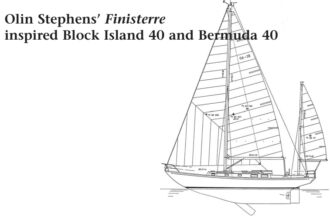
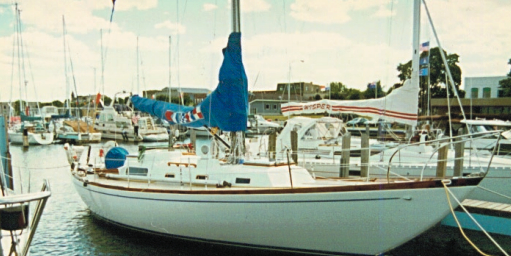
The traditional-looking Block Island 40, drawn in 1957 by William H. “Bill” Tripp, Jr., is considered by many to have some of the most aesthetically pleasing and balanced lines of any boat ever built. The Sparkman & Stephens-designed centerboard yawl, Finisterre, is most often cited as having been the inspiration for the Block Island 40 and the Hinckley Bermuda 40, both of which are Tripp designs.
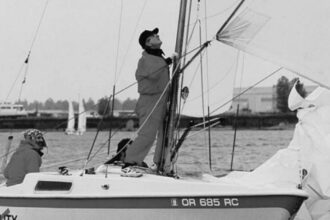
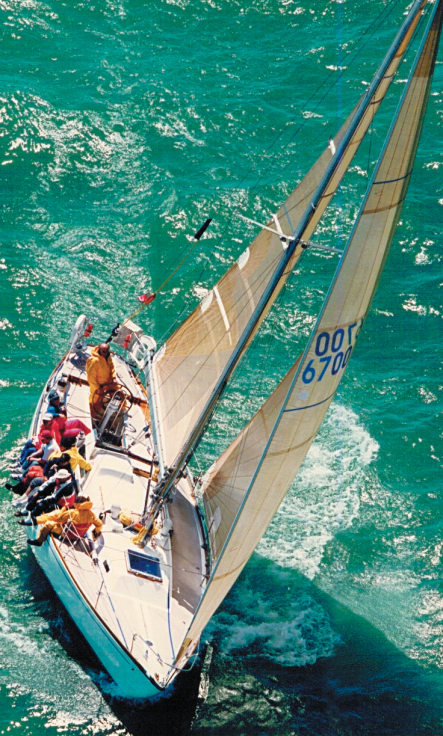
One of the finest examples of the Block Island 40 to be found anywhere is on Lake Michigan’s Green Bay. She is Bantu, owned by Thomas Kuber of Menominee, Mich. Tom is one of a number of accomplished yachtsmen who own or have owned one of these rare, true dual-purpose boats which are equally adept at racing and cruising. The list of owners of the first 10 boats built reads like a Who’s Who of yachting in the 1950s and ’60s. The list includes the likes of Van Allen Clark, Niebold Smith, and members of the prominent Vanderbilt and DuPont families.
The original BI 40 first sailed in 1958. That boat, Rhubarb, was owned by Benjamin DuPont who won the Bermuda Race that year. The boat is still a member of the DuPont family. Bantu, one of the first fiberglass hulls built in 1958, is hull #7. At the time, these were the largest fiberglass yachts yet built.
Two companies — American Boat Building Corporation of Warwick, R.I., and Metalmast Marine, Inc., of Putnam, Conn. — built a total of 36 boats. (Those companies have long ago gone out of business, but new BI 40s continue to be built, almost to the original plans, by Migrator Yachts of Wareham, Mass.)
You won’t find many boats the vintage and design style of the Block Island 40 out on the racecourse competing in, much less winning, races these days. However, in its day, the BI 40 enjoyed a successful racing career, mostly under the old Cruising Club of America (CCA) rule that had its heyday in the ’50s, ’60s, and early ’70s. In the 1960 Bermuda Race, six of the first 11 places were won by BI 40s, and as late as 1978, the BI 40, Alaris, won her class in that race. (The story goes that Bill Tripp, Jr., designed and built the BI 40 to beat the very successful Finisterre.)
Since the inception of IOR and IMS rating rules, it takes some pretty expensive high-tech boats to win major races. Yet today, Tom Kuber and Bantu continue to win big races around the Great Lakes under PHRF rating rules.
Tom is an entrepreneur who owns and manages industrial warehouses trucking and dock facilities in Northeastern Wisconsin and the Upper Peninsula of Michigan. He recently began a commercial shipping operation with three oceangoing ships. His shipping line provides regularly scheduled cargo service between the Great Lakes and European ports of call.
Tom was attracted to BI 40s for a number of years before he bought Bantu. In fact, he has had a connection of some sort to Bantu since the 1960s when he raced against her on a Sparkman & Stephens-designed 40-footer named Windborne. They raced in the same class, but “Bantu always cleaned up,” he says. In the ’60s the boat was raced out of Chicago, but for some reason she wasn’t being raced during the summer of 1967 and was being kept at the Palmer Johnson boatyard in Sturgeon Bay, Wis. Learning the boat was available, Tom and some racing friends made a deal to charter Bantu for three races on Green Bay. “We had a lot of fun with her that summer,” he says. Later that year Bantu was sold to another Chicago racer who re-named her Fury and raced her for another seven years until, as chance or fate would have it, Tom’s brother, Jim, bought the boat. Jim, who lived in Fond du Lac, Wis., and sailed on Lake Winnebago (which is a big, but very shallow lake) was looking for a larger, shallow-draft, centerboard boat, and he asked if Tom knew of any boats of this type that might be available. As it happens, Tom had just become aware that Fury (formerly Bantu) was up for sale. Jim bought the boat in 1974 and kept it until 1989 when he sold it to Tom.
“The interesting story behind that transaction,” Tom says, “is that my brother called to tell me he was selling the BI 40 and wanted to know if I would like to buy it. Of course I said I would love to, but there was one problem: with two daughters in college I couldn’t afford to pay for it.” In true brotherly fashion, Jim said, “That’s all right, you’re my brother; you can have it.”
“So,” Tom says, “we worked out a price, and when my daughters graduated from college, I paid him for the boat.”
Although Tom is a dedicated racer, he bought Bantu as a cruising boat. His last big boat, prior to the BI 40, was a Hans Christian 38 he owned from 1980 to 1985 and on which he cruised with his wife and three young daughters. “When the girls were small,” he says, “I retired from racing and spent every weekend on the Hans Christian, cruising and having a lot of fun with the family.”
As a kid, Tom started sailing on Snipes with friends who still sail with him today. Around 1964, he bought a varnished wood 22 Square Meter boat which he raced against four others on Green Bay. In 1966 he bought and raced a 5.5-Meter boat, and then in 1971 he purchased a Soling and raced it. In early 1985, after he sold the Hans Christian, Tom, not a man to be without a boat, bought and raced Pearson Ensigns, finishing sixth in the nationals one year. Although he still owns two Ensigns, he is not actively racing them. He loves one-design racing and has had a lot of fun with those boats.
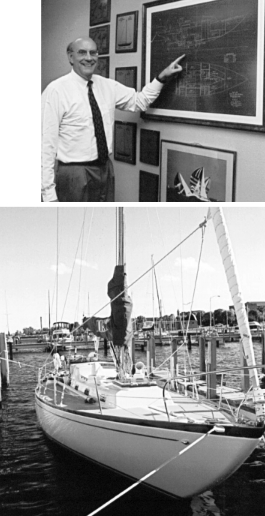
Tom’s office is a testament to his passion for and success in sailboat racing. The walls are covered with sailing photos, prints, models, half-hulls, plaques, and trophies commemorating racing successes with Bantu and one-design boats over the years. A large blueprint of the BI 40 takes a prominent place on one wall. Even with all that, though, he seems proudest of the large framed photograph of his three lovely daughters at the helm of a sailboat.
Once Tom took possession of Bantu (he re-named her Bantu because everyone around the lakes knew this BI 40 by that name) in the fall of 1989, the first step in the restoration process was to completely strip the boat inside and out. He went to work with fervor. The work went on all winter and well into the next summer until she was finally relaunched in August of 1990. More work was done again on the boat in the fall of 1990 and spring of 1991. Tom estimates he has spent over 2,000 hours working on the boat himself, and he’s lost count of how many thousands of hours of paid labor have gone into her over the years.
To this day, Tom expresses a sense of amazement when he speaks about how the hulls and decks of these BI 40s were originally constructed. According to Tom, while he was in the process of installing a thru-hull transducer for a new knot-meter, it became apparent that the transducer wasn’t long enough to reach all the way through the hull. When he called the manufacturer of the knotmeter to explain his dilemma, the manufacturer wanted to know how thick the hull was. When Tom told him that he measured it at 1 3/4 inches, the man didn’t believe him. “In fact,” Tom says, “he told me that’s impossible — you’re out of your mind, no fiberglass boat built in America has a hull 1 3/4 inches thick.”
Tom assured the man that he did, in fact, know how to read a tape measure and that the hull was definitely that thick. Finally taking Tom at his word, the manufacturer explained that the only transducer they had that was long enough was a special bronze one they made exclusively for some custom wooden boats being built in Europe. These boats’ hulls were still being constructed of double planked mahogany 1 3/4 inch thick. Needless to say, Bantu now has a bronze thru-hull transducer for her knotmeter.
Bill Tripp III, the son of the BI 40 creator, once explained to Tom that when his dad was building the BI 40s, wooden boats were being built with 1 3/4 inch-thick hulls. As this was the first attempt at building a big boat out of fiberglass (smaller boats like the Pearson Triton had been built by this time, but this was the first really big boat), and since they really didn’t know what fiberglass would do and how the engineering would work, they built the BI 40 out of hand-laid fiberglass the same thickness as a wooden hull. The solid hand-laid decks are 1 3/4 inches thick as well. Tripp III also remembers that in 1959, when his father was working on the Hinckley Bermuda 40 design, he would take newly molded pieces of fiberglass 1 1/2 inches thick out on the driveway of the family home and drive over them with the family’s 1957 white Jaguar XK-140 trying to measure deflection of the material. He told Tom that the hull of the BI 40 was so strong that he could use the boat as an ice breaker when Green Bay froze over in the winter.
Although 40-footers with a displacement of 20,000 pounds are now considered heavy, back then, when compared with the wooden boats of the day (which weighed in at 30,000 to 40,000 pounds), they were relatively light.
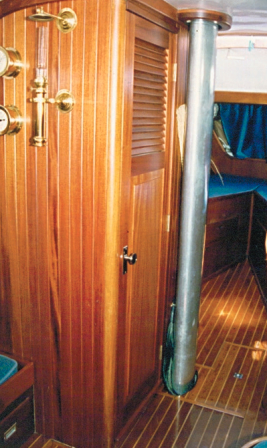
Bantu has been rebuilt twice while Tom has owned her. The first time was in 1989 and 1990, when he first bought her. The second time was in 1995 and 1996 when he made the decision to get serious about racing her. Tom readily admits that Bantu will forever be a “work in progress.” There is always a lengthy work list of projects and things that need to be done. The list usually includes some form of fiberglassing, painting, interior modifications, and go-fast upgrades.
During the winter, Bantu is stored in one of Tom’s warehouses along the Menominee River. That is where the work is done. He hires mostly local labor and feels they are some of the best craftsmen around. One of these craftsmen, and a person Tom also considers to be a good friend, is Mark Zimmerman. Mark does the fiberglass and painting work with such artistry he has been nicknamed Picasso. When Tom first got the boat, Mark worked on her almost every day for 10 months. Another artist who works on the boat is carpenter Jimmy Biersteker. “The job he does is incredible,” says Tom. “The work is intricate and detailed, and Jimmy is meticulous about how he goes about doing it . . . the finished product is absolutely gorgeous.”
The BI 40s were built prior to gelcoat technology. Nothing fancy here, just hand-laid fiberglass faired with Bondo autobody putty, which is then painted. When it came to re-painting the hull, Tom didn’t go the route of modern two-part paints. The hull is spray-painted with a white acrylic enamel automotive paint and then covered with six coats of clear enamel to protect the paint and give the hull a high gloss shine. This method is less expensive than using special marine paints, and the process of repairing any scratches or dings the boat may get over the season is much easier, he says.
The original boats were not finished all that well down below, Tom admits. His first order of business was to gut the interior and have the inside of the boat sprayed with acrylic enamel paint as he did with the outer hull. The original builders installed a linoleum sole in the boat and used a lot of mahogany veneer for interior panels, doors, and trim. The linoleum was replaced with a handmade teak-and-holly sole, and the wood veneer doors, panels, and trim were replaced with vertical tongue-and-groove mahogany.
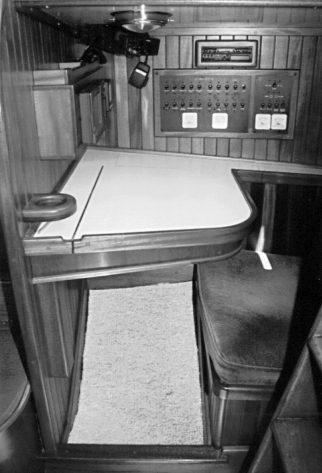
Corian counter tops replaced the old Formica ones. When Tom’s wife, Sandy, learned that he had installed better quality countertops in the boat than they had at home, she wouldn’t let him hear the end of it. Tom admits that the Corian tops are heavy, but says, “we don’t worry about weight on Bantu, because we are so heavy to begin with.”
On the starboard side of the boat, where a large refrigerator once took up residence, there is now a new steel-reinforced, mahogany navigation table. Although the boat was rewired in 1990, she was rewired a second time in 1996 when the new navigation station was put in and all new state-of-the-art electronics were added.
Some additional interior modifications include a remodeled head with a full-length mirror (a concession to his wife and daughters for when they are on the boat) and a compartment just for eye glasses. Most of Tom’s crew-members are in their 40s and 50s. (Tom figured the average age of Bantu’s crew for one race last year was 53-plus years.) With reading glasses, bifocals, and sunglasses, they often end up with 30 pairs of glasses on board. “With that many eye glasses on board, it was important to have a safe place to keep them together and out of the way,” Tom says.
The restoration also included replacing the original aluminum ports with bronze ones. Every fitting on the boat was re-chromed and all the stainless parts were buffed to shine like new. And Bantu has been refitted with a 35-hp Westerbeke/Universal diesel to replace the original Gray Marine engine which was really tired and had a shot transmission.
Tom keeps in contact with Eric Woods, the owner of Migrator Yachts, who builds new BI 40s. He has sent Eric photos of the interior work and other projects that he has done. Eric told Tom that if he had to finish a new BI 40 to the level of Bantu’s finish, he can’t imagine what price he would have to charge.
Some day, Tom would like to add teak decks to Bantu, but that day won’t come until her racing days are over. None of the BI 40s ever had teak decks, but he likes them, and feels they would aesthetically complement this very special boat.
All BI 40s were built with yawl rigs. For racing purposes, Bantu’s first owner converted her to a sloop. Tom has chosen to leave her that way. It is uncertain if he will convert her back to a yawl when her racing days are over.
Racing the BI 40 was not the original plan when Tom bought the boat, but with his extensive racing background and Bantu’s noted racing heritage (she won the Chicago-to-Mackinac race in 1964 and 1965 with her first owner), the urge to race was too strong to ignore. Tom started racing a little bit in 1992 and 1993. In 1994 he entered a couple more races. “We were doing OK but not great,” Tom says. However by then he had really gotten to know Bantu, and he could see that this beautiful sailing icon from another era could still be very competitive.
Bantu races as a class boat under the PHRF rating rules. When the racing rules changed from CCA to IOR, the BI 40s (and boats like them) became totally non-competitive. But under the PHRF rating system, they can compete quite successfully. Unfortunately the better she does, the more the PHRF rating committee lowers her handicap rating (this has happened twice since 1994) in an attempt to level the playing field between Bantu and her competitors. This is grossly unfair according to Tom. “BI 40s are ‘class boats,’ and Bantu now has the lowest rating of any BI 40 in the country, including the four others that have been converted to sloops,” he says. “What we have done to make this boat fast is to spend thousands of hours on the details to make her as competitive as possible under the rating rules,” he says, “We have never added anything, taken off anything or, in general, done anything to the boat that would affect her rating under the rules.”
Tom is motivated to keep Bantu competitive, if for no other reason than to show people that you can take an old boat with good sailing qualities, add good equipment, involve an experienced crew, pay meticulous attention to detail, and compete against and beat larger, faster high-tech boats costing $500,000 or more. This concept doesn’t always endear him to some of his competitors (especially the ones who have paid big money for those high-tech sleds).
In 1995, after the first rating change, Tom’s response was to attack the BI 40’s bottom in order to make it as smooth and efficient as possible. He also put together a seasoned crew. “My crew is from all over,” Tom says, “just a bunch of friends I have known and raced with for years.”
In 1995 and 1996, Tom added the necessary go-fast upgrades Bantu needed. He focused on the performance aspects of the boat: a Harken BatCar system was added to the mast and mainsail, but the mast is still the original heavy, overbuilt, thick-sectioned one that came with the boat. All new Harken hardware and hydraulic backstay tensioners have been added. The boat has been upgraded to be an “absolute racing machine — all on the original hull,” he says. “We have upgraded it technically to make it an absolute super, super-fast boat, but again we haven’t done anything that would change the rating.”
Bantu gets the best new racing sails every year. In 1996, 10 Melges sails were added, including a new main, a couple of new genoas, high top reachers, and three spinnakers. Tom is constantly upgrading sails as part of his comprehensive racing program. This attention to detail really began to pay off when Bantu started winning the big races. They won the Chicago-to-Mackinac race overall in 1996 and 1997. Also, in 1997, Bantu won the Queens Cup race, the M & M 100-Miler race and took a third overall in the Port Huron-to- Mackinaw race . . . almost a clean sweep. In addition to these victories, Tom and Bantu have won three other Queen’s Cup races and two other M&M 100-Milers. They’ve placed first in their class in both the Chicago-to-Mackinac and the Port Huron-to- Mackinac races since 1993.
Tom readily admits that he picks races that are best suited to the boat. He doesn’t do any around-the-buoy races. A long-keeled, centerboard boat is not designed to be very fast beating to weather. Bantu is no exception. The boat is fastest reaching and running. The bronze centerboard requires constant adjustment for different points of sail. It is a good heavy-air boat because of its weight. During the race, the crew is constantly changing sails, depending on wind strength and the wind angle. Tom credits his very experienced crew, as well as the BI 40, with their racing success.
With Bantu only competing in about three or four big races each year, the rest of the season is spent daysailing with some short cruises thrown in. At that point the racing sails come off, and the cruising mainsail and the roller furling genoa goes on. With this setup, Tom is able to sail Bantu singlehanded, something he enjoys doing. That’s not to say he doesn’t sail with the family. All three of Tom’s daughters are sailors. And Sandy likes to take short cruises around Green Bay with Tom and Bantu a couple of times every year. “She enjoys being on the boat when the weather is nice, and it’s fun to go sailing,” Tom says of his wife, “Sandy is not a racer, and she certainly wouldn’t enjoy being out there during a thunderstorm.”
Tom plans to keep Bantu until his last day. “The boat is in my will to go to my children . . . not to own,” he says, “but to sail.”
Thank you to Sailrite Enterprises, Inc., for providing free access to back issues of Good Old Boat through intellectual property rights. Sailrite.com