A good first boat, made for gunkholing
Issue 31 : Jul/Aug 2003
In 1965, the South Coast Seacraft Company, then located in Shreveport, Louisiana, introduced two fin-keeled sailboats, the South Coast 21 and the South Coast 23. Both of these classic design offerings had come from the drawing board of the noted naval architect Carl Alberg. While both boats were well received and moderately successful financially, Hollis Metcalf, the founder of South Coast Seacraft, searched for a way to capitalize on the emerging trailerable “pocket cruiser” market.
With the assistance of James Monroe, who was to later design the South Coast 26, Hollis modified Carl Alberg’s South Coast 21. They lengthened the cabin area, installed a larger doghouse, and replaced the fin keel with a swing keel. The result was the South Coast 22, by far the most successful of the South Coast line of sailboats. At one time, there was an active one-design racing fleet, with annual regattas held in Shreveport, Louisiana.
For several years running, Lake Michigan was home to the South Coast 22 nationals, which were sponsored by the then very active Chicago South Coast Club. In addition to being offered as a completed boat, the South Coast 22 was also marketed in kit form, at a substantial saving, to the do-it-yourselfer.
While Hollis was working on the design of the South Coast 25, his son, Warren, died as a result of a diving accident. Unable to maintain the company within the family, Hollis sold South Coast Seacraft in 1975. Under the new ownership, South Coast Seacraft continued producing sailboats ranging in size from 21 to 26 feet. Even with the addition of the Eclipse (an upgrade of the popular South Coast 22) and the Rozinante (a 28-foot double-ended, ketch-rigged daysailer designed by L. Francis Herreshoff), failing finances forced South Coast Seacraft to close its doors in June of 1981. South Coast Seacraft’s legacy includes more than 4,000 sailboats, of which more than 3,000 are South Coast 22s.
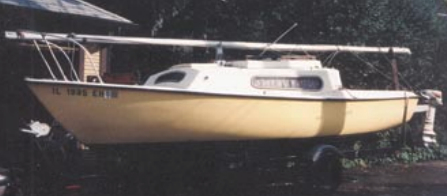
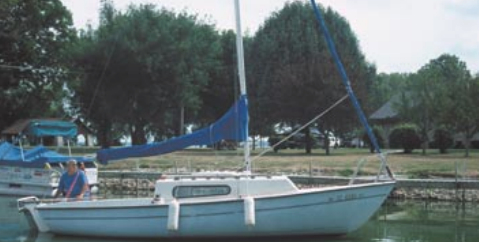
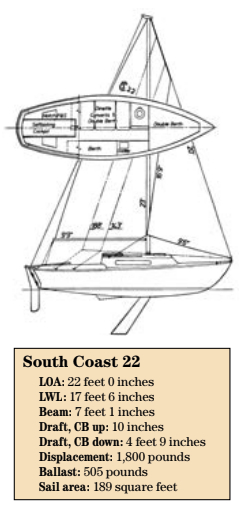
At a price below that of many daysailers of smaller size and displaying the classic lines inspired by Carl Alberg, the South Coast 22 was one of the best boating buys of its time. It has an overall length of 22 feet, a waterline length of 17 feet 6 inches, a beam of 7 feet 1 inch and a displacement of 1,800 pounds with 505 pounds of ballast.
Construction
The hull of the South Coast 22 is solid fiberglass laid up by hand, largely of woven roving, and is close to 1⁄2-inch thick in some places. The deck is a sandwich comprised of two layers of fiberglass with an end-grain balsa core. While balsa coring significantly increases strength, not to mention affording good temperature and sound insulation, it has the potential downside of soaking up moisture and turning into mush if you don’t take the time to carefully seal the through-holes of deck fittings. The hull-to-deck joint is bonded with adhesive, mechanically fastened with what appears to be pop rivets, and covered with a one-piece vinyl rubrail. All deck hardware is easily accessible, but there doesn’t appear to be any reinforcement in the form of backing plates.
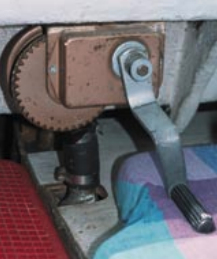
The South Coast 22 features a 505-pound swing keel made of cast iron. With the swing keel raised, the boat draws a mere 10 inches of water, compared to 4 feet 9 inches when it’s lowered. The raising and lowering of the keel is accomplished by means of a brake winch inside the cabin, just beneath the bridge deck. The winch automatically brakes when the handle is released.
Once the keel has been lowered and the cable slackened, a 1⁄2-inch-by-5-inch pin is inserted through the keel trunk, locking the keel in place. With the keel locked down, the boat is said to be self-righting. Unlike many of the boat’s contemporaries, whose swing keels form stubby “shoal draft” keels when raised, the South Coast 22’s keel is almost fully retracted into the hull of the boat. This enables the craft to venture into thin waters and to be easily beached. However, with the center of gravity raised to such a height, the boat becomes extremely tender.
Marketing strategy
While the South Coast 22 might be considered a typical product of the early days of fiberglass construction, it was marketed atypically. One could buy a factory-assembled boat or a kit version.
For the do-it-yourselfer, there was a substantial (approximately 30 percent) saving in purchasing a South Coast 22 kit. The most difficult parts of building the boat (hull-to-deck joint, rudder and keel mounting, bulkhead and hull supports) were already completed by the factory. All that was required to finish the job were a few ordinary hand tools, approximately 20 hours of time, and various critical items from the list of optional equipment.
Hundreds of these kit versions were sold. And it is this à la carte marketing strategy that can also be seen in what is called the “completed boat,” especially in the list of optional equipment, which more correctly should be referred to as an “à la carte menu.” While such items as bow pulpits, lifelines and stanchions, sail covers, and spinnaker gear are customarily considered optional equipment, South Coast Seacraft also listed as options such critical items as mooring cleats, a hinged mast step, a bow eye, the basic sails, and even the hatches.
To quote a loyal South Coast 22 owner, “The boat was marketed to a price point, and that price point was low.”
Overall appearance
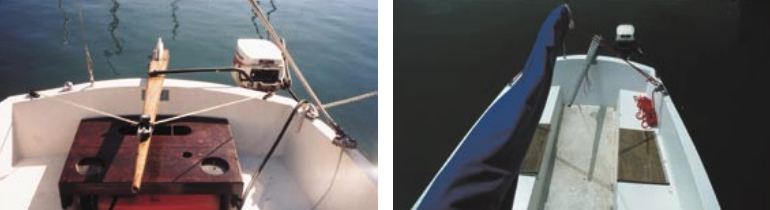
When viewing the South Coast 22, one immediately spots the Alberg design influence. This is characterized by the spoon bow, pleasing sheer, and long, slender hull with slight overhangs. The foredeck is completely free from clutter and is a generous 6 feet long. It provides a more-than-adequate work platform for making sail changes, deploying and retrieving ground tackle, and like tasks. Combine this generous free space with the 14-inch-high sloping front of the somewhat boxy doghouse and you have a great sunbathing deck with a built-in backrest.
The deck and cabintop have molded-in non-skid surfaces. The shrouds are outboard of the 7 1⁄2-inch sidedecks, and there are teak handrails (optional) along the cabintop. These handrails, along with the companionway hatch slides, are the only teak accents on the boat. The base boat did not come with pulpits or lifelines; however, they were available from the long list of optional equipment.
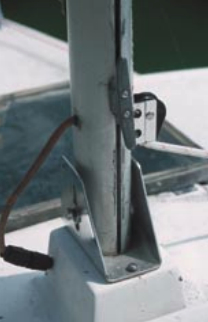
On top of the cabin, just in front of the mast, is the forward hatch (optional) made of opaque fiberglass. The main companionway also uses a one-piece opaque fiberglass hatchboard. While the companionway bulkhead opening can be considered of average width, the top opening is a generous 38 inches wide. To take advantage of this large opening, a “jumbo hatch” pop-top option was available.
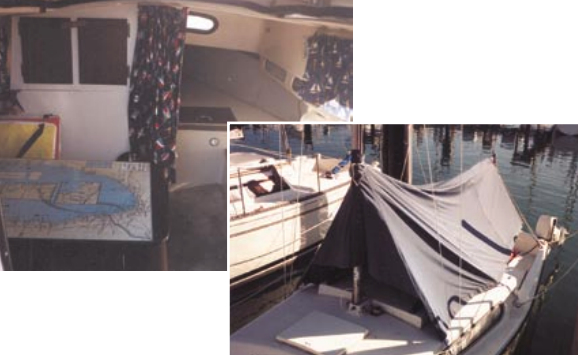
The cockpit is 7 feet long and, with the addition of a canopy or boom tent, can be used to expand the living/sleeping area. There are two cockpit-seat hatches (optional), one to port and another to starboard. Both allow access to the cockpit lockers as well as to the cabin’s interior, since they are not partitioned off inside.
The cockpit is self-bailing by means of a drain located at the forward end of the cockpit, just aft of the 8-inch-deep bridge deck. This barrier between the cabin below and a wave-filled cockpit is sound design insurance and a feature often lacking on boats of this size. The cockpit coamings extend smoothly aft, blending nicely into the transom. They are reasonably high and provide good back support.
Mounted on the transom is a fixed spade rudder with an oak tiller. A kick-up rudder was available as an option. Standard equipment included a fixed, fiberglass outboard-motor mount to port.
Belowdecks
Unlike many production boats of this size, the South Coast 22 did not use a one-piece fiberglass pan for structural integrity or to determine the location of interior joinery. Instead, all bulkheads and hull supports (which form the bases for settees/berths) were individually glassed in place. There is no fabric or vinyl liner to give the interior a “finished” look. Instead, the majority of the interior (headliner, sides, and sole) is painted textured fiberglass.
Forward, underneath the foredeck, is a potentially claustrophobic V-berth measuring 6 feet long. Beneath this V-berth is foam buoyancy. Aft on the port side, just forward of the main bulkhead, is space for a Porta Potti. A curtain covering the remaining bulkhead opening gives the V-berth and Porta Potti some privacy. The corresponding starboard area is either a continuation of the starboard settee/berth space or a combination of optional galley (forward) and settee/quarter berth (aft). The optional galley is a self-contained, polyethylene, molded unit that consists of a sink, hand pump, countertop, and a 12-gallon potable water tank.
Aft on the port side is a dinette (table optional, of course) that converts to a double berth. Below all settees/berths are bin stowage areas. Cabin cushions were optional equipment. With the standard companionway hatch, headroom is 4 feet 7 inches, or 6 feet with the “jumbo hatch” raised. Further aft, under the cockpit seats and sole, is stowage and the cockpit locker.
Since the South Coast 22’s swing keel is housed inside, there is a 15-inch-high keel trunk that runs the entire length of the cabin. This is a source of restricted movement and bruised shins.
The rig
The South Coast 22 is a masthead sloop with the mast stepped on deck and supported below by a wooden compression post. Both the mast and boom are anodized aluminum. The standing rigging is stainless steel and comprises a headstay, single spreaders, upper and lower shrouds, and a single backstay. The standard sail area is 189 square feet, comprised of a 112-square-foot mainsail and a 77-square-foot jib. All halyards are Dacron, external, and cleated at the mast. The running rigging hardware supplied by the manufacturer is substandard and a candidate for upgrading.
There are no winches or headsail sheet tracks. Jib sheets are led aft through fairleads on the cabintop and cleated off with cam cleats further aft. The boom-end sheeting is an awkward triangular affair that runs back and forth from the boom to a block on the starboard coaming and back and forth from the boom to a fiddle block on the port coaming, where it is cleated off. This arrangement is fine on a starboard tack, but a bit clumsy on a port tack or even on a run. There are no reef points in the mainsail, but roller reefing was an option.
Underway
The South Coast 22 makes a good first boat. It is comfortably sailed in protected waters and, due to its 10-inch draft, really shines when gunkholing in thin water. Its narrow beam and light displacement make for a tender craft that heels quickly and then stiffens up at 15 to 20 degrees. The boat’s best point of sail is a reach, and it is quick. There are no bragging rights when on a run, however, and its performance in light air is just OK.
The helm is a bit quick, but with a little time and effort can be mastered easily. The standard hardware and relatively small headsail hold the boat back. Upgrading these two areas will yield a significant improvement in overall performance. Like many boats with swing keels, the keel cable tends to hum. This can be eliminated by easing the cable.
Things to check
Before you reach for your wallet, remember that a South Coast 22 could have already celebrated 30 or more birthdays, and a boat that old has experienced its share of both good and bad. Survey carefully. Also, more than 3,000 of these boats were produced, many in kit form. It goes without saying that the quality of the finished kit product needs to be checked out closely.
Check the deck for delamination caused by a balsa core that has deteriorated due to water saturation. Pay keen attention to the areas around all deck fittings. Delaminated areas sound dull and hollow when tapped with the handle of a screwdriver.
There have been reports of leaking keel pivot pins, as well as the keel stop bolts and keel locking bolts. All of these are stress areas. The keel cable and its attachment point at the keel are other keel-related items to scrutinize.
The cockpit of the South Coast 22 drains into the keel trunk. As such, these boats routinely experience problems with water burping up through the cockpit drain. Many owners have resorted to putting a plug in the drain while under sail, while others have embarked on various replumbing projects.
It is doubtful that a South Coast 22 exists sporting only stock deck hardware. You can be almost certain that the quality, variation, and installation of these owner upgrades will cover the entire spectrum of seamanship and craftsmanship.
The bottom line
The lines of the South Coast 22 are unmistakably classic Alberg, owing to the fact that it’s a copycat big cousin of the South Coast 21. The overall construction is sound and what one would expect to experience in the infant years of fiberglass boat construction. It’s the Spartan touch — even lacking deck hardware and creature comforts — that detracts from the boat.
This is a low-end trailersailer. As such, it makes for an acceptable first sailboat. Company advertisements boasted berths for four; that’s two adults and two small children . . . assuming the boat is equipped with the optional cabin cushions, that is.
There are no major flaws or problem areas common to this model, but like any boat of this vintage it’s a good idea to conduct a thorough survey before closing any deal.
When considering the purchase of a South Coast 22, remember that this model was sold both as a completed boat and in kit form. This not only was reflected in the original selling price, but also affects the resale value. For example, in 1968 a completed boat with sails sold for $2,845, while its kit version was $1,900. In 1975, the same versions were $3,490 and $2,545, respectively. Today, you can expect to spend between $900 and $2,500 for a South Coast 22. What a bargain, especially as this often includes an outboard motor and trailer.
For additional information and to contact South Coast 22 owners, log on to the South Coast Owners Association website.
Thank you to Sailrite Enterprises, Inc., for providing free access to back issues of Good Old Boat through intellectual property rights. Sailrite.com