Comparing the Victoria 18 with three trailersailer cousins
Issue 31 : Jul/Aug 2003
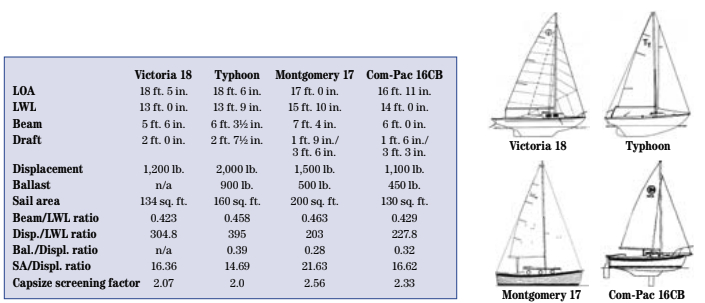
This comparison posed a few problems for several reasons. First, data on these boats was on the slim side, and no waterline lengths were given in the scanty information accompanying the small drawings of the boats. That was solved, simply by measuring the waterlines on the tiny sketches and proportioning them from the given LOA. First problem solved, close enough for practical purposes.
Then the Victoria’s data showed no ballast weight either, and I was unable to find it in any of my other references. Second problem unsolvable, so I’ll avoid references to the ballast/displacement ratio. It really is not serious in any case. The heavier Cape Dory Typhoon is the only one of the four with a significant amount of ballast; the prime stability factor in the three lightweights will be the crew weight and position.
The third problem was the question of displacement. On boats of this size, the crew weight is a very large part of the overall displacement. I’m certain the manufacturers kept the reported weights as light as possible to encourage trailersailer buyers so, to even things out, I added 300 pounds — a 170-pound husband and 130-pound wife crew — to the displacement shown for the boats when calculating the displacement/length ratio and sail area/displacement ratio.
I did not add that crew weight to the capsize screening factor since, in all probability, the crew would be thrown out of the cockpit in a serious capsize and would have little effect on the unlikely event of the boat’s righting itself. In any case, these little yachts should not be in big waters where a capsize from wave action is a possibility.
Some readers will write to say that their favorite small boat has successfully sailed from California to Hawaii or crossed the Atlantic in mid-winter. Indeed, I know of an 18-footer that circumnavigated the globe. But my reply will always be, “Not with me aboard!” I’m far too aware of people who have died, or nearly died, in large, seaworthy yachts to risk my life in a vessel that should not sail out of sight of land.
So, here are the facts, only the facts, ma’am!
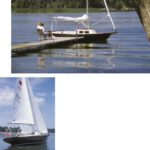
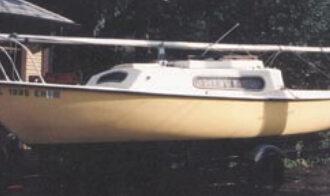
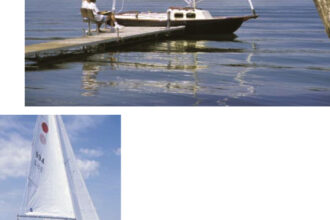
It’s obvious that the performance champion of the group is the Montgomery 17 with her long waterline, generous sail area, and modest ballast adding to the form stability of her beamy keel/centerboard hull. The Victoria and Com-Pac should be fairly evenly matched on a reach, but the latter’s centerboard would probably give her an edge to windward, and her lower wetted surface would win out in light air.
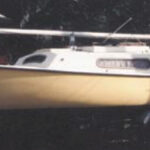
I do like the Victoria’s rig. It is rather old-fashioned with a large main and small jib; she should sail well under main alone. That can ease handling in tight quarters or let her slip through a squall with the main luffing slightly and no need to panic.
The figures leave the Typhoon as the slowest of the bunch due to her heavier displacement, modest sail area, and greater wetted surface. Still, her husky displacement and good ballast ratio will come into play when the wind pipes up, and she might well walk away from the others when the lightweights are making heavy weather of it. In any case, her lovely balanced ends and perky sheer make the Typhoon the beauty queen of the group, at least in my eyes.
Any of these boats would make a decent weekender for a couple, and the lighter three, with their shoal draft and modest weight, are quite suitable for trailering behind a medium-sized car, thus extending their cruising grounds substantially.
Thank you to Sailrite Enterprises, Inc., for providing free access to back issues of Good Old Boat through intellectual property rights. Sailrite.com