Ted Hood’s lively centerboarder still a great performer
Issue 32 : Sept/Oct 2003
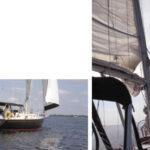
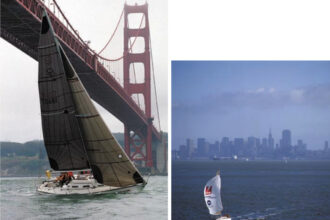
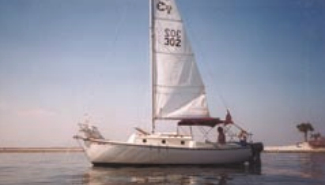
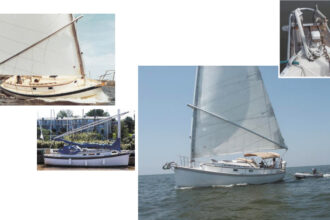
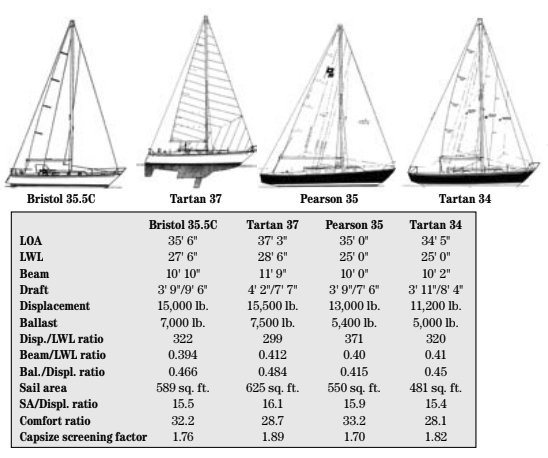
The Pearson 35 and Tartan 34 first saw the light of day in the late 1960s, the Bristol 35.5C and Tartan 37 in the late 1970s. This galaxy of cruiser/racers thus illustrates the changes that occurred in the design of keel/centerboard yachts over that 10-year stretch. The most noticeable change, due to the shift from the CCA handicap rule to the IOR rule, is the shorter ends and reverse transoms on the two 1978 models compared to the long overhangs and more traditional sterns on the older boats. Speaking of tradition, the Tartan 34 has a very traditional and lovely Sparkman & Stephens sheerline and is far and away the prettiest of the four yachts to my eyes.
The Pearson 35 is, very definitely, the most conservative of the group and much more akin to an early 1960s CCA cruiser/racer than the others. She is the only boat to have a full keel/centerboard hull while the others all sport moderate fin-keel/centerboard underbodies with skeg-hung rudders. Not one of these boats is a lightweight by today’s standards but the Pearson, carrying her beefy avoirdupois on a short waterline, has a displacement/LWL ratio of 371, quite hefty indeed. Another sign of her older heritage is the typical CCA rig with its low-aspect ratio mainsail, having a luff/boom ratio of only 2.23 compared to the taller 3.3 to 3.4 ratios of the other three.
The Pearson’s performance may not be as competitive as the others, but she is still a desirable yacht for coastwise cruising, with roomy accommodations for her era and a spacious cockpit. She carries a good ballast ratio and has a reasonably low capsize screening factor (CSF). Still, her large 9-foot long cockpit could pose a problem in storm conditions offshore, so I would not recommend her for long ocean passages.
Speaking of the CSF numbers, these boats all have reassuring figures for offshore use, but it must be remembered that their shoal draft reduces the effectiveness of the ballast. If capsized, they may well right more slowly than the CSF number would appear to indicate.
The three fin-keel/centerboard yachts, with their lower-wetted-surface underbodies and taller rigs, are considerably more performance-oriented, but they are still of husky displacement by contemporary standards. Part of that weight is a big chunk of ballast, and all the boats have higher ballast ratios than are seen in most of today’s beamy lightweights. Of course, by being shoaldraft centerboard designs, the ballast is not carried as low as on a deep-keel hull, so it is not quite as effective, pound for pound.
With the exception of the Tartan 37, these vessels are also considerably narrower than modern yachts. This adversely affects their form stability. Obviously, heavy ballast is necessary to compensate for this as well as for the higher center of gravity resulting from the centerboarder’s shoal draft. The husky displacement that results gives all the boats a high comfort number so — even if they are no longer viable as first-line ocean racers — they still have much to offer as fine cruisers and, given a good crew and sails, club racers.
The Tartan 37 — having the widest beam, the deepest draft, the heaviest displacement, and the highest ballast ratio — is likely to be the most powerful of the four yachts by a good margin. The 37 has a small edge in sail area/displacement ratio as well and, given her other characteristics, might appear to be the pick for best performer. However, Ted Hood has a deserved reputation for designing fast centerboarders and the 35.5C was noted for being a lively boat in her day. I’m confident that a well-sailed Bristol can still put up a good show against any yacht in her size range, regardless of age.
Thank you to Sailrite Enterprises, Inc., for providing free access to back issues of Good Old Boat through intellectual property rights. Sailrite.com