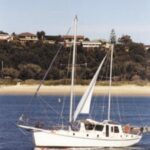
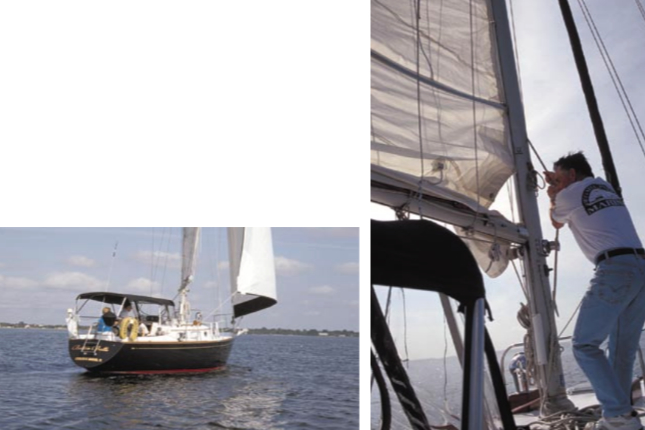
Both Paul Niland and his beloved Bristol 35.5 sail their hearts out
Issue 32 : Sept/Oct 2003
“Sailing is not a matter of life and death. It’s much more important than that,” believes Paul Niland. Now that he has spent four years renovating his 1980 Bristol 35.5, he can live that philosophy — with the full blessing of his wife, Peg.
“None of our neighbors goes out sailing as often as Paul does,” she says. “He loves every minute when he’s sailing.”
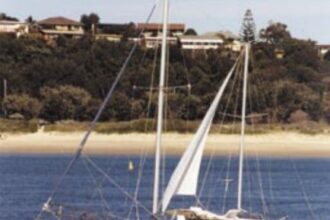
Their sleek, black 35-foot sloop is frequently seen in Charlotte Harbor, a sailor’s paradise on Florida’s west coast. Paul often sails alone on that 10-by-20-mile, elbow-shaped bay, day and night. Sometimes he sails with Peg and occasionally with their visiting grown children or fellow members of the Isles Yacht Club. “Sometimes we go out with a sandwich and watch the sunset . . . just letting the boat drift,” says Peg.
Paul can have Boston Belle under full sail in minutes; the dock of their canal-front home in Port Charlotte is only three lots from the harbor. “We moved here from Hingham (a Boston suburb) so we could sail all year,” says Paul, 69, who retired from his Massachusetts electrical contracting business in 1989. Paul gravitates to the helm. “It’s my job,” he says.
“Paul’s a go-go person, and sailing relaxes him. He’s the sailor. I just go along for the ride,” says Peg, who often reads or does needlework as they cruise (though she takes the helm while Paul handles sails). “He knows just how he wants things done.”
Besides sailing in Charlotte Harbor, they daysail and weekend among the islands, bays, and sounds along southwest Florida’s Gulf Intracoastal Waterway. Paul loves to anchor in unspoiled coves on the uninhabited barrier islands. Peg enjoys Cayo Costa, Keewayden, and other gorgeous island anchorages where “we could fill a dump truck with shells in an hour,” but prefers cruising to Naples, Sanibel, and other towns with shops and restaurants ashore. “We try to mix it up, with some of each,” Paul says.
Minimal cooking
For longer cruises, Peg bakes and cooks ahead, packing Boston Belle’s refrigerator and freezer with frozen prepared meals. “I just take what we need and do minimal cooking on board,” she says.
Paul discovered sailing at age 35. “Hingham’s a big sailing town, and it looked like fun,” he says, “so I bought an old 18-foot Hustler sloop, fixed it up, and went daysailing. I’d take our girls out one weekend and our boys the next. That’s how the kids learned to sail.” He did a lot of night sailing in Hingham, because the short season, running a business, and raising five children didn’t leave much other time.
Their 18-footer didn’t make the move to Port Charlotte. Once settled in Florida, Paul bought a daysailer and spent months exploring Charlotte Harbor. “Prevailing winds are southeast, about 16 knots . . . less in summer,” he says. “Winter means better sailing but lower tides (which are affected by the winds). “Best is a winter norther, when the weather’s crisp and clear.”
Once familiar with the harbor, he got bored. “I needed a bigger boat.”
Paul searched for a Bristol because “they made a quality boat in the 1980s, and the draft of 3 feet 9 inches (with the board up) is very important here.” He found his Bristol 35.5 in Oriental, North Carolina. The boat was a disaster — it had a rat’s nest of old wiring, a leaky fuel tank, and was just plain dirty. After two weeks spent working on Boston Belle, Paul began a six-week cruise home.
“The first night, I headed for a recommended anchorage off Camp Le Jeune. I dropped anchor in the middle, prepared for the predicted ‘possible showers.’ By 2 a.m. the wind was howling 45 knots, gusting to 60, the boat was jumping around, and it was pouring rain.” He dropped a second anchor and powered into his anchors, unable to see anything through the rain. At first light, he found he had dragged to within 50 feet of a steel bulkhead, despite having 50 feet of 3⁄8-inch chain out. “There was no bottom, just gunk. It took me five hours just to clean the boat.”
Spruced her up
The rest of the cruise — down the Intracoastal Waterway, around the Florida Keys, and up to Port Charlotte — was uneventful. He stopped for a week in Hollywood, Florida, to spruce up the boat. “Peg’d throw me out if I brought it home the way it looked.”
In reality, she was thrilled. “He worked so long, so hard for so many years, he deserved it,” she says.
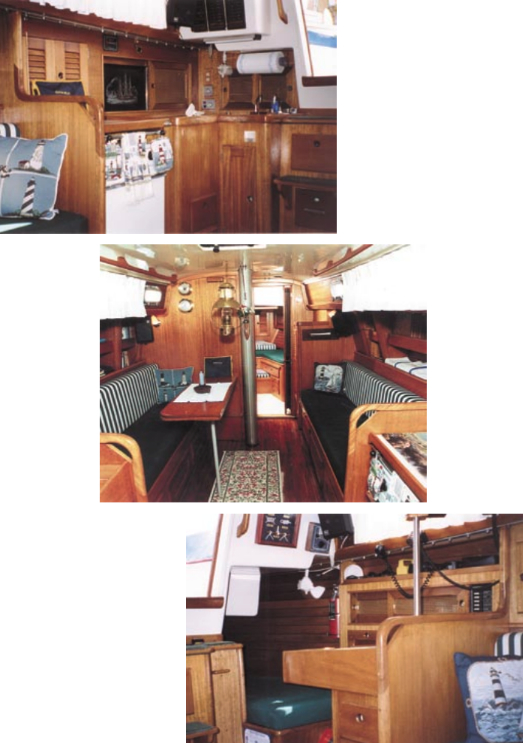
Once at home, Paul put Boston Belle in a do-it-yourself boatyard in Placida (14 miles away) and began work. He installed a new fuel tank, “a beast of a job” which required taking out partitions, removing the water heater, and fitting the new heavier-gauge tank in through the port cockpit locker. He rewired the whole boat, removing a tangle of vintage wires. He stripped and revarnished the mahogany interior. He replaced the cane inserts in the cupboards. He rebuilt the Edson steering. He repainted the hull. He added all new canvas, an electric Autohelm, and two dinghies: an inflatable with a 6-hp Evinrude and a sailing dinghy. “Paul did everything,” says Peg. “He can do anything.”
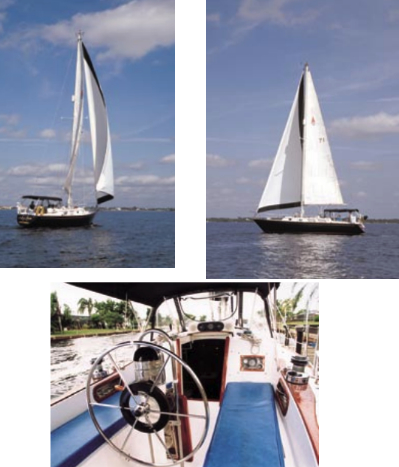
All lines lead to the cockpit, which is covered by a large navy dodger and Bimini. Sails total 589 square feet and include the main, a 135-percent jib, a 120-percent jib, a storm jib, and a staysail. Paul retained the original Universal 24-hp diesel engine.
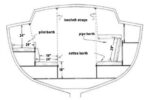
The cabin is traditionally laid out — a U-shaped galley with a gimbaled, three-burner propane stove, a stainless-steel sink, a refrigerator/freezer, and cabinets aft to starboard. There is a quarterberth and nav station with GPS, VHF, and chart storage aft to port, with the instrument readouts visible from the cockpit. The main saloon’s port and starboard settees flank the bulkhead-mounted table and pull out to become full-sized bunks. Forward, there is a hanging locker to starboard and a head with shower to port. A V-berth fills the forepeak.
Now that he’s redone the boat from stem to stern, inside and out, Paul says, “Boston Belle’s like a new boat. She’s very fast for an old girl and loves to flaunt her stern to other boats.
“I like everything about this boat,” he continues. “She’s very forgiving. The bigger they are, the easier they are to sail. If you make a mistake in a small boat, you’re in the water.”
Totally renovating their home, maintaining their rental house, redoing an old Cadillac, plus the usual home-maintenance chores keep Paul busy ashore. “But I can tell when he needs a fix on the water,” says Peg. “He still sails more than any of our neighbors and friends. He loves it so much.”
Thank you to Sailrite Enterprises, Inc., for providing free access to back issues of Good Old Boat through intellectual property rights. Sailrite.com