Instant anti-flap for the rigging before you hit the freeway
Issue 33 : Nov/Dec 2003
One of the biggest advantages of trailersailing is that you are not limited to one sailing area in a single sailing season. You can instead experience a cornucopia of sailing destinations, compliments of our extensive highway system.
To achieve this enviable versatility, the mast must be unstepped, the gear properly secured, and the rigging made fast for the ensuing road trip. While a boat’s rigging is designed to withstand the various stresses of sailing, her ability to cope with the stresses of highway speeds is definitely challenged.
Running rigging can be easily removed and stowed. However, it’s the standing rigging, the stainless-steel wire shrouds and stays, that can be damaged or even cause damage to your craft, if they’re not properly prepared for high-speed, highway travel.
Like running rigging, standing rigging can also be removed and stowed. Nevertheless, this process is more involved and basically amounts to: the more rigging removed = the more time spent rerigging, which = less time spent sailing. Not a happy little equation.
There are many methods for securing rigging for transit, and I’ve tried most of them with various degrees of success. Using short lengths of line, or “small stuff,” is nautical, but often results in slippage and the unrestrained flapping of loose ends. Also, if you’re not adept at knot-tying, the resultant jumble looks like the work of a Boy Scout gone berserk. The clip-, buckle-, or Velcro-type ties you can purchase are just an expensive alternative to rope and, in actual practice, don’t work as well. Tape (riggers’, electrical, duct, and so forth) works very well. It’s quick and easy to apply and to remove. However, tape leaves a sticky adhesive residue. The method I’ve found to be foolproof is . . . cable ties.
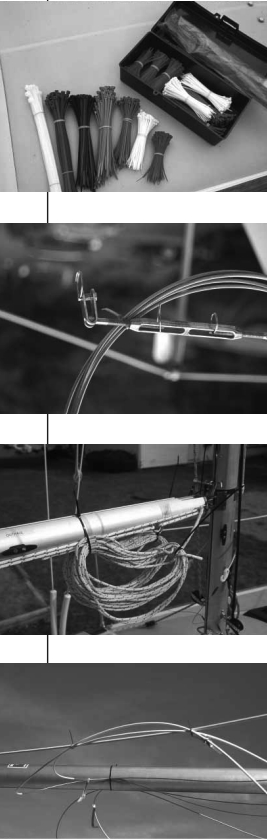
These simple, adjustable, nylon, self-locking strips are easy to use, come in a variety of lengths, are inexpensive (I bought a 1,200-piece assortment for less than $5), and are downright tenacious. I figure I use between eight and 10 ties per trip. Doing the math: 10 ties times two trips for each outing (there and back) times 16 trips a summer equals about 320 ties per season. That 1,200-piece package should last me more than three seasons for $5. It comes to about $1.34 per year.
If you’ve ever done any electrical work aboard, you know how handy these little gems are at keeping wiring shipshape. In addition to their intended electrical use, cable ties are excellent for securing all types of rigging for highway transport. The beauty is in their simplicity and versatility.
To prevent rigging from slapping, getting caught on something, or coming loose and being damaged or causing damage, use cable ties to secure it to the mast, lifelines, or even to itself. Then, once you’ve reached your destination, remove the cable ties quickly and easily with a snip of your wirecutters or a slice of a knife.
Once you’ve tried them, you’ll agree that nothing beats cable ties for securing your rigging for a high-speed, interstate experience.
Thank you to Sailrite Enterprises, Inc., for providing free access to back issues of Good Old Boat through intellectual property rights. Sailrite.com