How a can of fruit salad and some hose clamps saved the day
Issue 33 : Nov/Dec 2003
Day two of our planned trip up to Lake Michigan to Michigan’s Upper Peninsula dawned like the previous day: hot, humid, and absolutely no wind. At least there was no sign of the fog that we had worked our way through the day before in the first two hours after leaving our homeport of Winthrop Harbor. Fiona and I had spent a pleasant night tied up at the marina in Port Washington, some 56 miles up the Wisconsin coast. But anxious to make as much northing as possible, we left at 0830 with a full tank of fuel for a second day of motoring. Later that morning the wind came through. So for a little more than two hours off Sheboygan, we sailed on a nice downwind run up the Wisconsin coast staying about two miles offshore. Then as abruptly as it arrived, the wind left us to face calm seas and slatting sails once more. Time to furl the jib, stow the main, and switch the engine on again.
The exertion of stowing sails left us both with a thirst, so Fiona went below for soft drinks. She came straight back up with a serious face and very calmly announced, “I think we have a fire.” Behind her were wisps of white smoke coming out the companionway. After I shut down the engine, I made a quick trip into the cabin, which was full of smoke, with more coming from the engine compartment. There were no apparent flames. I grabbed the fire extinguisher and carefully lifted the engine cover. Again, no flames, but a lot more smoke.
Time to think
We obviously had some time to think the problem through, so we retreated to the cockpit while the cabin aired out. A quick confirmation of our position found us about midway between Sheboygan and Manitowoc with no other vessels around and in 40 feet of water. With no wind, tide, or current to worry about, we were not going anywhere, so we felt anchoring was unnecessary.
Once the cabin was clear of smoke, it was time to solve the problem. Restarting the engine quickly showed us the problem: a split in the exhaust pipe was allowing exhaust gases to pass into the engine compartment and diverting some of the cooling water to the bilges. Since it was still calm and we were two hours from Manitowoc, we were reluctant to call for help and a tow. This was, after all, a shakedown cruise in preparation for extensive cruising in the years ahead. We both felt that this was a test of our abilities and self-sufficiency.
After allowing the pipe to cool, I carefully felt the area of the leak. It seemed to be cracked, but the exhaust pipe wrap did not permit a full inspection. My first thought was to wrap the pipe with underwater epoxy to make a seal. Unfortunately, I could get only one hand to the area, and the epoxy kept slipping, finally setting as a useless glob. The solution was obviously to wrap the pipe . . . but with what?
Somewhere from deep within our memory banks, we pulled out the idea of using a tin can and hose clamps. We had the materials, and it was worth a try. We found a can of fruit salad that was about the right diameter. We emptied out the fruit salad, cut the bottom out of the can, and split the side. We opened up four hose clamps and joined them to create two larger clamps. Then we began the job of fitting the can and clamping the repair together. Did we mention Lake Michigan’s biting flies? They descended just about the time we started on the repair. While one of us was inside the engine compartment, the other’s job was to keep the flies at bay.
In a half an hour the repair was in place, and it was time to start the engine. Our biggest surprise was that there were no exhaust fumes and no water leaking. It seemed that the tin can clamped around the exhaust pipe provided a reasonable gasket seal. But we continued to check the repair every 15 minutes until we were safely alongside in Manitowoc. By then, we were sufficiently happy with the repair that we decided to continue the next day to Sturgeon Bay, which has more extensive repair facilities.
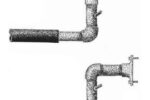
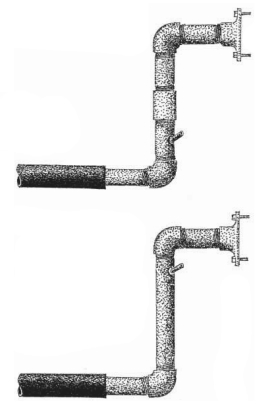
Once we removed the exhaust pipe and stripped off the heat-wrap tape, we found that the original exhaust was made from threaded black-iron pipe and bends that had a threaded connector in the middle of the pipe. The vertical section was made from two short lengths of pipe and a coupling, making four joints instead of two. A possible contributing item was that the water-injection point was at the bottom of the pipe, not at the top, allowing the pipe to be heated to the exhaust temperature.
Lessons learned:
- A good selection of stainless-steel hose clamps should be in every spare-parts box.
- When an exhaust pipe is covered in exhaust wrap, you cannot tell what is happening underneath.
- Access is good from on top and the starboard side of my engine compartment, but the exhaust pipe runs at the back to the port side. It’s worthwhile to improve access.
- Simple Green does a good job of cleaning the soot from the engine compartment and from the side lockers.
- Upholstery must be dry-cleaned after being exposed to a cloud of exhaust gases.
- Insect repellent doesn’t work for Lake Michigan fl ies.
- Next time we’ll keep the fruit salad, instead of dumping it in the trash.
Thank you to Sailrite Enterprises, Inc., for providing free access to back issues of Good Old Boat through intellectual property rights. Sailrite.com