Here’s how to enjoy maintaining your brightwork
Issue 35 : Mar/Apr 2004
Most good old boats come with at least a little teak. Our 1982 Baba 30 came with lots: teak decks, teak caprails, teak decorative trim on the top edge of the hull, teak bowsprit, teak hatchcovers, teak-and-holly cabin sole, teak bulkheads . . . not to mention a spruce mast and vertical spruce staving around the cockpit.
My husband, Ken, and I happen to love teak. It’s one of the aspects of our traditionally styled, fiberglass-hulled Baba that drew us to purchase her. Along with the commitment to maintain all the boat systems was the requirement that at least one of us would maintain all the wood, inside and out. My mechanical skills are non-existent, while my husband’s are excellent. It fell to me to learn how to maintain our exterior brightwork and interior teak.
I discovered that almost everyone has something to say about maintaining teak. The most common advice is: “Buy fiberglass!” I’m not about to claim that I’ve found the perfect method for preserving teak. Instead, I’ll share the techniques I found to be most effective and efficient for our purposes as liveaboards. However, far more important than technique is the attitude one needs to adopt if one is to maintain teak year after year and actually enjoy it.
Granted, teak maintenance is not for everyone. That’s why there are lovely boats with almost no teak whatsoever. But if you admire teak brightwork, if you love the rich glow of wood in the saloon, if you like the traditional appeal of teak decks, you may discover that “doing wood” is a peaceful, rewarding activity. Maybe not as much fun as romping at the beach or sharing a rum-and-Coke with other cruisers, but pleasant.
All the instructions
I was fortunate early in my wood maintenance career to discover Rebecca Wittman’s wonderful book, Brightwork: The Art of Finishing Wood. Since I had no experience with wood refinishing, save a minor oak-chest restoration project years ago, her book was ideal, with instructions on how to prepare, varnish, and repair wood finishes. Unlike other books on the subject, Brightwork gives detailed instructions and valuable tips, such as how to wrap your fingers with masking tape for trimming the deck caulking with a razor blade, in order to prevent painful chafing of your fingers. In addition to these nitty-gritty instructions, the book includes a history of varnish, comical anecdotes, and gorgeous glossy photos displaying exemplary wood-finishing projects.
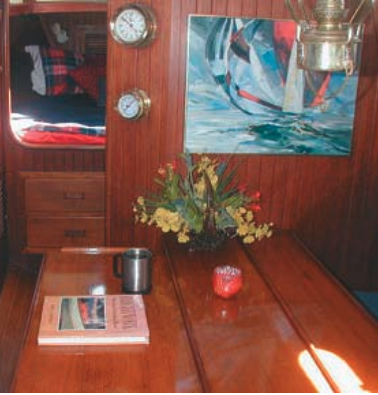
I used this book faithfully as I worked on our teak down inside the cabin. When we purchased Kahlua, the cabin sole was unfinished and filthy, the holly strips not even distinguishable from the teak. I was delighted with Rebecca’s recommendations for treating cabin soles that cannot be removed from the boat: Daly’s two-part hydrogen-peroxide bleach. To me, the beauty of this solution is that it’s a very effective bleach, yet it is easily removed by hand with a rag using an alcohol and water solution. Sure beats hosing down the interior of the boat. As Rebecca says, it “makes you wonder if the boat fairies came in the night and left you a completely new floor.”
Another of her recommendations for the interior is the oil-sanding technique. I found this to be an outstanding way to maintain teak on the bulkheads. The process involves brushing on good quality teak oil using a disposable foam brush, letting it soak in a bit, then sanding it in — with the grain — using wet-or-dry sandpaper. Finally, you buff the wood with a soft cloth. A repeat buffing about 20 minutes later will remove any droplets of oil that “bleed back” through the wood. It is amazing to watch the oil disappear into the wood as you sand. I tend to get carried away, using not only the recommended 400-grit, followed by 600-grit, but sometimes even using 1,000-grit sandpaper. I just can’t resist the baby-smooth, glassy finish this technique produces.
You can’t rush it
Which brings me to my point about attitude: you can’t rush wood. You might think that since we live aboard our boat and are not being paid to maintain our teak, we would want to hurry the process and get it over with. I guarantee that if you approach wood maintenance in this way, you will not enjoy it; you will quickly tire of it, and you will likely produce some nasty messes in your haste.
I take a different approach. First, I select wood treatments that produce good, though not necessarily “creampuff,” results. We aren’t getting ready for a boat show; we just want our boat to be well-maintained and attractive. Thus, we do not varnish the exterior brightwork, except for the mast. Sorry, Rebecca.
Like many other boatowners, I find that Cetol produces very nice results, lasts well, and is far easier to use when it comes to maintenance coats than varnish. Little to no sanding is required, and I can easily blend it in when touching up areas. Cetol saves me hours and hours of time in exchange for a slight loss of wood clarity. I use the new lighter-colored version of Sikken’s Cetol, which sacrifices far less wood clarity than the original, darker-colored Cetol.
I used to finish with Sikken’s Cetol Marine Gloss, but I no longer use the gloss coat because, like other cruisers I’ve talked to, I found the finish is not as durable and is more difficult to repair when it breaks down. The gloss coat soon develops “holes,” allowing moisture under the finish to create black spots and requiring complete stripping to repair. Using plain Cetol allows me to simply sand and re-coat any area needing repair. Even spot touch-ups can easily be blended in so they don’t show.
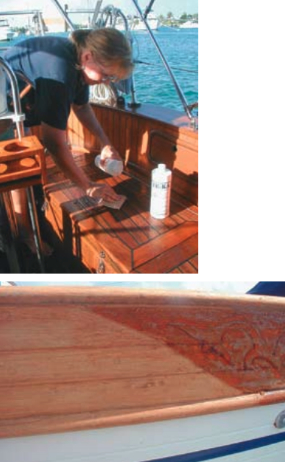
Still caring for them
Likewise, we have found that no finish at all is the most effective and efficient approach to our teak decks. However, that does not mean we don’t have to care for them. Initially, we followed Rebecca’s recommendations, cleaning and brightening the wood, trimming the deck seams so we could sand effectively, and sanding the decks lightly to get them smooth. Smooth deck wood attracts less dirt and debris as there are fewer crevices for it to collect in. Once the deck was properly cleaned and prepared, we were able to adopt a maintenance routine of washing the decks gently with a mixture of TSP and Joy, or rinsing them nightly with seawater. Either one helps keep the decks lightly bleached.
Besides choosing realistic, time-effective techniques, my most important choice has been to slow down. If I am doing maintenance coats, I decide on a reasonable amount of wood to complete in, say, a morning. I then mask off everything that needs to be protected, taking my time and doing it neatly, which will save lots of time later by preventing messes that must be cleaned or scraped up. Once I have all the pieces masked, I can apply a coat of Cetol in a relatively short amount of time. Could I save time by not masking? Maybe you could, but in my experience, I can brush on the Cetol far more quickly and easily if I have masked everything and I don’t have to spend time cleaning up blurps.
If I am stripping and completely refinishing a piece, I again slow down. I know that I will first have to strip off the old finish, clean up the mess, clean then brighten the teak, sand and re-sand until the wood is smooth, then coat with two or three coats of Cetol.
Since we are liveaboards, staying at anchor or a mooring most of the time, and have only a small generator, I cannot use a heat gun for stripping. I have had excellent results using CitriStrip, a thick, orange-scented gel that stays where I put it, even on vertical surfaces, and melts away the finish.
Taking it slowly
But again, I slow down. I sit comfortably. I do not plan on doing anything more than stripping the old finish off and maybe cleaning and brightening the wood. I relax, enjoy my surroundings, and do small sections at a time until, before I know it, all the old finish is gone. I take pleasure in watching the old finish peel away from the wood. I love cleaning and then applying the brightener to the grayed wood. I am a fan of TE-KA cleaner and brightener and use them whenever I can get them. I once ran out while doing our teak decks and had to use an alternative product on one side of the boat. The difference was striking. TE-KA outperformed the other reputable brand by a long shot.
I must admit that the part of wood maintenance I like the least is sanding, but here, too, I have learned to slow down. I know from experience that if I take my time with each step of the process, the wood will turn out lovely. If I rush or skip steps, I am almost never happy with the results. Either I leave blemishes in the finish, or I accidentally scar a nearby piece of wood, or the wood is not sanded smooth enough to produce a shiny finish no matter how much Cetol I brush on, or I knock something over and have a nasty mess to clean up. When I go slowly, but steadily, I actually get the job done in less time, and it is done right. What’s more, I get to savor the feel of smoothly sanded wood against my fingers, to marvel at the glow of the newly coated teak, and to smile with pleasure in response to the compliments we receive from other boaters.
You may be thinking this slow approach is all well and good for live-aboards, but doesn’t work for weekend sailors. I must disagree. I developed this approach while we were still shore-bound, weekend sailors. True, back then a larger proportion of our total time on our boat was spent working on the teak. However, I am still doing teak and still loving it. This, after owning our Baba for eight years, only two of them liveaboard years.
If you own or are considering buying a boat with substantial amounts of teak, I urge you to consider taking a longer view of wood maintenance. If you want to maintain a loving relationship with your boat and your mate, I strongly suggest you cultivate the ability to enjoy working on wood. You are going to have to do it anyway, so why not slow down and make it pleasant? Trust me, it will all get done. Maybe not as strictly on schedule as you planned, but it will get done. Then you’ll be able to relax and enjoy sailing and playing on your beautiful boat, free of any nagging dread about having to do the wood again.
Thank you to Sailrite Enterprises, Inc., for providing free access to back issues of Good Old Boat through intellectual property rights. Sailrite.com