Shorthanded or sailing solo, this trailing line could save your life
Issue 35 : Mar/Apr 2004
Anyone who has ever sailed offshore shares a common dread: falling overboard and helplessly watching the boat sail away. No matter how many shipmates you have resting belowdecks, if you’re alone on deck, you’re at risk just as much as the singlehanded sailor. No one will hear your calls.
Most passagemakers take the obvious precautions: maintaining pulpits and stanchions with continuous lifelines around the yacht’s rail and running jacklines along the sidedecks to clip on the safety harness that we wear most of the time. Some even tow a so-called “safety line” astern. Still, every so often we hear of the ultimate tragedy: some sailor has fallen overboard and been lost at sea.
I’ve singlehanded quite a bit and, over time have given the problem serious consideration. I came up with a solution that I’ve tested and used for years. If this system were used by more sailors, it could save some lives. It’s a simple, inexpensive lone-sailor-overboard rescue device that I call Captain Tor’s Last Chance Tripline.
If you were to grab a simple “safety line” trailing behind a boat sailing at 5 or 6 knots, you’d have a tough time trying to haul yourself forward on it while being dragged through the water. Fully clothed, it would be nearly impossible. Eventually, you’d tire out and let go. But the result of grabbing the Last Chance Tripline is that the boat will almost immediately come to a near or complete halt, giving you an opportunity to regain the ship. It will work aboard any boat, providing one last chance to save yourself if the nightmare ever comes true and you find yourself overboard and alone while underway.
Floating line
The tripline consists of about 200 feet of 1⁄2-inch, yellow, floating poly- propylene line, a Styrofoam ball float of the kind lobstermen use to mark their traps, at least two 5-foot pieces of 5⁄16- or 3⁄8-inch elastic shock cord with a plastic hook at one end, and one or two 1⁄2-inch blocks on lanyards. It’ll also require a bit of trial-and-error experimentation because precisely how this equipment is assembled will vary from boat to boat. What follows is the basic idea.
The buoyant tripline, which has half hitches tied in it every 6 feet or so for better gripping, trails behind the boat while voyaging offshore. The Styrofoam float marks the “bitter end” (pun intended), while the inboard end is led in such a way that increased drag on the trailing line will disengage the self-steering mechanism or engine throttle. In the case of a vessel under sail, it will then steer the boat up into the wind to stall it. Once you’ve worked out the right adjustments for your boat, you can set up your tripline in a couple of minutes anytime you’re heading out to sea.
The normal line tension created by towing is countered by the shock cord, hooked to a bight in the line two or three feet abaft the stern rail. Because of this, the inboard portion of the tripline remains just barely slack until the weight of a dragging person overcomes the shock cord to exert force on the inboard end of the line.
There are several ways to accomplish the goal of stopping the boat. The first is to disconnect the autopilot.
Tiller autopilot
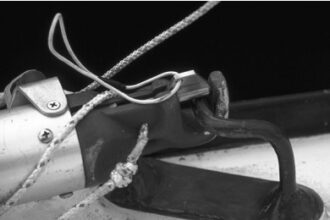
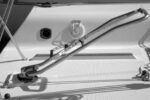
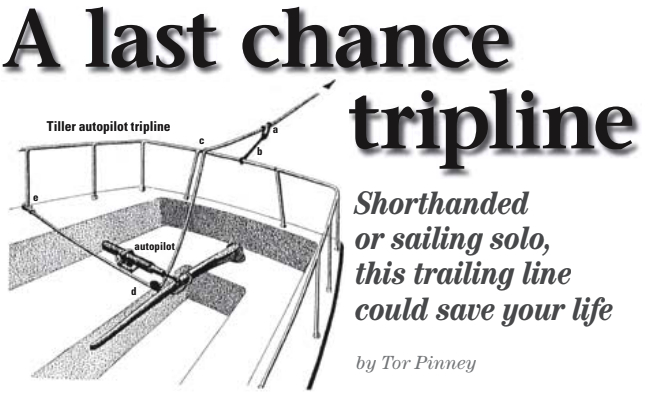
The external autopilot on a sailboat’s tiller (see illustration above) is the easiest to disengage — all it takes is a light lifting motion to jerk its drive arm off the tiller-attachment knob. To do this, the inboard end of the tripline runs from the bight (a), to which the shock cord (b) is attached, over the pushpit rail (c) to give it some height, then through a block (d) lashed to the tiller immediately aft of the attachment point of the autopilot drive arm. The block hangs by its lanyard just a few inches below the tiller. Finally, the tripline runs across the cockpit and slightly forward to the lee rail where it is tied to a strong attachment point (e) that is only slightly higher than the tiller. This end is secured, taking up almost all the slack in the tripline, but still allowing the shock cord to take the entire pulling force of the line trailing aft.
Because of the shock cord, the inboard end of the line remains slack (but just barely so), exerting no force on the autopilot or the tiller. But if someone in the water were to grab that tripline and drag behind the boat on it, the increased line tension would stretch the shock cord, putting tension directly on the tripline inboard of the bight. The taut tripline will raise the block, lifting the autopilot drive arm off the tiller and simultaneously pulling the tiller to leeward. The boat will head up, luff the sails, and stall. If the jib is trimmed for windward sailing, it will likely back, temporarily causing the boat to heave to. If the sails are trimmed for a reach, they’ll likely continue luffing even if the boat falls off again. In any case, the person overboard has time to reach the stalled boat.
Wheel autopilot
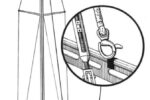
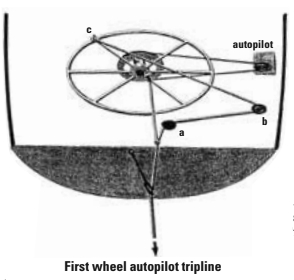
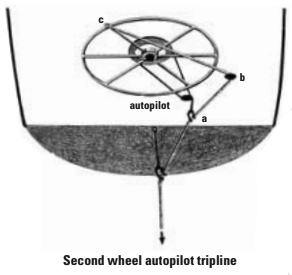
Disengaging autopilots on boats with wheel steering requires variations of this principle, depending on the autopilot system used and how it is installed (see first wheel autopilot tripline above). It may be necessary to run the tripline through a block on a short lanyard (a) tied to the autopilot’s clutch knob so that it will, under tension, pull out the knob to disengage the self steering. The same principle applies to both wheel-hub clutches and to foot-level clutches. From the clutch block, the line passes through a second block (b) stationed to port or starboard of the helm, and then across to the wheel’s rim (c) in order to have the ability to turn the boat. If the second block is on the lee side of the cockpit, the line’s attachment point along the rim will be at the farthest (windward) spoke below the wheel’s horizontal center plane. If the block is on the windward side, the line must be led to pull on the farthest (leeward) high spoke in order to turn the boat into the wind. Again, the shock cord aft holds the inboard line section barely slack until a strong pulling force is applied to the outboard end of the tripline.
An easier system
On some boats a line-and-lanyard system might be easier to use (see second wheel autopilot tripline at left below). Simply tie a second bight into the tripline, anywhere between the side block and the shock cord’s bight. Lanyards or short lengths of shock cord can be easily led off a bight to pull clutch knobs and switches. Whatever directional pull it takes for a tripline to disengage the self-steering unit and/or head your boat into the wind can be engineered with blocks, shock cords, lanyards and a bit of ingenuity.
With internal autopilot units, a lanyard coming off the tripline may be led so that it flips a toggle switch that turns off the unit, allowing the tripline to turn the helm. Better still, a tug on the tripline could be rigged to activate an electric override switch that will cause the autopilot to steer the boat sharply to windward. The same switch could also activate an alarm to arouse sleeping crew, but keeping it simple and self-reliant is probably best.
Windvane tripline
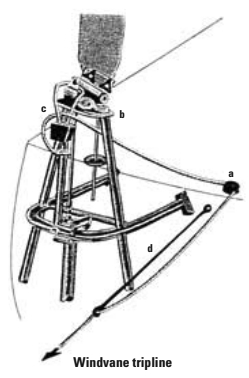
Windvanes pose no problem once you grasp the general idea of the Last Chance Tripline, but rather than disengaging the windvane, the trick here may be to use it to steer the boat into the wind.
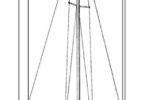
On a Monitor windvane (see illustration on facing page), the tripline passes first through a block on a lanyard (a), then between the rods holding the vane’s lead counterweight, which is below the wind paddle (b), and finally ties to a convenient part of the windvane’s framework (c) or ship’s hardware. Once again, the shock cord (d) is attached to the tripline at the outboard bight, in this case just aft of the block. Because the shock cord keeps tension off the inboard section of the line, the windvane is free to operate unimpeded — until someone pulls on the tripline. Then the cocked windvane will steer the boat up into the wind, stalling her. By having the block on a lanyard, it’s easy to shift its position and experiment to determine the correct angle of pull on the windvane’s counterweight. This changes as the windvane paddle is swiveled for different points of sail. In this manner, you control which way the windvane will turn the boat when the tripline is pulled.
Lastly, stopping a boat that is motoring is as simple as rigging the line or lanyard to pull back the throttle, the throttle and gearshift levers, or the engine shut-off knob. After reviewing the above variations of leading and balancing the tripline, an engine-stopper should be easy to figure out aboard your own boat.
As a boat’s sailing speed increases, it may be necessary to adjust (tighten) the shock cord. Otherwise, the increased drag on the line could overcome the shock cord and trip the system. The tension of the shock cord is adjusted from the inboard end so that it continues to barely overcome the pulling force of the dragging tripline. But beware! Too short a shock cord will not have enough stretch left in it to allow the tripline to work when needed. When adjusting for increased boat speed, it’s generally better to re-tie the shock cord farther forward rather than to shorten it. If this still isn’t enough to overcome the drag or if the shock cord is stretched nearly to its limit, then double up on the shock cord with a second piece. Ultimately, the shock cord must absorb the towing force with elasticity to spare.
Testing the system
Your tripline system is easy to test without throwing your mate overboard. Just reach over the stern rail, beyond the shock cord, and haul firmly and steadily on the line. A safer alternative is to tie a bight in the line just abaft the shock cord attachment point, slide the end of a boathook into it, and push to create the drag effect. If the ultimate result is that the boat comes to a halt, you got it right.
Once the tripline has done its job and allowed the lone sailor to get back to the boat, there’s still the problem of climbing aboard unassisted. A permanent ladder or steps installed at the transom or a means for a swimmer to pull down a stern boarding ladder will ensure a happy ending to the crew-overboard self-rescue.
By the way, the polypropylene tripline and shock cord should be stored out of the sun when not in use. Otherwise, they will deteriorate rapidly from exposure to ultraviolet rays.
You might argue that at night the tripline and shock cord could be difficult to find quickly enough for a frightened person grappling in the dark or that it’s useless to an unconscious man overboard. You can also insist that nothing takes the place of exercising proper caution to ensure that crewmembers don’t fall off the boat in the first place. You’d be right. The tripline is no substitute for wearing your safety harness while on deck, nor is it a 100-percent-guaranteed lifesaver in every situation. But for the lone mariner who suddenly goes overboard while the boat sails on relentlessly, the Last Chance Tripline is a whole lot better than the alternative — no chance at all.
Thank you to Sailrite Enterprises, Inc., for providing free access to back issues of Good Old Boat through intellectual property rights. Sailrite.com