Don’t blame the cook if the galley’s no good
Issue 35 : Mar/Apr 2004
Napoleon once said that an army marches on its stomach. If that is true, a ship floats on its stomach. A well-fed crew is always a happy crew. I could tell you about one Trans-Pac Race where the galley was very complete, and the cook — nay, the chef— was a magician. We lived like kings for 11 days on delicious salads, roasts, chops, and fresh-baked pies! That said, the galley of even a small yacht is a vital component of the vessel and, as such, it deserves every bit as much thought as the deck layout or the sailplan.
In the good old days of large yachts and paid crew, the galley was often placed forward in the vessel, but the usual location in the small yacht is aft, close to the companionway. Indeed, in more than 40 years in this business I’ve only designed one boat in which the owner requested the galley forward, and that was for a large charter yacht. The big advantages of the galley aft are that it is convenient to both the cockpit and the saloon and, as a bonus, in heavy weather there is considerably less motion aft than forward. That definitely eases the chef’s job of feeding a hungry crew.
Stoves
Other than the galley location, the very first decision that must be made when designing or rebuilding a galley is the choice of stove fuel.
Alcohol: The old mainstay was the pressure alcohol stove, which had to be primed to start in order to pre-heat the fuel. Overpriming was the cause of many glorious flareups and scorched overheads. Those pressure stoves are largely things of the past. Today’s non-pressurized alcohol stove was pioneered by Origo, a Swedish firm. It uses a wick contained in a canister to absorb the fuel and is available as two-burner fixed or gimbaled stoves. The latter is available with an oven.
I’ve had no experience with pressure alcohol stoves, except to gobble down whatever the cook created on them, but I have had Origos on three boats and grew to love them. They are simple, almost foolproof and work surprisingly well, boiling a quart of water in about six minutes. I say “almost” foolproof, since overfilling the canister can produce sensational results, as my good wife found out to her dismay. Fortunately, alcohol fires can be extinguished with water. This is one of their great safety features.
One problem with the alcohol stove is that the fuel gives the least heat per buck, is costly, and is not readily available everywhere. This should not bother the coastal cruiser as a two-week vacation and a few long weekends afloat will not break the bank as far as fuel costs are concerned. I doubt if we ever spent more than $25 for alcohol in a summer’s cruising. However, alcohol is not a fuel I would recommend for the bluewater cruiser, due to cost and scarcity in third-world countries.
Kerosene: Called paraffin in the British Isles and other countries, this is the hottest fuel and is available in most areas. The stove has to be primed, so there is still a flareup problem, and the fuel smells so bad that some sailors are sickened by it. Since a spill is difficult to clean up and a fire is hard to extinguish, kerosene stoves have gone out of favor in North American yachts.
Liquified petroleum gas (LPG):
This is the favorite stove fuel for larger craft. It is hot, available, economical, convenient, and familiar; just like the gas stove at home. The tanks are available in 5- to 20-pound sizes and are quickly refilled or exchanged for a full tank when empty. The usual practice is to carry two tanks and switch over when the first empties, then refill or exchange the empty one for a full one as soon as it is convenient.
The danger of LPG is that it is heavier than air. Spills that drift down into the bilge become highly explosive when mixed with air. This has resulted in many deaths and injuries over the years. Obviously, LPG must be stored and handled carefully. Here are some rules to follow:
- LPG bottles must be stowed in a compartment that is isolated from the yacht’s interior and that drains any spilled fuel overboard. The safest place for the bottle is a vented locker above deck.
- A gas “sniffer” should be fitted to warn of any leaks into the hull.
- An electric solenoid must be fitted at the bottle so the cook can turn on the gas from the galley. The solenoid should automatically turn off the gas if the power is interrupted or if the switch is turned off. Systems are available that will also turn off the gas if a dangerous concentration is detected, and these are highly recommended.
Compressed natural gas (CNG):
This is safer than LPG as the gas is lighter than air, so it will not concentrate in the bilge. It is more costly than LPG, is not as available outside North America, and is hard to find in North America compared to LPG. In addition, less fuel can be stored per cylinder. Despite its safety advantages, CNG has never become popular.
LPG and CNG gas cylinders are usually steel, but these rust eventually. Aluminum cylinders are available but may not be accepted in some countries since they are not considered to be as strong as steel. In the long run it’s probably cheaper to replace the rusted steel cylinders.
Diesel: Diesel stoves have several advantages. The fuel is economical and burns efficiently. There is no need for two different fuels aboard, as you can draw right off your engine fuel tank, and the stove gives off welcome dry heat for those cold, raw days in our northern latitudes. Coils can be fitted to provide a good supply of hot water, even when the engine is not running. Disadvantages are that the diesel stove gives off lots of undesirable heat in the tropics as well, and it needs a large-diameter smokestack, which means the stove cannot be gimbaled. Dickinson is a well-known maker of diesel stoves, and most of their products have ovens. Not being gimbaled, they are fitted with high-sea rails and must be fitted so the cook stands fore or aft of the stove for safety. The smallest Dickinson is about the size of a small two-burner gas stove with oven. It works well on craft to 30 feet and under, while their larger models are often fitted to large commercial trawlers. It’s common to carry a small, two-burner LPG camp stove and use it on top of the cold diesel stove when the weather gets hot and muggy.
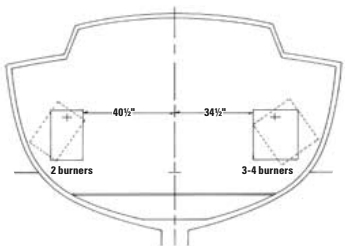
Location: Obviously a non-gimbaled stove must be fitted to face fore-and-aft so the cook stands out of line with any scalding spills. Such a stove also needs high sea rails plus a high dam on the inboard side to prevent spills from burning any passing crewmember. The gimbaled stove is, with few exceptions, fitted to face athwartship but must be located far enough inboard that it can swing to 30 or 35 degrees as the yacht heels. Indeed some designers recommend that it can swing to 45 degrees! Even then the cook must wear foul weather gear in heavy seas for protection against spills as a scalding burn at sea can prove fatal.
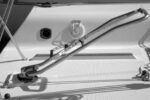
Any stove should have a fixed guard, usually a stainless-steel tube, so cooks cannot fall into the stove in a seaway, plus a safety belt, so they cannot be thrown off their feet while holding a hot utensil. The safety belt may pose its own problem though, as a belted-in cook cannot easily skip out of the way of a spill. Wearing complete foul weather gear does reduce that danger. The stove should have a lock to prevent gimbaling at anchor and a lock to keep the oven door closed if you are cooking a roast or casserole in heavy weather. Of course the stove space should be completely lined with sheet metal, usually stainless steel or aluminum, to prevent a fire in case there is a spill of fuel or burning fats.
Sinks
Galley sinks must be quite deep as the all-too-usual 5-inch- to 6-inch-deep sink is useless at any reasonable angle of heel. Indeed, one 9-inch- to 10-inch-deep sink is much better than two shallow sinks, but two deep sinks are better yet. A too-small sink is almost as bad as one that’s too shallow. A sink with a 13-inch by 17-inch outside dimension, including the flange, works well. The shallow round basin that is often seen in smaller craft is almost useless. It should be relegated to the head, rather than built into the galley.
Sinks are usually located as high and as close to the centerline as possible so they will drain properly. However, sinks can be fitted with a positive manual pumpout, hand- or foot-operated, and will then work well in any location or heel angle. A good diaphragm foot pump is recommended as it is less likely to be clogged by grease or food particles than a vane pump. The drain is very rarely fitted with a proper trap, but it should be. You don’t want the loose diamond from your ring to plop into 600, or even 60, feet of water. The galley drain must always have a proper seacock where it exits the hull, of course, and the seacock should be readily accessible and have a wooden plug handy in case of a hose rupture.
The galley should have two faucets, one providing fresh water and the other hooked to sea (or lake) water, as this will conserve the freshwater supply. The seawater pump should be fitted with a strainer as well as a two-way valve so it can provide fresh water in case the pressure system goes kaput. I recall a trip to Bermuda in the early 1960s when the batteries died, the pressure system went out, and we had to unbolt the top of the water tank to dip out the precious fluid. That was a good lesson for a designer.
For manually operated galley faucets, I prefer the Whale or a similar foot pump to a hand pump. With the foot pump, you can have the water running and still have two hands free to hold and scrub a pot. Pressure systems can be the simple on-demand type where the water flows as you open the faucet and are capable of handling two to three faucets at a time. For such systems I recommend the diaphragm-type pumps that can be run dry without damage and a small pressure accumulator that will reduce cycling and pump noise.
Larger yachts will require a more sophisticated and expensive system, such as the Paragon or Groco, complete with a large pressure tank, in order to handle the greater requirements of multiple faucets, showers, and so on. Where freshwater tankage is moderate, spring-loaded faucets will conserve water on a pressure system.
Refrigeration
The typical small cruiser will have an icebox, not a true refrigerator, as the machinery required for the latter can be quite expensive and temperamental as well. A good icebox liner will be of stainless steel or fiberglass, but the most important thing is the insulation. The best insulation is freezer grade polyurethane foam, 4 inches or thicker, and with a vapor barrier, such as a polyethylene sheet, on the warm side of the box.
Access to the box contents is usually attained by top opening, as this spills less cold air in theory and, in turn, conserves the ice. Still, a front opening box is handy as it gives much better access to the items in the bottom of the box. In the long run, it may spill less cold than dragging everything out to get at whatever’s buried deep in the bottom. If the box faces athwartships, the shelves should have a deep lip to prevent spills when the door is opened at any heel angle. The perfect icebox would have top and front openings, in my opinion.
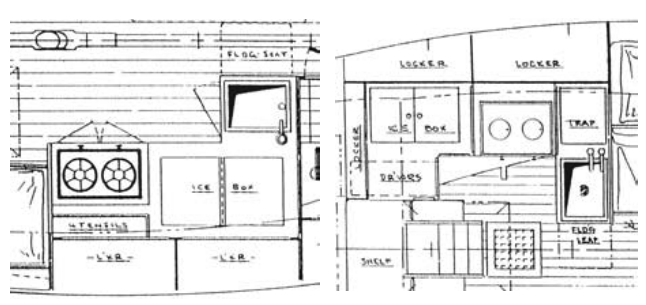
Few iceboxes in stock production boats have much in the way of shelves, yet a few well-placed shelves can do so much to keep the contents in order. Shelving can be of stainless-steel wire, expanded aluminum, or traditional ash. A neat feature, seen on far too few yachts, is a deck-loading hatch, usually through the bridge deck, that plops the ice into a bunker part of the box (see illustration on Page 19). One essential is a good icebox drain to get rid of the melt water. This can be a simple tube leading to a container in the bilge that can be lifted out and drained overboard or a small bilge pump fitted in the box to pump the ice water into the galley sink. Whatever you do, don’t drain the melt water into the bilge as ice usually contains small organisms that will die, decay, and stink.
Electrical refrigerators for small yachts can be the simple 12-volt DC/115-volt AC units, similar to small household refrigerators, offered by Norcold and similar makers. We have used these on our boats with very good results. The current draw is high, but running the engine a few hours a day handles it. We’ve found they will hold the cold overnight, plus the units can be run on 115-volt AC when you’re parked at the marina. They’re very useful for the weekend cruiser in areas where ice is not readily available.
The even smaller electric ice chest run on the thermocouple principle can make sense for the very small yacht. We have one we run in our car on cross-country trips; it definitely beats hunting for ice every day. Since it runs on both 12 and 115 volts, we take it into a motel at night and plug it in. The same could be done at a marina, of course. The one advantage of these units is they are portable; you can take them ashore to clean or refill them and chill them at home before you head out for the weekend on the boat.
The refrigerator and freezer on larger yachts can be mechanical and run off the engine by a vee belt with an electric clutch, or it can be completely electrical. The latter may be 12-, 24- or 115-volt, depending on the yacht’s system. I prefer boat voltages to 115-volt AC as, with a large battery bank, you can still go ashore for a day or two to tour the area. With 115-volt AC, the engine must be started periodically to bring the box temperature down, and this may be inconvenient if the boat is at anchor.
Large refrigeration units usually have holdover plates so the engine only needs to be run an hour or two a day to charge them. They are ideal for bluewater cruisers provided they have adequate power generation and large battery banks. Like most yacht designers, I’m not a refrigeration expert so I tell clients wanting such a unit to consult with a professional accustomed to dealing with marine refrigeration and its many problems.
The cabinets
Galley cabinets should be about 36 to 38 inches high if the boat has standing headroom and 12 to 13 inches above the seat cushion if the boat has only sitting headroom. The galley top is usually Formica, but some prefer stainless steel. My feeling about stainless steel is that you might as well fit your dishes with roller skates in any kind of a seaway. Matte Formica works much better, and a rubber nonslip pad can be used in heavier going to keep things in place.
The final dish saver is a high fiddle of teak or ash, about 1 1⁄2 inch, strongly through-bolted and shaped to provide a hand grab for the cook in extreme conditions. The corners should be open for an inch or two so that crumbs and other crud can be cleaned off easily with a damp rag. I have often extolled the beauties of a maple or ash counter top, and they are pretty, but in these days of increased concern about hygiene, I think I’ll pass on that. A food preparation surface should be of a material that is more easily cleaned and disinfected if you are to avoid severe digestive problems at sea.
A big part of galley stowage is the trash. When harbor hopping, you can be charged $2 or more to dump a bag of trash. A trash bin in the galley is convenient, but it won’t suffice for anything more than a weekend voyage. My recommendation for a long ocean voyage is to carry plastic and heavy paper bags. Separate the plastic, store it in a plastic bag and, where possible, drop it off ashore where garbage can be properly handled.
If you are making offshore passages, decomposable items can be placed in a heavy paper bag and dumped at sea . . . way out at sea. Know the discharge regulations and be in compliance with them. Punch the bag with multiple holes so it will sink and weight it so it will sink quickly. I’ve sailed with some engines that would make a good weight. Failing that, take along a supply of heavy beach rocks.
That’s it. A good galley takes a great deal of thought. I didn’t know just how much until I started to write about it and put down much of what I’ve learned the hard way over the years. Even now, I’ve just scratched the surface.
Thank you to Sailrite Enterprises, Inc., for providing free access to back issues of Good Old Boat through intellectual property rights. Sailrite.com