A marine surveyor’s best friend
Issue 36 : May/Jun 2004
A moisture meter is a marine surveyor’s best friend, but do you need to own one if you are not a surveyor? Basically there are two types of marine moisture meters, the pin type and the pinless. The ones to use on our boats are the pinless variety. We don’t want a thousand small pinpricks in our beautiful fiberglass hulls. There are other types of industrial moisture meters, but they are not suitable for use aboard recreational boats.
Pin-type meters work on conductance, while the pinless meters work on capacitance. Pin-type meters are used to measure wood and other materials that can have the probes driven into the material. These pins measure the conductivity of the material into which they are placed. This does not give the actual moisture content or a true reading but an inferred reading based on the conductivity of the sample.
The pinless, or capacitance-type, meters are completely nondestructive and quick to use, but they are sensitive to surface moisture. They also depend on material density. Pinless meters work on the principle that the capacitance of a material changes with its moisture content. They also give a relative value of the water in the substance being tested. They do not give the actual amount of water. All meters must be calibrated for the specific material they will be inspecting, but calibration is a quick and easy process.
Not long ago, while doing a survey on a Watkins 27, I used the moisture meter to check the decks. The client asked me if I thought he needed to own a moisture meter. I answered, “No, I don’t think you really need one. First of all, you can get a complete survey for less than the cost of a meter, and you will know all there is to know about your boat. Second, moisture meters are easy to use, but it takes a bit of interpretation to know when the ‘Moist’ reading on the meter is a source of concern and when it may be caused by surface water, dew, or even perspiration.” In the end the client decided he didn’t need a moisture meter, but he did want to commission a survey to show him where potential problem areas existed.
Gradual process
A boatowner needs to realize that moisture in the deck is a gradual process. The moisture does not appear overnight, and penetration can be prevented. Particular attention should be paid to any area where the skin of the deck is penetrated. This is especially true of lifeline stanchions, cleats, blocks, and the like. Constant maintenance and annual inspection of the caulking in these areas will prevent water from getting a start into the deck.
Some boatbuilders use moisture meters to determine the moisture content of the balsa wood core before it is installed into the deck of a new boat. By simply being exposed to the atmosphere for a period of days in a humid climate, balsa will absorb some moisture and not bond to the fiberglass structure as well as it should. A problem has started, and the boat is not even built yet.
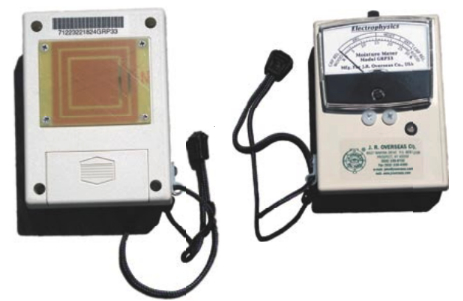
A typical moisture meter has two scales, one for wood and one for fiberglass. The scales on the meter shown can be somewhat confusing. For wood, 0 to 15 percent moisture content is considered dry. The range above 15 percent up to about 23 percent is considered moist, and above 23 percent is considered wet.

Different percentages
It is not appropriate to use these moisture percentages for fiberglass. On the same meter, the fiberglass range considered to be “dry” is actually zero percent to 0.85 percent (that’s right, less than 1 percent). The “moist” range for fiberglass runs from 0.85 percent to a little over 2 percent. Above the “moist” range, the “wet” range runs from a little over 2 to 3 percent, which is considered absolutely saturated. To put it another way, full-scale deflection of the meter needle reads out as 30 percent when testing wood and 3 percent when testing fiberglass.
Moisture meters will not read accurately through bottom paint. This must be removed to get an accurate reading. The readings of these meters are to some degree relative. It is good to start at some point that is presumed to be dry and to reference all readings to that point.
Moisture meters are useful instruments that tell us not only about the moisture in our decks or hulls, but specifically where the moisture is located and relatively how much. This is valuable information in mapping out the area of a deck to be repaired. By carefully running the meter over the suspected wet area, an outline in chalk may be laid out delineating the wetness and showing those areas of good deck as opposed to the wet deck. When doing a repair, this saves a lot of time and effort and avoids destroying part of what is otherwise a good deck.
A moisture meter may be used to track a troublesome leak that originates perhaps at a portlight and exits several feet away at a liner seam. This feature proved valuable on my own boat.
Finding osmosis
A moisture meter may be used to determine osmosis in a hull and specifically where the osmosis is located.
A moisture meter is not the be-all and end-all of assessing a boat’s condition. It must be used with some experience and judgment by one who is familiar with this instrument. It is an invaluable tool. When combined with a surveyor’s experience and knowledge, it is able to give a full picture of the condition of a fiberglass boat.
Thank you to Sailrite Enterprises, Inc., for providing free access to back issues of Good Old Boat through intellectual property rights. Sailrite.com