What’s at the end of your shrouds and stays?
Issue 36 : May/Jun 2004
The stainless-steel standing rigging that supports our masts is critical to our sailing safety, and the terminals at the end of these stainless-steel cables are the vital connection between those cables and the mast’s tangs and the hull’s chainplates. Although most use a single terminal type, the swaged fitting, there are actually many other types of wire terminals.
In the old sailing ships of yesteryear, standing rigging was made of natural-fiber rope terminating in an eye that was wrapped around a wooden deadeye (see Good Old Boat, January 2002). When metallurgy was finally able to produce strong and flexible wire cable, these natural-rope shrouds were replaced by wire rope, but deadeyes still were used for tensioning. Finally, as manufacturing technology advanced further, stainless-steel standing rigging and threaded turnbuckles superseded the ancient ways of supporting masts.
However, there still are some boats whose stainless-steel rigging terminates in an eye. This eye is usually a wire-rope splice around a thimble — a sailor’s art that is not common in the repertoire of today’s boaters. Once the eye is formed at the end of the shroud, a turnbuckle can then be attached to this eye/thimble combination at the hull end and a shackle at the upper end.
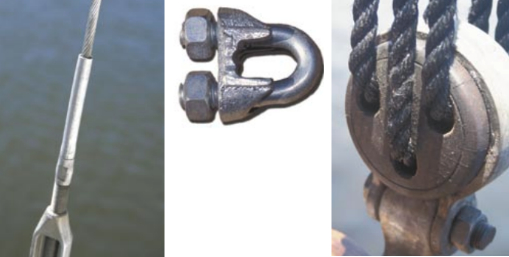
Patent wire clamps
Although a wire splice is the strongest way to create this eye, occasionally you’ll find bulldog fittings used. These fittings are U-shaped clamps with a sliding bar that is usually curved to fit the wire-rope diameter.
Though seldom seen as a working system these days, bulldog-fitting clamps are useful for an emergency repair of a broken shroud. When used for this purpose, the U-shaped end should never be used on the standing part of the shroud, since it tends to crush the cable. Even if you never plan to use this method to terminate your standing rigging, it’s a good idea to have two or three bulldog clamps and a thimble, sized to your standing rigging, as part of your emergency kit.
Galvanized bulldog clamps can be purchased from your local hardware store for less than a dollar each, and stainless-steel ones are available in marine stores for several dollars each. With these you can rapidly make a relatively strong eye at the end of a broken shroud or connect two broken ends together. This is a much faster fix than trying to use a more permanent fitting, such as a Nicopress, since the oval sleeve of that fitting requires a cleanly cut wire end, which could take time to accomplish, and time is in short supply during an emergency of this nature.
Getting a clean cut on stainless-steel wire rope is a tough job unless you’ve spent a lot of money for a pair of cable cutters made just for that purpose. One way to achieve a clean cut is with a hacksaw and several new fine-toothed blades. The key to cutting with a hacksaw is to have a portable vise so that you can hold the wire firmly and rotate it as necessary to cut through the strands. A pair of clamping pliers will also work in a pinch. Electrical tape, tightly wound around the wire rope at the point of cutting, is a big help.
Oval sleeves
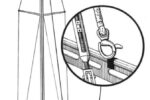
Another method of creating an eye in wire rope is the Nicopress (pictured at far right) or Talurit system. This method of terminating the shrouds is still seen occasionally on small boats. An oval metal sleeve is fitted over the short and standing parts of the shroud. This sleeve is then compressed hydraulically or manually, until the relatively soft metal of the sleeve fills in all the voids between the strands of the wire ropes as it compresses them together. To minimize electrolytic action, these sleeves are made of copper or stainless steel when used on stainless-steel rigging.
The manual hand-crimping tool that compresses this sleeve looks like a giant bolt-cutter, but instead of cutting blades, it has indentations in the jaws that fit the sleeve. Although some people call this a swaging tool, it should not be confused with real swaging. Another, simpler tool for this operation is one that compresses the sleeve between two metal bars by wrenching down two machine screws that pull these bars together.
The true swaged terminal, pictured on Page 13, is the type we are most familiar with. This type of fitting has an eye, fork, threaded stud, or insulator on one end, and a sleeve, the exact size of the wire rope, on the other. With the wire rope inserted into the fitting’s sleeve, the stainless-steel sleeve is hydraulically squeezed, rolled, or pounded until it forms into the contours of the wire rope. The roller swager, sometimes called a Kearney after one of the manufacturers, compresses the terminal onto the wire by rolling it between two wheels. There are small, portable, roller-swagers with hydraulic hand-pumps as well as larger swagers that use electrically operated hydraulic pumps. Even larger wire sizes require a swaging machine, which is an enormous device that can weigh a ton or more. It hammers the fitting until the sleeve is beaten into the wire. This machine, which costs thousands of dollars, performs the most satisfactory swaging operation.
Not superior
Most wire terminals found on today’s sailboats are swaged fittings, but professional rigger Brion Toss suggests that this is not because they are superior solutions — which they are not — but because these end-fittings can be produced in volume at relatively low prices and fastening them to the rigging can be done rapidly by anyone with the right equipment, whether highly skilled or not. This last point may be the reason for the high number of banana-shaped sleeves on the swaged fittings that Brion encounters on his clients’ boats (see Good Old Boat, January 2003).
There’s yet another type of swaged terminal fitting. It looks just like a normal swaged fitting but the sleeve that is squeezed onto the wire is a soft alloy, so a manual crimping tool can be used. This kind of fitting, which is often used on lifelines, is designated as a hand-crimp fitting. This hand-crimp soft-alloy-type of swaged fitting should not be used in high-load applications, such as standing rigging, due to its lesser strength (and I have strong reservations about using it for lifelines, also). When a hand-crimping tool is used on this type of fitting, it is usually crimped in three places, leaving three indentations in the sleeve. When a swaging machine is used on this type of fitting, the sleeve is smooth.
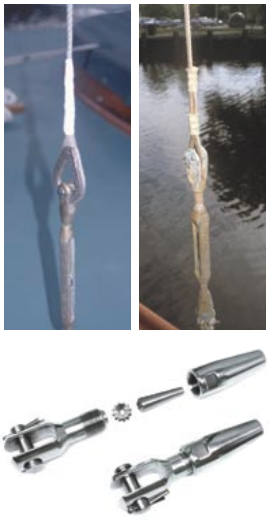
The final terminal fitting is a swageless terminal. Although a bit more expensive than the swaged terminal, this fitting is a do-it-yourself terminal that can be connected to the wire rope by a boatowner using nothing more than two wrenches. The fitting is machined from stainless steel and is stronger than any of the other rigging terminals. Because of its strength, reliability, and ease of replacement, it is often preferred by world voyagers.
Swageless fittings are reusable (except for the inner cone) and, as with swaged fittings, are available with an eye, fork, threaded stud, or insulator. There are several manufacturers of this type of terminal: Norseman, Sta-Lok, Suncor Quick Attach, and Hayn’s Hi-MOD (pictured at left), among others. Swageless fittings are an excellent choice when it comes time to replace the old standing rigging on your boat. It’s a job you can do yourself, one that will create a stronger mast-supporting system than when the boat was new. Installation instructions, with diagrams, come with each fitting.
There are also terminal fittings for rod-rigging, but as this type of standing rigging is uncommon on our sort of boats, we needn’t venture into that specialized territory.
Thank you to Sailrite Enterprises, Inc., for providing free access to back issues of Good Old Boat through intellectual property rights. Sailrite.com