Living with an old motorsailer calls for patience and special skills

Issue 37 : Jul/Aug 2004
Motorsailers are a vanishing breed. Every year one or more manufacturers drops from the field. If not in actual Chapter 11, they usually convert their production lines to make tugboat trawler look-alikes. In the words of Rodney Dangerfield, we motorsailors “don’t get no respect.”
In my area of the Lower Hudson there are only two true motorsailers in a fleet of several hundred recreational boats, both made by Willard a full generation ago. It’s hard to say who designed the Willard 30. Apparently the design was made by a committee, albeit a very talented one. The original lines for a 30-foot boat were laid down in 1957 by Bill Tighe, the founder and long-term president of Willard Marine. The boat was custom produced for several years.
In 1961 Bill Garden designed a slightly enlarged version, the Willard 36. This was Willard Marine’s fi rst production boat. The Willard 30 was introduced in 1972. Bill Garden lists it in his catalog of designs, so it appears that he had a hand in modifying the original concept. The sailing rig and the topsides of my Willard Horizon were designed by Bill Crealock. In 1974, in response to the fuel crisis, he modified the Willard 30 hull by adding a bigger mast and rig, modifying the topsides, and enlarging the keel to create the Willard 8-Ton Cutter, a true cruising sailboat.
Tighe, Garden, Crealock — quite a trio. Apparently they got it right because the hull was in production from 1972 to 2003, a 31-year run. Willard stopped making recreational boats last year because they were swamped with military orders following 9/11.
It is hard to defi ne a motorsailer. Francis Kinney, who revised Skene’s Elements of Yacht Design, lists a general rule that a motorsailer is a yacht with enough engine power to achieve hull speed and enough sail power to claw off a lee shore. Insurance companies conclude that this requires at least a sail area equal to the waterline length squared, divided by two. Thus, a motorsailer with a 40-foot waterline should, for insurance purposes, have at least 800 square feet of sail area. Less than that, and it is basically a powerboat with steadying sails.
Juan Baader, in The Sailing Yacht, has a much more pragmatic rule. He says that if a yacht is faster under sail than under power, it is an auxiliary-powered sailboat. On the other hand, if it is faster under power than under sail, it is a motorsailer.
Internal helm
All current motorsailers feature a pilothouse with full headroom and an internal helm. In fact, this feature almost defines the class. Several manufacturers, including Pacific Seacraft, build boats with identical hulls but differing deck moldings. Those with a pilothouse are called motorsailers, those without are called auxiliary powered sailboats. The type is much more popular in Northern Europe where typical boating conditions are such that most American yachtsmen would be heading for the nearest bar in search of a hot toddy.
Most motorsailer owners slip into the class as a waystation between sailboats and trawlers. They figure they can use their hard-learned sailing skills in the air-conditioned comfort of a full-powered trawler. They couldn’t be more wrong. I’ve been there, I know.
A motorsailer has twice the maintenance problems of the average boat. Not only do you have a full mechanical plant to agonize about, but you also have sails and rigging to consider. These take up space on deck and impose the ever-present threat of getting hit by a wildly swinging boom when jibing. Jibing, as I tell my non-sailing friends, is roughly the equivalent of backing your car into a garage. Easy when you know how, but the learning curve is full of dents and dings.
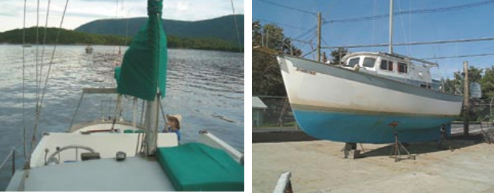
I have an older Willard Horizon motorsailer, Puffin, essentially the Willard 30 trawler hull with a mast and sail. This 30-foot hull has been produced by Willard Marine, Inc., of Anaheim, Calif., since the Jurassic Age, or at least since 1973. The hull has been in production as the Willard Passagemaker 30, although like most of us, it has grown slightly heavier with age. It has been fitted with a variety of topside moldings ranging from a commercial fishing boat through a luxury liveaboard for people who are content to reside in small spaces.
Feels larger
Puffin’s LOA is 30 feet, but the boat feels larger. The waterline length is 27.5 feet. It has a displacement of 16,000 pounds, of which 4,000 pounds is internal ballast. On my boat there is a wide, short bowsprit, and a full-width stern boarding/swimming platform. These appendages bring the length between perpendiculars to about 35 feet. The beam is nearly 11 feet, and the draft a measly 3 feet 6 inches, thanks to a full-length broad keel. The hull shape is vaguely similar to a Colin Archer turn-of-the-century lifeboat with a high bow and a canoe stern.
Like the Colin Archer designs, the Willard has very good seakeeping characteristics — a necessity, since it cannot outrun any storm. The rounded bottom gives it a tendency to roll more in a beam sea than hardchine trawlers do, but not as much as most sailboats under power. It is seaworthy but not altogether comfortable in bad weather. Boat motion is excessive in beam seas of 3 feet or more; it is unwise to have breakable crockery on the table or open beer bottles on deck when being passed by a powerboat.
Power is supplied by a Perkins 4-107 driving an 18- by 14-inch prop. The boat carries 260 square feet of sail on a low-aspect rig, a large foresail and a smaller main. This is only about half the sail that a cruising sailboat of similar specifications would carry, and Puffin can be considered to be sailing under perpetually reefed conditions. It is best considered a 30/70 motorsailer (see Ted Brewer’s article on motorsailers in Good Old Boat, January 2003).
Easily maneuvered
Maneuverability under power is exceptional with the sailboat-sized rudder, a 3.25- square-foot, half-inch-thick bronze plate mounted behind the prop. The inertia is fairly high, given the hull’s mass, but if you have the dexterity of a six-ball juggler, you can manipulate the engine controls and rudder to turn 360 degrees in the boat’s own length, convenient in crowded marinas.
The specifications were established when fiberglass construction techniques were still in flux and err on the conservative side. Trawler mavens speak of the Willard as the “pocket battleship” of trawlerdom and, judged by solidity of construction, they are certainly correct.
My boat is laid out like a cross between a cruising sailboat and a contemporary trawler. It has a conventional standing-headroom forepeak with two sleeping berths. Immediately aft and up a couple of steps is the pilothouse with full engine controls and navigational equipment. There is a complete electrical panel with circuit breakers for all onboard equipment and a 110-volt distribution system for the infrequent times we use shorepower.
The engine lies below the pilothouse floor at about the midpoint of the hull. It is easy to reach by raising a hatch, but all maintenance has to be undertaken upside down. Not good for someone prone to headaches. Fuel is stored in two 60-gallon black-iron tanks on either side of the engine. The engine’s central location requires a 13-foot-long propeller shaft with two support bearings, each of which must be greased periodically. There is little sound treatment, and noise levels are fairly high under power.
Double bed
Aft of the pilothouse is the main saloon with a galley and sink to port, and a table and dining area to starboard. The couch to the side of the table can be converted into a double bed for friendly guests. There are plenty of storage areas and cabinets. Aft of the dining area is the head and shower, small but adequate. The freshwater capacity is 100 gallons. Exit the saloon by climbing a couple of steps, and you are on the stern deck. There is sufficient space for a small party of, say, six people. It’s just about right for a summer barbecue but too small to host a school reunion unless you went to a very small school.
The water tanks and our LectraSan waste treatment system are in the lazarette below the stern deck. There is an additional large storage area there as well.
Above the pilothouse is the upper steering and sailing-rig control station. This is not the same as a flying bridge on a conventional trawler. A seating area and footwell for the helmsman are molded into the starboard side of the deck. A destroyer wheel is placed before the helmsman with a set of engine controls but no instruments. The mast is immediately to the left on the centerline of the boat. All sailing lines are led to the helmsman; the boat can be sailed singlehanded. Visibility is excellent but because the boom swings directly overhead, a Bimini with adequate headroom is impossible to fit while sailing. Sailing conveniences, as delivered, were minimal. We had to add cleats, winches, topping lifts, and so on. The boat could be sailed without this extra gear, but it wouldn’t be fun.
The interior decor is reminiscent of a well-appointed workboat, say, the private boat of the owner of a fishing fleet, rather than a floating boudoir. This is not a boat that was intended to appeal to the ladies. There is a lot of varnished teak inside and out and relatively small ports. The Willard 30 hull permits only about 200 square feet of living space . . . about that of a Sing Sing jail cell. This means that the boat is too small to live on comfortably for extended periods, particularly for those desiring a high degree of privacy. It is not an ideal marina-bound family “summer home.”
Comfortable cruiser
We have found that, compared to sailboats, the increased cabin space and relatively stable hull form make for comfortable cruising, but the practice of sailing takes some relearning. First, the drag of the prop is so great that sails alone move the boat at only 4 to 5 knots in 15 knots of reaching winds. Pointing is similarly poor. Sailing closer than 60 degrees to the wind is a chore. Under sail alone, Puffin’s performance is roughly on a par with Columbus’ caravels. We motorsailors learn to sacrifice a lot for creature comforts.
Running the engine at a tick over 900 rpm (about 350 rpm at the prop) when sailing makes all the difference. This compensates for the drag of the large propeller and provides enough prop wash to assist in turning the boat. Otherwise, you will spend half an hour backwinding the jib and getting caught in irons (another best-forgotten nautical term) every time you try to come about. The slight motor assist also permits you to sail closer to the wind than you can in a conventional sailboat, and you can move faster too.
You can overtake sailboat racers in a light wind with a boat that looks like Tubby the Tugboat with a mast. Just remember to turn off the engine as you pass so they can’t see the telltale exhaust, then make a quick turn downwind as if you’ve grown tired of a contest too easily won. The embarrassed and confused sailors will spend the next half-hour fidgeting with their sails to see what has gone wrong.
Apart from such puerile amusements, what is gained and lost with a motorsailer as compared to a conventional motorboat or trawler? Well, as I said, the maintenance offers more opportunities for worry, and you have the nagging problem of the mast for winter storage. Do you leave it up or down? The mast also inhibits your ability to pass under low-lying bridges, and you find yourself consigned to the parade of circling sailboats waiting for hourly openings while boats with less elevation scoot through.
Alternate propulsion
On the other hand, you gain the confidence of an alternate means of propulsion. If your motor ever packs up, you could eventually maneuver back to shore. This mitigates some of the obsession that motorboat owners have with fuel filtering, electrical malfunctions, and other power plant-killing gremlins. That, of course, and the confidence that sails provide unlimited range. Although it must be said that the wind, as an alternative source of power, leaves much to be desired. It either blows in the wrong direction, doesn’t blow at all, or provides an overabundance of propulsive effect in the form of gales, storms, and hurricanes.
But there are pluses. Motorsailers are, by and large, very attractive boats. Most landlubbers, and many yachtsmen too, equate boating with sails. Do tramp steamers attract as much admiration as tall ships? The necessity of mounting sail hardware spares most motorsailers from the futuristic design excesses of sedan cruisers. After all, who needs tail fins at 8 knots? In almost every marina I’ve had people come up to me and compliment the looks of my 30-year-old motorsailer. “It looks like a real boat,” they say. OK, so it can’t go faster than a 6-year-old on a tricycle — it’s better to look good than perform well.
In addition to the inherent “get home” ability, there are several real functional advantages of the motorsailer over a trawler of similar size. First, when compared to trawlers, the sails provide very good roll damping in beam winds and seas. I can ignore all the yacht club bar discussions about active vs. passive damping, paravanes, and flopper-stoppers. Who needs them? When the sails are up in a beam wind, my boat is rock steady, although it helps if your upwind leg is a few inches shorter than your downwind leg. And when those sails are up and the motor is going, fuel consumption drops to amazingly low levels. I am grateful that with fuel prices climbing to the stratosphere, I can squeeze an entire season’s cruising of about 1,000 miles out of one fill of diesel fuel. If I were to attempt a circumnavigation (fat chance), I would choose a motorsailer for that fact alone.
More gunkholing
Most motorsailers have less draft than sailboats of comparable size, opening up many miles of previously risky shoreline. This includes much of the eastern Chesapeake, the Florida Keys, and the coastal Carolinas. I don’t know about the West Coast, but I’m sure there are plenty of shallow, but desirable, areas. The easily lowered sailing rig makes canal cruising relatively simple. I can drop the mast singlehanded in about five minutes. This converts my motorsailer into a somewhat awkward trawler. At my disposal, I have the New York circumnavigation Little Loop (Hudson, Erie Canal, St. Lawrence, Lake Champlain, back to the Hudson) and the eastern U.S. Big Loop (ICW, Hudson, Erie Canal, Great Lakes, Mississippi, Tenn/Tom, Gulf Coast, Florida, and back to the ICW). Sailboats, with their masts and lower-powered engines, can make these trips but with far greater difficulty.
A motorsailer presents somewhat less challenge to basic seamanship skills. Full power turns contrary winds into a mere inconvenience. You can even plan trips and meet a schedule. My dedicated sailing friends accuse me of copping out, but I remind them that I have already paid my dues.
The Willard’s forte is extended cruises to remote anchorages for a reasonably adventurous couple. Here the seaworthiness and self-contained nature of the boat pay off. Its size and power requirements make for economical operation and a long range. The dimensions of the boat and conservative nature of the mechanical plant permit most maintenance to be carried out by the owner.
Solid hull
The Willard’s quality of construction is generally good. The very solid hull molding, the inner liner, and the deck molding are well bonded together making for a very rigid structure. Like many factory-made boats, the mechanical components are inserted during construction and access for repair or replacement is minimal. Most owners who have repowered their boats report that considerable surgery has to be performed to get at all the bits and pieces. Fortunately, the mechanical parts are very conservatively rated and last a long time.
The older Willard hulls are susceptible to osmotic blistering. This seems to be characteristic of many boats made during the 1970s. The gelcoat on my boat shows an overall superficial craze of fine cracks. I was told by a factory engineer that the early series hulls were constructed of the same plastic used for military-specification boats. Willard supplied many of the craft used to pacify the Mekong Delta during the Vietnam War, and halogen salts were incorporated into the resin as fire retardants. Unfortunately, the salts also absorbed water. Obviously, Navy combat and surfboats were never intended to last 25 years. We have repaired more than 300 blisters below the waterline, some up to 4 inches in diameter. There are numerous small gelcoat blisters above the waterline but, since they pose little structural threat, they have been largely ignored. The final fix, total below-waterline repair with six layers of Interprotect epoxy barrier coat, seems to be holding; only a few new blisters emerge each year.
Barring the annoying blistering and crazing problem, the Willard 30 motorsailer is just fine for a retired couple who want to experience the cruising lifestyle without selling the old homestead and moving aboard. It is small enough to keep the costs reasonable, especially for a handyman, yet large enough to take any coastal voyage imaginable. It is more comfortable than our previous sailboats and provides almost enough room to swing a very small cat. My wife and I have lived aboard a month at a time and still speak to each other.
The basic problem of the motorsailer is that it requires a psychological straddle on the part of the owner. Sailboat owners find pleasure in the process of sailing. Trawler owners are much more goal-oriented. They find pleasure in the destination. A motorsailer requires that the skipper possess the attitudes and skills of the power community some of the time and those of the sailing community some of the time and to mix the two the rest of the time. Most owners lean one way or the other. Comparatively few owners seek the middle ground.
Besides, sailing a motorsailer gives me sails to fiddle with on those long boring passages. Who knows what trouble I might get into if I didn’t have that diversion?
Too bad motorsailers are a vanishing breed.
Thank you to Sailrite Enterprises, Inc., for providing free access to back issues of Good Old Boat through intellectual property rights. Sailrite.com