Nearly 20 years in production, and this centerboard cruiser is still going strong
Issue 37 : Jul/Aug 2004
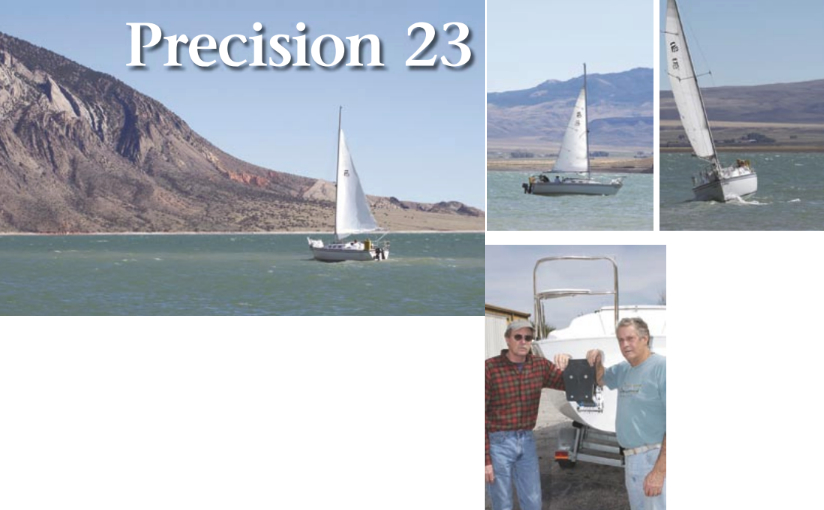
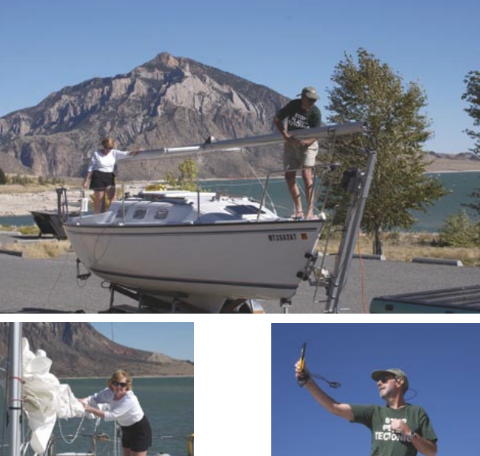
Given the choice, I’d rather test boats when the sun is shining, the temperature is in the 70s, and the wind is blowing. So when those conditions appeared on the day I was scheduled to test the Precision 23, I donned shorts and a T-shirt, laid on the sunscreen, and headed for the Buffalo Bill Reservoir near Cody, Wyoming, with a smile on my face.
The reservoir may not be San Francisco Bay, but wind is wind and water is water, and we had the entire 8,000-square-acre patch to ourselves except for a handful of retirees on the beach guarding fishing poles and bottles of Bud. Filled by the North Fork of the Shoshone River flowing from Yellowstone National Park, the reservoir provides plenty of swirling wind during summer months and room enough for a 23-footer to stretch her legs on a downwind run.
My hosts were owners Carol Jackson and Chris Allen, residents of Red Lodge, Montana, a 50-mile jaunt from their favorite cruising ground. On this day, Carol was a schoolteacher playing hooky. She grew up as a cowgirl on a family-operated ranch that runs cattle drives between northern Wyoming and southeastern Montana. Her introduction to sailing occurred when she and
Chris crossed paths in Indonesia. Chris, a self-described wanderer before finally enrolling in college at age 32, had migrated to Indonesia to take his first real job as a high-level manager with a mining company. After years in the corporate world, he is now consulting, and in between paid jobs he says he is “making up for 15 years of no sailing by spending most summer days on the water.”
On the beat
Initially sailing with a full mainsail and jib, the Precision beat to weather under Chris’ steady hand on the tiller while Carol trimmed sails and soaked up Vitamin D. In moderate winds the Precision sails at 4 to 4.5 knots and tracks well with just enough helm to keep the skipper on his toes. She easily tacks through 90-degrees and accelerates quickly after every turn, reaching 5 to 5.5 knots with sheets eased.
However, the easy sailing disappeared when afternoon thermals produced 15- to 25-knot winds and 3- to 4- foot waves that extended from one end of the lake to the other. A characteristic of the boat is that when windspeed exceeds 15 knots, it’s time to tuck a reef into the main, and when it pipes up into the mid-20s, the jib works best from the inside of a sailbag.
Nonetheless, though we beat and slammed to weather, she was very manageable, her helm light and responsive, except when a 4-foot wave elevated her bow more than 45 degrees above the horizon. With the mainsheet cleated near his fingertips on the backstay, Chris was able to quickly ease the sheet when she felt overpowered. On a beat, her flared topsides deflected most of the waves, except the rare rogue that found its way onto the deck. Sailing downwind, the ride was faster but bumpy. I bet she’d surf down the waves under spinnaker.
The company
Now celebrating their silver anniversary year as the owners of Precision Boat Works, Inc., in Palmetto, Florida, brothers Bill and Richard Porter have unceremoniously and unobtrusively carved a niche in the boatbuilding world that, like clockwork, results in the production of 140 new vessels every year. (Actually, with business up 16 percent this year, they’ll do more.) More than 3,000 14- to 28-footers have been completed since they opened the doors for business. During my tour of the factory on Florida’s west coast, Precision 23 hull #500 was in the mold being readied for completion.
Interestingly, the brothers’ sales accomplishments have been produced by a distribution system that fluctuates between 25 and 35 dealers, most located east of the Mississippi River, and virtually zero advertising in the glossy magazines. Word of mouth among happy owners is a major contributor.
Following childhoods spent in Detroit, and after disdaining academia, the brothers, now in their 50s, gravitated to southern Florida. As Bill says, “We began our careers as boatbuilders not as the owners of a boatbuilding company.” They eventually found a home at Hidden Harbor Yachts, the manufacturer of the Seaforth sloop. During their tenure there, they established a reputation as the builders of high-quality molds, among the most critical ingredients in the construction of a boat. When that company went out of business, the brothers purchased the molds and started their own firm. “We started in 1978 with the idea of bringing sailing to the average person,” Richard says.
Eventually crossing paths with Jim Taylor, they began the first of the new breed of Precision yachts with an 18- footer introduced in 1984. Other similar keel-centerboard weekender-style boats (including a cabin) included the 21 and the 23. The most recent of the company’s Taylor designs is the Precision 185, which is a high-performance daysailer.
Never far from the shop floor — “we’re not the type to sit in a second-story office and watch the workers,” Richard says — they both spend five to six hours a day overseeing the construction of new boats, assisting their crew, and training workers to do things the Precision way.
The company also manufactures Steve Colgate’s well-known daysailer, the Colgate 26, a zippy learning platform for newcomers to sailing. It has produced 200 of that model, including a fleet used for training purposes at the U.S. Naval Academy.
The design
Despite her age, the Precision 23 has as much curb appeal as the most recently designed sloops on the market. The underlying theory of Jim Taylor’s boat design as it related to Precision yachts is that “fast is fun, we want quality, and they should be easy to build.” That this 1980s design still looks as fresh as many New Millennium production boats is a testament to the fine eye and skill of the noted naval architect, who fashioned designs for the Precision 18, predecessor to the 23, and the 28, her big sister.
Of the Porters, Jim says, “to their everlasting credit, Precision Boat Works has always eschewed flash-in-the-pan gimmickry in favor of structural integrity and long-term functionality.”
Jim Taylor began his career by spending five years in the Ted Hood design office. He was involved in the 1974 and 1977 America’s Cup, working on Hood’s Independence and the reconfigured Courageous that Ted Turner drove to victory in 1979. After opening a solo practice, he produced a fleet of 40-footers in the 1980s that were designed to the emerging International Measurement System (IMS) rule and was a member of the design team on Bill Koch’s winning America3 Cup effort. He also designs production boats for Sabre, including the 386, a traditional-looking cruiser with a contemporary underbody.
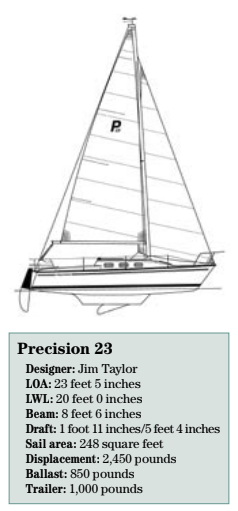
Jim’s challenge from the Porters was to provide the trailerability of the 18-footer while adding a cruiser aspect to the bigger boat. “We wanted the biggest trailerable cruiser possible, a ‘maxi-trailerable,’” he says. Coming on the heels of the 1980s fuel shortage and a (short) period during which auto manufacturers were more interested in producing small, fuel-efficient vehicles than SUVs, matching boat weight to towing capacity was added to the mix. However, he managed to design a craft that displaces only 2,450 pounds, so is towable by a typical family sedan or half-ton pickup.
Careful refinement
The hull represents “a very careful refinement of the basic form that has proven successful in other trailerables,” Jim says. She sports a fractional rig that, except on a scattering of raceboats, was unusual at the time. The sail plan is “fairly simple,” he says, though inboard chainplates improve sheeting angles.
A “racer-sharp waterline entry, which we learned really does carve through waves, is augmented by flare in the topsides,” he notes. That keeps the crew dry in gnarly conditions. The boat also has “powerful quarters that taper to a shapely and relatively small transom.” The underbody is the product of tinkering he did with his personal craft, a 23-footer that he successfully raced in MORC and Mini-Ton racing divisions. On the circuit, the Precision 23 PHRF rating is 220 to 225, depending upon the locale.
“We wanted to produce a well-balanced boat with good fore-and-aft distribution forward so that when she’s heeled, the bow does not go down, which stalls the rudder. She’s not cranky when heeled,” Jim says.
Having learned the intricacies of centerboards during his tenure with Hood, Jim’s design for the keel incorporates 850 pounds of inboard ballast and a relatively light, 85-pound centerboard that tucks into the hull when on the trailer.
“Heavy centerboards require a lot of machinery to operate and don’t produce boats that sail well with the centerboard up,” he says. Since the centerboard on the Precision 23 is primarily a lifting foil, it contributes to weather performance, but does not produce a boat that spins out with the board up.
“Another requirement was that she be open and stylish,” Jim says. To that end, chainplates and genoa track were moved from the rail to the side of the cabin, a move that allowed the house to be moved outboard, creating space belowdecks, while still leaving a deck wide enough to allow crew to move forward easily. As a result, “the seating area in the main saloon produces comfortable backrests and plenty of headroom when seated,” he adds.
Construction
One of the large financial institutions recently developed a slogan to attract new investors: “We make money the old-fashioned way. We earn it.” The same could be said of the construction methods employed at Precision by the Porters as they oversee the day-to-day activities of a year-round workforce of 20 employees.
As Richard says of the construction process, “Jim Taylor designs boats that go together well, so our workforce doesn’t have to be acrobatic in order to lay up a boat. Since we’re using and maintaining our own tooling, the product is consistent.” Sticklers for detail, Richard carefully monitors the lamination process, and each boat must pass Bill’s quality-control inspection before going out the door.
“We don’t ship a boat until we’re happy with it,” Bill says.
Hulls are constructed of hand-laid fiberglass. As Bart Bleil, the firm’s sales manager, says, “We don’t even own a chopper gun.” Vinylester resins are employed in the skin coat on most recently constructed boats; early models were constructed using a polyester resin, although at that time the company offered an epoxy barrier coat for sailors concerned about blistering of boats that were wet-sailed.
The layup includes woven roving on the hull with two additional layers below the waterline that overlap 12 inches on both sides of the centerline. The thinnest sections are a combination of 1.5-ounce mat, 24-ounce roving, and another layer of 1.5-ounce mat. The cabinroof is a foam-cored sandwich with Divinycell or Klegecell inlaid between three layers of 1.5-ounce mat; extra roving is added along the rail and in high-stress areas.
The hull liner is integral to the structure, replacing the old-fashioned method of laying beams and stringers, and extends to the sheer clamp, where it is sandwiched between the deck and hull flanges. It is bonded with 3M 5200 and bolted to form the hull-to-deck joint. My survey of used boats reflected only one owner who experienced a leak at the joint; odds are that was caused by a bonding compound that deteriorated with age.
From a historical standpoint, the extra time and care taken to build each boat have resulted in a mostly happy fleet of owners.
Cockpit and deck layout
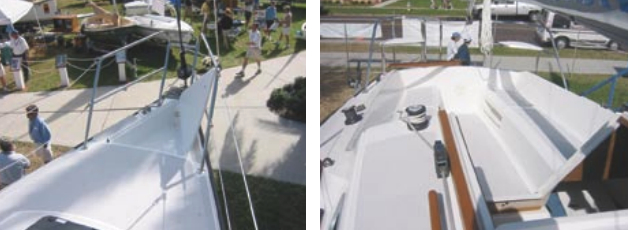
Sailing the boat is a simple matter of pulling a string here, turning a winch there, and managing the tiller . . . unless the wind pipes above 15 knots or you’re flying a spinnaker. The length of the cockpit at seat height is 7 feet, so there’s plenty of room for four adults.
The cockpit is equipped with two primary winches that were initially installed too far forward to be easily reached by the helmsman; these were relocated further aft in newer boats, an improvement.
My only complaint about the layout of gear is the location of the Harken 4:1 mainsheet at the end of the boom, which is sheeted to a cam cleat on the backstay. Though that allows the helmsman to control the sail, the angle of the sheet does not allow the mainsail to be trimmed for maximum performance, a condition that will be of little importance to most sailors. A mid-cockpit traveler is not an option since it would be a nuisance for most sailors, so the best alternative is the addition of a vang, which will improve sail trim.
There’s a sail locker in the cockpit, as well as an open-sided fuel-tank-storage locker that is large enough to stow a 12-inch x 24-inch x 9-inch-high fuel tank.
Belowdecks
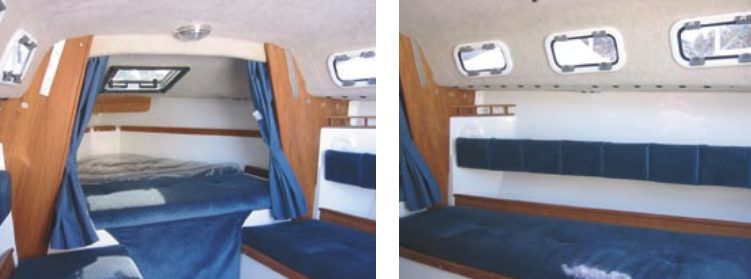
One of the appeals of this boat is that the designer managed to maximize space belowdecks without altering the hull shape, perhaps sacrificing performance in the process. Moving the chainplates inboard increased interior volume, and cutting away the middle section of the forward bulkhead created a visual sightline from companionway to bow. The V-berth, which measures 77 inches on the centerline, is enclosed by a privacy curtain, as much privacy as can be expected on a 23-footer. Cabin headroom is 54 inches, and aft berths are 73 inches and 138 inches long (for sleeping head-to-head).
Settees port and starboard amidships provide comfortable seating. The galley, equipped with a small stainless sink, two-burner alcohol stove, and room for a 48-quart ice chest, is large enough for camper sailing. Accent pieces are nicely finished teak plywood, a headliner constructed of a polypropylene fabric that is mold resistant, and 3-inch-thick cushions protected with Scotchguard.
Pricing
New boats sold in 1984 for $18,415 from the factory. Base boats, with sails and all standard equipment, have a suggested retail price today of $23,195. A trailer, which adds $3,695 to the price, was specifically designed by Richard to locate trailer bunks in a fashion that does not put stress on the hull. A welcome addition to the trailer is a standard mast-raising winch system mounted on the tongue that makes hoisting the rig a snap.
Conclusion
Bottom line: nearly 20 years after noted yacht designer Jim Taylor completed the design for this little number, she’s still in production and very competitive with similar boats on the market.
Thank you to Sailrite Enterprises, Inc., for providing free access to back issues of Good Old Boat through intellectual property rights. Sailrite.com