Sailorly advice for the fight against the evils of alcohol
Issue 44: Sept/Oct 2005
Advice to the new owner of a boat with a Princess stove:
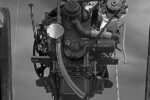
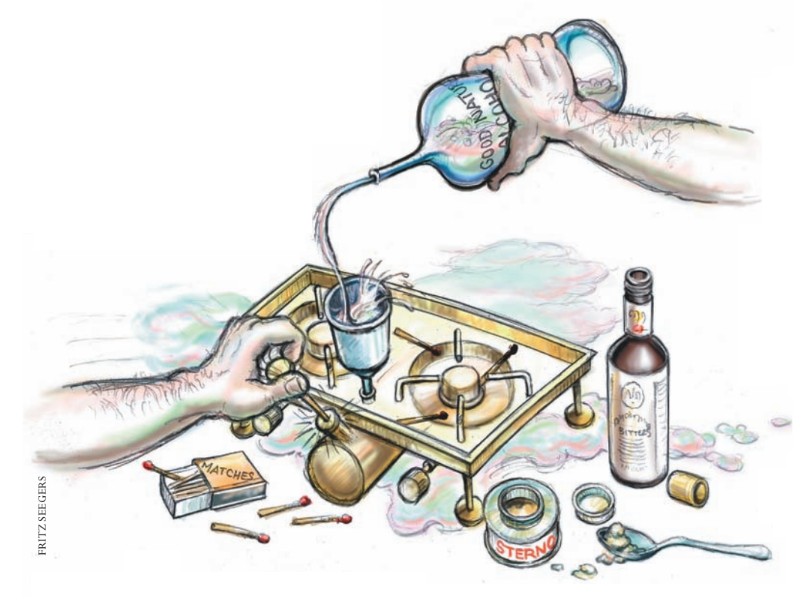
THE VALVE-LIKE THINGIE ON THE TOP of the stove is where you pour in the alcohol. Turn the valve; you’ll notice that it screws off like a cap.
Now you need some fuel. Make sure you buy official marine-grade alcohol stove fuel. Pay no attention to the denatured alcohol solvent at your local paint store. One thing to remember about alcohol as a fuel is that it is invisible in whatever form you find it. You should use a funnel to help get some of the alcohol into the stove. Much of it, with no explanation at all, will escape the funnel, no matter what you do, and soak your sleeve or pour itself down the back of the stove and wind up underneath.
Carl Jung opined that obsessive drinkers are trying to contact their spiritual natures through the use of spirits. I’d say spirits (or alcohol) have the ability to do amazing things all by themselves. I am living proof that this is so. I’d have to guess that, between the threat posed by my Princess alcohol stove and the 16 gallons of gasoline in the tank for the Atomic 4 engine, I’m just playing Russian boat roulette, but then I really am a risk taker. I also used to own a 1959 Jaguar with a Lucas electrical system, so I know the true meaning of the word “risk.”
After you manage to get some alcohol into the Princess, you are now prepared to find out that the stove needs a serious rebuild. You can get the parts from A&H Enterprises, 714-258-2525. If you’re like me, and you have a $30,000 restoration project ahead of you just to keep your boat from sinking with all hands in the marina, you’ll press ahead without the Princess rebuild. Many seasons will come and go, and you’ll be looking for a reasonably priced Origo stove, but just when you find one for sale cheap on the Internet, someone else will snap it up, or you’ll be out of cash at that moment. Finally, in desperation you’ll go back to your boat and use the Princess.
Pump the plunger
Where was I? Ah, yes, after you mop up the now completely invisible alcohol stove fuel and have recovered from the fumes, you just pump in and out on the plunger on the front of the stove. If you are lucky, it’ll pump solidly about 8 percent of the time, and you’ll be able to pump up some pressure inside the fuel tank. If you vary the angle of the plunger slightly on each stroke, you may find an angle that gives you more solid pumps than other angles. This angle will change after every plunge, so experience won’t do you any good, but you will have something to do with your mind while you are pumping up the pressure.
Next, bring out your secret weapon. You will need either a little squirt bottle of alcohol stove fuel with a teeny little squirt nozzle on top or some Sterno. The good thing about Sterno is that you can squeeze it through a sock and become an obsessive drinker. Anyway, squeeze a leetle tiny bit of alcohol stove fuel into the bottom of one of the burners or spoon in a tiny bit of the Sterno and a dash of Angostura bitters, then light it off. You can probably dispense with the Angostura bitters if you are religious.
The purpose of the first ceremonial lighting of the fuel in the bottom of the burner is to placate the curtain gods. It is well known that from time immemorial the curtain gods have frowned on all watercraft, especially watercraft with pressurized alcohol stoves, most especially watercraft with Princess stoves and cheap owners. You have not yet sacrificed properly, the curtain gods say. You don’t have an Origo stove. Therefore, if you approach the Princess without a sacrifice, you risk burning up your curtains and losing your eyebrows. This is why I have Peek-a-Booo shutters on my portlights. I’ve changed the dynamics of the struggle entirely. Of course, soon after I made that change I began experiencing strange shorts in the electrical system, so I think I’ve merely succeeded in driving the struggle deeper into the psyche of the boat.
Goal achieved
When the invisible flames have died down, you have achieved your goal. The curtain gods have been appeased. If you have your pot of water or soup pot or whatever it is that you want to heat up, put that pot on the burner just after you light off the ceremonial fire. This starts heating the pot, keeps the flames contained, and preserves your eyebrows. Maybe. At this point you may be thinking of bringing nothing that needs heating on any subsequent trip — ever.
The side effect of the ceremonial sacrifice to the curtain gods is that when the flames die down, the burner will be hot. This is the magic moment. If the stars are aligned properly, if the bottom is perfectly faired and barnacle-free, and if the Dow Jones average is just so, you should be able to release ever so slightly just so much pressurized alcohol stove fuel by slowly turning one of the fuel-release knobs on the front of the stove and holding a match to the resulting fuel/air mixture.
Know what a fuel/air bomb does? Maximum damage. Remember this when releasing the fuel into the burner. It won’t explode, but a flareup will spell curtains for your curtains. Just a wee bit of fuel will do. You’ll hear the hissing almost immediately, and you’ll have your match there ready to light the stove. The fuel/air mix is now perfectly invisible, as will be the resulting flame, should you achieve one. You are left to your own devices to figure out if you have achieved success or whether you have to start over with the other burner.
Long lighters
What you really need to buy in order to light the stove is one of those long-nozzle plastic lighters, the ones that have a switch and a trigger. If you get enough pressure on the switch, you can’t properly pull the trigger. If you release some of the pressure on the switch, then you can pull the trigger but you won’t get a flame because you have to put more pressure on the switch to do that. After some practice you may get a flame 12 percent of the time. This is a high score; consider yourself lucky.
And there you go! Instant cheery heat to boil the water for your oatmeal, make coffee, or bake bread. Bake bread on a Princess stovetop? It can be done. And if all of this seems discouraging, it is not meant to be. After a few seasons of practice, you should be bringing a Thermos of hot coffee along from home and cooking on your propane barbecue on the stern rail.
Did you hear about the grease cup on the water pump on your inboard engine? Did you know that you have to give it a turn after every two hours of engine use? No? How about the freshwater flush of the outboard after every use? No? Well, there’s more boating fun ahead for you to discover.
Thank you to Sailrite Enterprises, Inc., for providing free access to back issues of Good Old Boat through intellectual property rights. Sailrite.com