How to make sailors of your four-legged furry friends
Issue 42 : May/Jun 2005
For boatowners contemplating frequent getaways or The Big Cruise, the most emotionally fraught question is sometimes a surprising one: wait for Fido or Tabby to die or take him or her along?
If home is not home without a companion animal, what are the complications and drawbacks of cruising with one? If you have read this far, you will probably be aware of the rewards of living with a pet, so what follows will emphasize the difficulties. Depending upon one’s preference in pets, these difficulties may be small or large. When cruising internationally, I came across a wonderful range of creatures aboard: a tortoise, a duck, dogs, cats, a pair of ferrets, a cockatoo, and a snake.
Most of these long-distance pets were small. In fact, most liveaboard pets were cats. On the Australian coast where Cooee and I are currently cruising, every second boat has a dog aboard, frequently a large dog and occasionally two or three of them. My own firsthand experience since living on a boat has been mainly with cats, but I have lived aboard with a bird, briefly, and with a monkey, very briefly.
Becoming converted
The first time I sailed with a pet was on a delivery trip across the Pacific, from Mexico to Australia. There were five of us on board, and before we left a friend pressed a pretty male kitten onto us. No one was keen on the idea, but the woman had been helpful to us and had too many cats already to care for another. We took Jack along, and it turned out to be a good decision. On long passages he provided a focus as he grew and changed and became a personality; he helped divert us from the small irritations that inevitably arise among people confined to a small space. There was little interest from officials; a cat raised no problems in the countries we visited on the way. But arrival in Australia was another story.
When we arrived we had to haul the boat and prepare her for sale. I had planned for Jack to stay on my brother’s (Australian-registered) boat at a mid-water mooring. No way, officialdom declared, Australian vessels are Australian territory. We found a foreign boat willing to take him as a boarder, and quarantine officers supervised the transfer. Jack reached adolescence during his time boarded out. To their credit, his caretakers stuck to their agreement. There was a certain amount of grumbling in bars, however, and I once heard our pubescent darling described as “a thorn in the side of Australia.” Quarantine officers were summoned again after relaunch to officiate when Jack was transferred back home and neutered on the galley counter; they then carried the offending parts ashore under tight security to be put to rest wherever such remains are laid.
Jack sailed out of Australia when the boat was sold to a new owner in the Philippines. He went overboard during that trip — at night, in bad weather — but had become such an important crewmember by then that the boat circled for an hour searching. He was finally spotted when the searchlight reflected off his eyes.
Cooee happened to be in the Philippines at the time and Jack became her ship’s cat. I did not even like cats — I was a dog person — but Jack converted me. The Philippines was where I began singlehanding. My increasing appreciation of self-sufficiency may have been a factor in this conversion: I was becoming less inclined to wag my tail and pant and plead, “Love me, love me!” Although I savored my solitude, I found great pleasure in having a non-needy living creature aboard.
Jack was not keen on water, but I have heard of cruising cats who enjoyed swimming with their humans. I know the breed known as Turkish Vans are swimming cats; these may make good cruising companions, though they have rather a lot of fur. Whatever the breed, there is a nice tradition of cats on seagoing vessels.
Food and litter
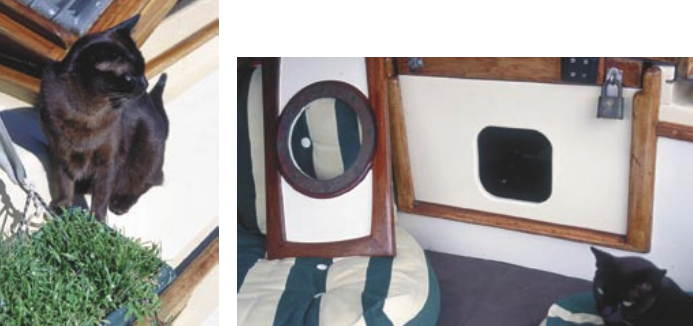
Cats are easy to have aboard. The only truly important things in their lives are food and a litter tray. Food is simple: fresh fish when available, otherwise cheap canned fish which is found in every country, with or without tomato sauce. A diet of dry cat food and nothing else is appealing for its convenience and weight but is likely to make a cat sick in time, perhaps fatally. Fletcher, Cooee’s cat, also has a potted patch of grass; she grazes on it daily so I guess that says she needs it for a healthy diet.
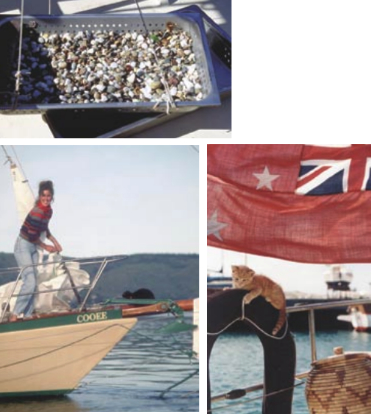
A cat’s food presentsno problems of acquisition and storage. However, litter presents difficulties in both. I have known cruising cats to be trained to use the toilet, but it must be difficult if not impossible for them in rough conditions. Cooee did not have a toilet when circumnavigating, and cat litter was unheard of in third-world countries where a lot of cruising and provisioning takes place. Jack and his successors improvised with this and that, including rice and dried beans in Brazil, before I developed the system Fletcher uses now which is simple, clean, cheap, and requires no storage space for litter. I bought a restaurant-style stainless-steel steaming pan consisting of a solid bottom tray and perforated upper tray, attached cords to the upper tray and half-filled it with small smooth pebbles as washable cat litter. Urine flows into the lower tray and can be washed out. Solids float off when the upper tray is dunked overboard on its cords; in places where this is undesirable they can be scooped off into the garbage. A dollop of cheap vinegar every couple of days prevents plaque and its subsequent smell from building on the trays; a dose of chlorine bleach also eliminates odor but will not prevent plaque. Recently I was asked by a magazine reader if I gimbaled the tray; the idea conjured hilarious images. Fortunately, my cat came gimbaled, though I do take her tray belowdecks to the saloon floor in rough conditions and give her a bit of support occasionally while she performs.
Dogs are often larger and present proportionately larger problems with toilet arrangements and food acquisition and storage. Unless the dog eats fish, dog food that does not need refrigeration may be hard to find in some countries. Coastal dogs oblige their owners to take them ashore for walks and toilet rituals once or twice a day, which is not a bad thing except in national parks where domestic animals are usually banned, at least above the high-tide mark. For passagemaking, an American I met had a particular piece of fake grass carpet. Wherever he put it on the deck became the dog’s toilet. It seemed satisfactory. Of course, one rarely meets an unhappy cruising pet owner; there are ways and means.
Alternative pets
On a recent delivery trip I did with crew, we picked up a parrot that was offered for sale in a Pacific Island village we visited. Again, he served magnificently in diverting us from interpersonal irritations. He ate fruit and sweet potato, cooked and mashed. These were simple to provide, but his fallout was messy and a bit smelly. Admittedly, we were not really equipped to give him suitable accommodations which might have contained his flying food and excrement.
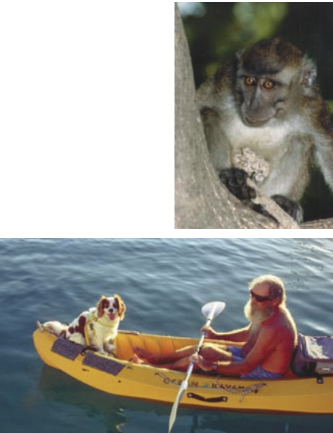
In the Philippines I had Zamboy, a monkey from Zamboanga, aboard briefly. I do not recommend monkeys as boat pets, although I have seen tiny females of more docile varieties kept successfully. Zamboy was mischievous to the point of evil: he snatched tools and raced with them to the top of the mast; he picked and chewed at sails; clothespins were there to be removed and tossed overboard; bottles had to be lifted like telescopes so he could squint at their contents which were by then pouring down his front. His cruising career was brief and ended when he was relocated to a village ashore.
Local or international
There is a need to differentiate between long-distance international and local cruising. Dogs frequently join their humans for coastal cruising. They are great company and are seen as a security measure; I have heard of two singlehanders who required their dogs to stand night watches after being trained and rewarded for spotting other vessels and raising the alarm. The downside with dogs is their pleasure in becoming wet and sandy, but dog lovers seem to see this as a minor inconvenience. While cruising internationally I came across dogs only occasionally and they were almost invariably small.
The quarantine aspects of cruising internationally with pets are generally overstated, I think. There are certainly difficulties entering Australia and New Zealand and perhaps some European countries — I have not sailed into Europe with pets — but they are not insurmountable. I have visited around 40 countries by boat, and in a couple of them I was asked to ensure that my cat remained aboard. In Fletcher’s case, while she enjoys visiting other boats where she is welcome, the last thing she wants to do is step onto that unfamiliar vessel, terra firma. In New Caledonia, she was taken into quarantine unexpectedly for five days, but I suspect this had to do with the politics of the day; I have not heard of it happening to others. Bringing her into Australia to live long term required organization and money, and I would strongly advise early contact with quarantine authorities regarding regulations and costs when an animal is to be imported anywhere. A period in a rabies-free zone such as the Pacific, for example, may significantly cut the quarantine sentence on arrival. Fletcher did 30 days, the minimum.
When cruising internationally, a pet who prefers remaining aboard to roaming ashore clearly presents fewer hassles. On a small boat, a pet whose accessories are simple and take little space is also desirable.
Leaving the boat
From time to time, cruisers need to leave the boat at anchor or in a marina while spending time away. I have had no problem finding animal lovers to take my cat aboard their own boats or to tend to her needs on Cooee if my absence was to be short. I have an extra washboard with a cat hole cutout, so I can leave Fletch to fend for herself for a night or two without bothering anyone. Some marinas have a stated policy of no animals, but I have found this rarely means they are banned. The clause is in the rules but is enforced only if a pet inconveniences other guests.
Safety issues
Levels of common sense and flair for derring-do vary widely among animals. None of my pets has been lost at sea though Jack came close after leaping for a boom-roosting bird. Jack was catnapped in Singapore during a haulout and my next cat, Lucifer Longtail, died ashore in South Africa. Fletcher has spent all 10 years of her life aboard, but still never ventures beyond the cockpit coaming while we’re sailing. People use life vests, harnesses, and lifeline netting. A particular pet may need such measures, but most cruising animals, in my experience, take care of themselves.
A final note: unlike us, not all animals want to go sailing. For brief cruises, arrangements for care will probably be easy to make and painless. The Big Trip, however, presents larger problems. With a new pet, a suitable home can probably be found. But if old faithful Fido or Tabby draws the line at life afloat, it is best to find out ahead of time. Spend time cruising together before any big long-term departure.
Thank you to Sailrite Enterprises, Inc., for providing free access to back issues of Good Old Boat through intellectual property rights. Sailrite.com