Shedding some light on portlight replacement

Issue 42 : May/Jun 2005
I’ve always though kitchen duty much more pleasant with a window to look out of . . . not only for the cook, but also for the cleanup crew (usually me). A galley on a boat is no different. When we were planning our first cruise, I told my wife that the view out of her galley window would be ever-changing, and I kept my promise. While Theresa prepared sumptuous meals on our 30-foot Mercator, she gazed on icebergs and glaciers in Alaska, the desert of Baja Mexico, howler monkeys swinging in the trees of Costa Rica, and tropical forests in Panama. (Also, of course, many white-tipped mountains of rolling ocean water.)
Looking out through crystal-clear portlights is an ever-changing event that connects you to the world when you can’t be on deck. So when we bought our next boat, a 1975 44-foot Van de Stadt cutter, I could see there was a problem. Rather, it was what I couldn’t see that was the problem. The boat had six large non-opening deadlights in the saloon that were made of plastic. The bad news was that they were so crazed that only soft fuzzy shapes could be seen of the outside world. The good news, I told Theresa, was that we didn’t need curtains. Other projects had priority. But since we were living aboard at the time, I knew the lack of view would become less tolerable in winter when the already-opaque view would be lessened by shorter days. It was time to bring some clarity to our world.
The big question was what material to choose for the portlights. Our last boat, the one that had afforded us such magnificent views of the world, had portlights made of glass — rather thin glass I later discovered when rebedding them. Though the crystal clearness of the glass was wonderful, I worried about the possibility of impact with an errant block, whisker pole, or even a crashing wave. Our new boat, according to the South African seller, had portlights made of polycarbonate that had been fitted only five years earlier while the boat was cruising the Caribbean. After looking at the work involved in replacing the portlights, I knew I didn’t want to do it very often, certainly not every five years.
If you want to see out, the choices for materials are pretty obvious — glass or plastic. But which kind of glass can be used, and what type of plastic works best?
Two plastic types
Two types of plastic are commonly used for portlights. The first is polycarbonate, variously known as Hyzod, Makrolon, or most commonly the GE trade name, Lexan. The second is acrylic, known as Acrylite and Lucite, although it is best known as Plexiglas, a trademark of Atoglas. Though similar, there are some significant differences that should be considered.
Polycarbonate has been hailed as one of the greatest plastics yet invented, with myriad uses including eyeglasses, bullet-proof riot shields, baby bottles, and even CDs and DVDs. It’s optically clear and transmits 98 percent of the light that glass does at half the weight. It has very high-impact strength and tends to cold-form, rather than shatter. In fact, Chuck Mulcahey, an engineer for GE Lexan, said that though it’s not sold for this purpose to the public, a 3⁄8-inch piece of Lexan will stop a .45 caliber slug. Unless you do most of your sailing in the piracy capitals of the world (and the bad guys only shoot at your portlights), that might not be relevant. But the same strength can withstand a stainless-steel shackle that’s being whipped by a sail, a runaway block, or a clumsy jack-booted third-world boarding party.
It’s important to note, though, that polycarbonate’s real claim to fame is point-impact resistance — up to 200 times that of acrylic, according to Hunter Marine. But polycarbonate’s overall strength when it comes to the usual knocks and dings expected on a boat is not much greater than acrylic’s. Its price, however, is. Standard Lexan is about $10 per square foot for 3⁄8-inch material bought as a 4 x 8-foot sheet — about twice the price of acrylic. You’d think with all its toughness, polycarbonate would be hard to damage, but its ability to absorb punishing blows without breaking also makes its surface easy to scratch.
Very economical
Acrylic has been around a long time in the boating world and has many things to recommend it for boat portlights, not the least of which to sailors is its economy. Like polycarbonate, it’s half as heavy as glass and has about the same transparency. Though over-shadowed by its polycarbonate cousin’s ability to shrug off a few rounds, Jack Reilly, a Plexiglas engineer, says acrylic is still many times more impact-resistant than standard glass and makes a great choice for portlights since it doesn’t scratch nearly as easily as polycarbonate. Due to its light weight, acrylic breaks into large dull pieces that tend to fly off with a lot less fanfare than glass.
Both acrylic and polycarbonate allow most of the sun’s damaging UV rays to pass through, which can cause sun damage to fabrics and finishes inside a boat. And both have more thermal expansion during temperature swings than glass does.
Weak link
The Achilles’ heel for both acrylic and polycarbonate is something boaters usually relish — the sun. UV rays can cause polycarbonate to become hazy in as little as six months of tropical use, especially if it’s exposed at an angle to the sun, as it might be on a pilot-house, hatch, or hard dodger. UV also causes a color shift in polycarbonate and eventually lessens its famous impact-resistance. Chuck Mulcahey says that problem can be solved by using Lexan XL10, which was designed for skylights. XL10 is treated to be far more UV-resistant than standard Lexan, but since it’s only treated on one side, it’s important to make sure the treated side is exposed to the sun. Other manufacturers offer treated polycarbonate as well. As might be expected, treated polycarbonate carries a heftier price — up to two-and-a-half times that of standard polycarbonate. Plexiglas is also offered with a coating called A200 that increases its abrasion- and UV-resistance even more.
Durable glass
Glass is made out of the same stuff as beach sand (or close enough) and laughs off the sun’s rays. What could be better for use on a boat? Glass is extremely durable and shrugs off acetone and other chemicals that would instantly ruin plastic, and it stays clear for generations. The glass portlights I rebedded in our last boat were installed in 1971. In 2003, they were as clear as when new. But the one thing that makes glass stay transparent for so long is its hardness which, alas, is also its weakness. Glass is a brittle material and does not deform before failure like plastic. It fails in tension regardless of the nature of loading. This brittleness is why glass fractures from impact or stress and forms razor-sharp shards — the last thing you want on your boat when things are going wrong. But there are a couple of things that can be done to make glass more suitable for portlights.
Tempered glass
Glass can be greatly strengthened through the use of a “stressed skin sandwich,” in which both surfaces are in compression and the middle is in tension. This can be accomplished by heating the glass nearly to its melting point and rapidly cooling both surfaces. The contraction of the middle of the sheet develops the desired stress on final cooling. Tempered glass is three to five times more resistant to failure by bending, impact, or thermal shock than non-tempered glass of the same thickness (but still not as resistant as that of either polycarbonate or acrylic and nowhere near polycarbonate’s point-impact resistance). Another advantage of tempering is that if it does break, tempered glass shatters into small pebble sized pieces, rather than large shards.
Tempered glass is comparable in price to polycarbonate until it comes to cutting. Typically, glass distributors will charge a nominal fee per cut, but odd angles and curves are expensive. We were quoted about $90 each for custom-cut rectangular portlights with rounded corners (our acrylic portlights cost less than $20; polycarbonate would have cost about $50).
Laminated glass
Laminated glass is a kind of glass/plastic hybrid. It’s a composite of a flexible plastic material (usually polyvinyl butyral) sandwiched between two layers of glass. The advantage over standard glass is that it will not shatter explosively since the plastic innerlayer is not subject to brittle failure as is the glass. Laminated glass has only about half the impact resistance of tempered glass but still much more than standard glass. If it does break, the glass pieces tend to stick to the plastic rather than flying about — anyone who’s seen a car windshield break can see the advantage. Another advantage of laminated glass to boaters is that it blocks 99 percent of the sun’s UV rays (tempered glass blocks about half). Laminated glass is typically more expensive than tempered glass, though the expense of cutting the latter can negate the savings.
Glass manufacturers are quick to point out that the impact-resistance touted by plastics manufacturers can be misleading. Tests of plastics are often done to highlight their superior impact-resistance, not overall strength. In the end, the strength of tempered glass vs. plastic portlights of sufficient thickness is probably irrelevant since the framing or even the cabin side is more likely to fail than the insert.
Working with plastic
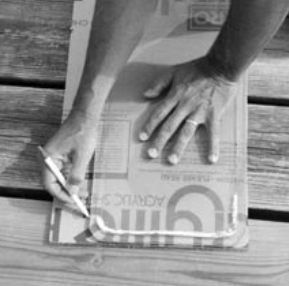
Replacing portlights with polycarbonate and acrylic is easy . . . it’s the thing that makes plastics ideal for the do-it-yourselfer. Both polycarbonate and acrylic can be bought in 4 x 8 sheets and in many other sizes, making it easy to cut and fit right at the boat.
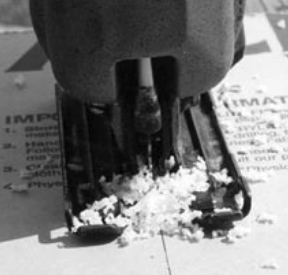
Cutting plastics is simple if you use a variable-speed reciprocal saw on a slow setting. Nearly any blade
will work, but the maker of Plexiglas recommends a carbide-tipped blade made for cutting plastic. It’s important to use a sharp blade to avoid forming microcracks along the edges, which can grow over time. Cutting is just a matter of following an outline of your old portlights; just don’t try to cut too fast. If your saw is making chips, you’re cutting it right — if you’re melting plastic and making goo, slow down. You can also dribble water as you cut to keep the blade cool. Be sure to leave the protective opaque film on the plastic while you’re cutting to protect the surface — don’t take it off until you’re ready to install.
One problem sometimes mentioned with polycarbonate is its temperature expansion and how this can cause portlight leaks when the expansion causes the sealant to lose its grip. But according to GE, a 2-foot section has only about an 1⁄8-inch expansion over a 100-degree range — about the same as acrylic. What that means, though, is that if polycarbonate or acrylic is drilled to fasten it to the boat, the holes may split during temperature extremes. Drilling the holes oversize to allow room for movement will solve the problem. Any drilling should be done with a special bit designed for plastic, otherwise the holes can chip and splinter.
It’s very important not to countersink the holes, otherwise stresses will cause cracking and splitting at the holes. The best method to attach plastic panes to a boat is with frames whose screws don’t penetrate the plastic. In some cases, the deadlights are simply set in cutouts and adhesives are used to hold them in place. Several products are designed for this purpose, one of which is GE’s SSG4000 Ultraglaze that’s used to hold Lexan windows in place in high-rises. 3M 5200 is not recommended as an adhesive, as the sun will turn it a rather disgusting shade of brown through the plastic.
Working with glass
Both tempered and laminated glass are much more difficult to work with than plastic. The biggest problem with tempered glass is that it must be tempered after being cut or drilled. Otherwise it will shatter (one glass manufacturer said cutting tempered glass is like trying to cut a balloon). This makes it impossible to cut and install right at the boat — it must be ordered in cut sizes from a distributor. And the cutting must be accurate — there’s no trimming to size if it’s off by a bit.
Laminated glass is rarely tempered and therefore can be cut at a local shop. It’s possible for a do-it-yourselfer to cut, but it’s tricky. When glass shops cut it, they score both sides, break it, and then cut the laminate. In the past, do-it-yourselfers have cut the glass and then poured methylated spirits (denatured alcohol) on the plastic laminate and lit it to melt the laminate away. Cutting laminated glass is best left to professionals.
Sealing plastic
Sealing acrylic and polycarbonate portlights is mostly a matter of what not to use. Polyurethane sealants (3M 4200/5200) and polysulfide sealants (3M 101, Life Calk) can’t be used, as they can cause the edges to craze. It’s also best to avoid caulk that is catalyzed by acetic acid (it smells like vinegar when it’s curing), as this may cause crazing as well. The best bet is marine-grade silicone. Though not an adhesive, it forms a great long-lasting gasket if used right. The trick is to apply it generously (one advantage of silicone is that it doesn’t stick well to new plastic so it’s easy to remove excess from the panes) and gently snug the screws so the sealant doesn’t squish out. Final tightening should only be done after it sets, usually 24 hours. Make sure the screw holes are sealed as well.
Sealing glass
Glass is pretty much inert to most chemicals onboard, so the selection of sealant is not as critical as with plastic. The best bet is a polysulfide sealant. One important point with laminated glass is to seal the edges of the pane (polysulfide can be used), otherwise the laminate can absorb water and become hazy.
Plastic care
Caring for plastics is different from glass, but it’s not hard. Chuck Mulcahey has a few tips: “Treat it as you would the paint on your car, since it’s very similar. You wouldn’t use acetone, MEK, or paint thinner on your fender. Rubbing alcohol and even kerosene is safe if done gently. Routine cleaning of the outside surface is not hard — wet it first and use a mild detergent, such as Joy with lots of water.” He warns, “Don’t wash in direct sunlight; the chemicals are more aggressive in the sun. Don’t scrub it hard and never wipe it while it’s dry since this will scratch it.”
If polycarbonate gets tiny scratches, it can be polished with Novus products but only on products that don’t have a coating. Chuck says they use Brillianize around the lab and not only does it clean, but it’s anti-static as well. He recommends an all-purpose cleaner, such as 409, for interior cleaning. Household products containing ammonia, he says, are probably OK since they contain very little ammonia, but those without are preferable. A 50/50 mix of rubbing alcohol and water is recommended for cleaning Plexiglas. Novus products can also be used for removing scratches in acrylic.
Glass care
Not much needs to be said about caring for glass. Any glass cleaner can be used, and scratches aren’t likely to be a problem. An application of RainX can be used to make the surface less likely to attract dirt, and it makes the glass look pretty cool when water beads on it.
Our choice
The choice of which material to use is dictated by the use the boat is expected to be put to. Though our glass portlights had served us well on our previous boat, we decided to use acrylic to replace the old polycarbonate panes on our new boat. We based our decision on the fact that the polycarbonate hazed so quickly in the tropics and the cost of treated polycarbonate is prohibitive since we had a dozen portlights to replace. Also, after removing one of our portlights, it became obvious that in addition to the high price, simply sending in the old plastic ones as a template for new tempered glass panes was impossible since the cutting on the polycarbonate was done poorly and custom fitting at the boat was called for. We ruled out laminated glass because, though it is safer in some ways than tempered glass by staying together when broken, it is only half as strong as tempered glass. This made it seem unsuitable for offshore voyaging.
Thank you to Sailrite Enterprises, Inc., for providing free access to back issues of Good Old Boat through intellectual property rights. Sailrite.com