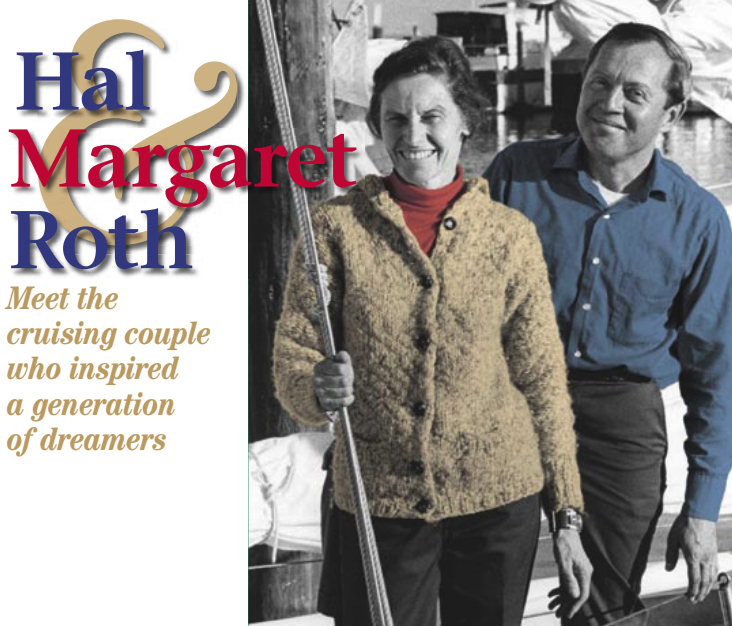
Meet the cruising couple who inspired a generation of dreamers
Issue 42 : May/Jun 2005
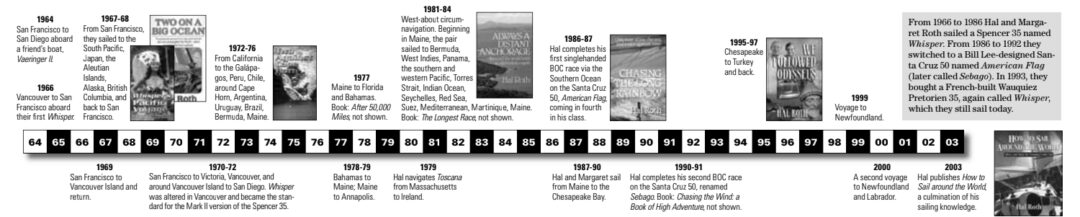
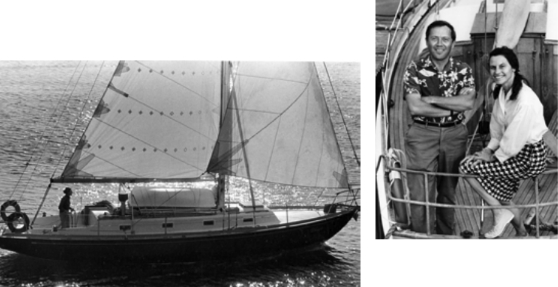
If it’s true that “marriage is one long conversation, chequered by disputes,” as Scottish novelist and poet Robert Louis Stevenson wrote, then Hal and Margaret Roth have conducted a prolonged and intense conversation. Over the past four-and-a-half decades they’ve sailed more than 120,000 nautical miles in a Spencer 35 called Whisper, a Santa Cruz 50 christened Sebago, and most recently, a Henri Wauquiez Pretorien 35, again baptized Whisper. Many of their adventures are recounted in Hal’s 10 books and numerous magazine articles.
And the partnership continues. When I visited the Roths at their on-the-golf-course townhouse in St. Michaels, Maryland, they had just finished repainting Whisper’s bottom. Margaret, who was turning 82 the following day, said this was the last time she wanted to scrape the keel. “Haulouts are dirty,” she said in her precise British accent. “Next time, we’ll have someone else finish the bottom.” She reflected a bit. “But,” she then added in a soft voice, “Hal is so fussy about the sanding and filling. So if he goes, I go too.”
That statement likely reflects Hal and Margaret’s relationship since they married in 1960. Since then, except for the two singlehanded BOC races Hal completed, they’ve spent all their time together circumnavigating the world, sharing the tranquility of countless anchorages, exploring the Mediterranean, and surviving some horrendous sailing debacles. If there have been disputes, they’ve been unimportant. And what’s even more remarkable about these celebrated adventurers is that they’d never sailed until they were 30-something — neither had salt in the veins.
Depression-era childhood
Hal was born in 1927 in Cleveland, Ohio. His father played the violin and directed a popular orchestra, but nearly disappeared from his son’s life in the early 1930s. Hal was raised by his mother and his grandparents. “Life was hard in the Depression,” he recalls. “But my mother got a job as a telephone operator. She earned $18 a week, and when she got a better job, with a $4 raise, it was a big thing for us.” In childhood, Hal developed the hobby of building model airplanes from kits. Eventually, his dexterity and inventiveness led him to design and build his own models and absorbed so much of his time that his high-school grades suffered.
“I was bored out of my skull,” he says. “In retrospect, I realize I just didn’t know about homework. I never did any. My parents were school dropouts and didn’t know about studying either.” When World War II improved the economic climate, Hal began taking odd jobs. At age 17, near the end of the war, he enlisted in the U.S. Air Force. “There was a policy never to reveal air-force casualties,” he said dryly. “So I didn’t know the casualty rate was 30 percent.” True to his youthful passion, he became an airplane mechanic and accompanied pilots and navigators on many B-25 and B-29 missions, “flying along to keep things going.” Much of this time was spent in Alaska, where he rose to the position of panel engineer.
After mustering out, Hal returned to Cleveland, took a bank teller job and enrolled at Western Reserve University. But a year later the young man traveled west, having decided California was a better place in which to live. He first signed up in chemistry at the University of California at Los Angeles, then transferred to Berkeley. Money was always a problem. “The GI Bill gave me $65 a month,” he grumbled. “Not enough for tuition and all the other expenses. Today, parents seem to be obligated to send their kids to college. In my day, nothing.” He vividly recalls seeing a billboard over the Oakland Bay Bridge advertising student loans. “It was the Bank of America. ‘We want to help the youth of America,’ they said. So I went and asked them for $1,000. ‘We need a co-signer,’ they told me. I hate that bank and have never done business with them.”
About that time the Korean conflict was heating up, and Hal enlisted in the Air Force Reserve. “I was patriotic and had a desirable skill. People who can fix things are always in demand.” As Cold War fears were on the rise, Hal flew in old World War II planes dropping shredded tin foil from the air to determine if Russian planes, using the same technique, could confuse radar. Results were inconclusive.
After serving two years in the Reserves, Hal re-enrolled at Berkeley and completed a degree in journalism in 1953. Why journalism? “I was always a good writer,” he says. He recounted how, at age 11, he wrote a letter to the editor of the Cleveland Press describing how his model airplane had been trapped in the thorns of an unclimbable tree. Wanting to save his precious model, Hal chopped down the tree. As the tree tipped, the model fell and was crushed under the branches. “The newspaper,” Hal says with satisfaction, “published the letter under the headline , ‘Poor lumberjacking.’ ” He picks up a 2-inch stack of paper. “These are copies of the letters I have sent this year,” he continues. “I correspond with people all over the world, with fans and editors and people I’ve met over the years. I much prefer letters over email. Much of email is appalling. Full of misspellings and poor writing. I try to write carefully and edit my stuff.”
Freelance career
With his journalism degree in hand, Hal went looking for a position as a newspaper reporter. But in the early 1950s, television was fast becoming a fixture in most households and newspaper circulation plunged. Hal remembers that in 1953 San Francisco had five newspapers. Two years later, just two were still in print. To earn his living, Hal turned to freelance writing, covering just about any topic.
He quickly noted that editors wanted photos to illustrate articles, so Hal, ever enterprising, took up photography. This time he was in the right place at the right time. He studied with such icons as Ansel Adams and Edward Weston. He bought a 4 x 5 Linhof camera and built a darkroom. Soon he was selling stories and photos to True, Argosy, and the Sunday supplement, American Weekly. He was able to capitalize on his model building by publishing pieces in model airplane magazines. Always a quick study, he also peddled articles to the medical press. But the golden magazine markets of the day were the Saturday Evening Post and Colliers. “I finally sold my first story to Colliers in 1956,” says Hal, relishing the memory. “They paid me $1,500. That was big money (equivalent to $10,500 in today’s funds). I was finally in the big time and counted on selling many more articles. The next year, Colliers folded. But I did sell photos to the Saturday Evening Post after I switched to a 35 mm camera.”
Growing up in Bombay
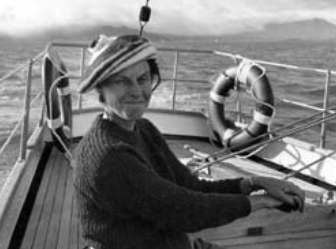
In 1958, Hal and Margaret met at a Chinese New Year’s party in San Francisco where Hal was assigned to take photos. Margaret had recently arrived from England. Born in Bombay of British parents, she’d spent her early years in India. At age eight she was sent to boarding school in England, a common practice in the 1920s and ’30s. Margaret remembers her time away at school with fondness. “I loved sports,” she explains. “Lacrosse, cricket, and tennis, I was quite good at all of them.” After serving in Britain’s Women’s Royal Naval Service (WRENs) during World War II and attending university, Margaret went to Paris for seven years as a translator for NATO.
In 1958, encouraged by her sister who lived in Westchester, New York, Margaret emigrated to the United States. “In the United Kingdom the winters were so cold,” said Margaret. “All those clothes you had to wear. Such an awful bore.” Later that year, Margaret decided to visit a former NATO colleague living in San Francisco. It was during this visit that she and Hal met. Neither revealed if love hit them like a lightning bolt, as the French say, but Margaret returned to New York, spent $150 on an old Plymouth and drove back across the country. The couple married a year later. Hal continued his work as a freelance writer and photographer; Margaret managed the financial side of the business, “doing the accounts and tracking spending,” and, of course, taking care of Hal. Forty-four years later, although suffering from a heavy cold and a back distorted by osteoporosis, she continues the pattern started early in married life. “When you get married,” she stated, “you have to adjust. Everyone has to adjust.”
The first sail
In 1999, Cruising World inducted Hal and Margaret into its Hall of Fame, demonstrating that you can start sailing in your 30s and still earn a most-valuable-player award. How were they transformed into sailors? I asked Hal if he’d ever taken advantage of Lake Erie’s proximity during his youth. “I couldn’t have afforded an oar, let alone a boat,” he groused. Margaret remembers her parents sailing 18- foot Bombay Tomtits, but she herself never participated.
They experienced their first salty adventure aboard a friend’s 38-foot wooden ketch. “Sailing has a lot of intriguing aspects,” says Hal. “You know, the design of a boat, the interplay of the wind and the water.” Smitten, the couple began walking docks and learning about various sailboats. They sailed on other people’s boats. Wishing to become more competent and confident, they decided to take lessons: to this day they scorn people who risk themselves on the open sea without training. A charter in Antigua supplied them with a captain, a 45-foot wooden cutter, and a lot of rums with ginger ale. “We were able to ask questions all day long,” recalls Hal. “We learned a lot.” During the charter, he took batches of photos and wrote several stories recounting their sailing education for the New York Times travel section.
They also signed up for a “nuts-and-bolts” sailing course on the Clyde in Scotland, then chartered in Greece to learn more. “It was a disaster,” says Hal grimly. “The captain didn’t know how to sail, the crew couldn’t boil water, and we had to [use] the mainsheet to moor.” Brightening, he adds, “but it did make an interesting story for Skipper, a slick magazine published out of Annapolis.”
In 1963, having gained confidence, the Roths bought their first boat in Holland — a 36-foot steel sloop called Golden Feather. It cost $4,500. Another $750 shipped it to San Francisco aboard a German Lloyd ship. They practiced sailing in sheltered waters, madly read sailing tomes, and tried to perform all tasks under sail, including docking. Two years after they acquired the yacht, a gasoline fire destroyed her.
The mishap did not deter them, and they began searching for a new boat. “Fiberglass was becoming a popular yacht material,” explains Hal. “There was a lot of skepticism about its strength. Many thought the stuff would dissolve in a year.” But Hal had written an article for Popular Science in 1958 describing the first large fiberglass production sailboat, the Philip Rhodes-designed 41-foot Bounty 2, built in 1956. He knew the newfangled material would last. So when he and Margaret spied the lines of a fiberglass Spencer at a Seattle dock, they traveled to Vancouver, British Columbia, to investigate the boatbuilder. Liking John Brandlmayr’s design and the Spencer’s construction, they ordered a boat despite its steep price of $16,000.
Offshore ventures
In his writings, Hal encourages boat buyers to purchase a used yacht, as they’re more economical. But in 1966, perhaps encouraged by the publication of his first book of text and photos, Pathway in the Sky: The Story of the John Muir Trail, the previous year, he opted for a brand-new Spencer. Moreover, it was about this time that the couple “elected to sail and earn our way with words and pictures while living aboard a 35-foot yacht,” as Hal wrote in his latest book, How to Sail Around the World. So they went to Vancouver Island to commission and sea-trial their new Whisper, met the famous Smeetons, and then left on their first bluewater sail to San Francisco. The trip stimulated them to plan a Pacific voyage, and a year later they provisioned, loaded two typewriters aboard, and set off from an island off Mexico straight to Nuku Hiva in the Marquesas. Hal chuckles, remembering they were given a couple of wooden spinnaker poles before their departure. “They were very thick and heavy. We had a terrible time raising them. So the first chance we had, we planed them. On the next island we planed them some more. At each stop these poles got skinnier and skinnier.”
From French Polynesia the Roths moved through the western Pacific to Samoa and the Gilberts, visited Japan and then circled past the Bering Strait to the Aleutians, British Columbia, and on to California. Hal chronicled their adventures in Two on a Big Ocean.
How did the couple manage the close quarters on their first offshore voyages? “It wasn’t much of a change,” says Margaret. “From the time we married, we were always together. You know, at boat shows when Hal is selling his books, men come up to us and ask how they can persuade their wives to cruise with them. Now I’m the first to admit there are dangers. So I tell these men that to sail together the wife has to have complete confidence in the captain. I’ve always had complete confidence in Hal.”
Margaret adds that they worked out a system for maximum safety. The couple shared watchkeeping around the clock, making sure each would have at least seven hours of sleep every day. “One of us was always dressed and ready for action,” says Margaret. “In busy places like Mediterranean ports, with boats everywhere, we’d both be on watch.” Each also used the sextant but always double-checked the other’s calculations to avoid errors.
Continuing offshore
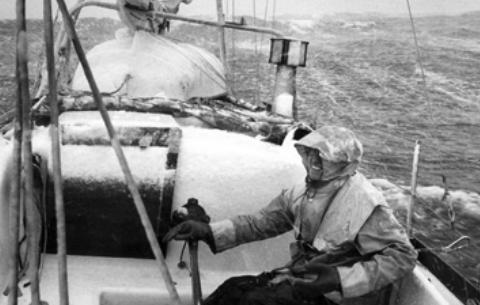
During their next major journey, the Roths went south, eventually rounding the Horn. It was at the Wollaston Islands where Whisper was blown ashore. “We set two anchors, but they dragged because there was too much kelp,” remembers Hal. “The boat was holed and half-filled with water. To survive, we set up camp on an island about a mile away. I was rowing stuff from our boat in our dinghy when the wind picked up suddenly, swinging our little vessel [the dinghy] out to sea. Three-foot waves are a big deal for an eight-foot dinghy. ‘Next stop, Antarctica,’ I thought to myself. But another tiny desolate island, one-quarter mile away, just allowed us to land. We ate wild celery and small crustaceans. When the wind died, we rowed over to the camp.”
A week later they saw a Chilean navy vessel and, after attracting the crew’s attention by signaling with an Aldis lamp, they were able to patch Whisper’s 3- by 4-foot hole with plywood and 75 through-bolts. After they pumped out the water, the yacht was towed and repaired in a Chilean port. Two months later, the intrepid pair again rounded Cape Horn, then sailed on along South America’s coast, eventually reaching Bermuda and then Maine. Their adventures led to another book, Two Against Cape Horn, a film, and a North American lecture tour.
Hooked on adventure in a small boat, the Roths next circumnavigated the world, from Maine to the Caribbean via Bermuda, through the Panama Canal, to the southern and western Pacific and Torres Strait, through the Indian Ocean to the Red Sea, Suez, the Mediterranean, Caribbean, and back to Maine. Their one misadventure, caused by a faulty Australian chart, left them on a reef in Torres Strait. How they managed to get off the sharp coral is described in Always a Distant Anchorage.
Racing around the world
Hal always had a yen to see if he had the backbone and skills to sail long distances singlehanded. He decided to sail the 1986-87 BOC Challenge, an east-about around-the-world race — 27,000 miles in four legs starting in Newport, Rhode Island, and on to Cape Town, Sydney, Rio de Janeiro, and back to Newport. He asked yacht designer Bill Lee to build him an engineless Santa Cruz 50, figuring an ultra-light boat would serve him well. It did. He completed his contest, with Margaret meeting him at the three stops and serving as shore support. Three years later he reenacted this feat, again with Margaret as backup and, of course, publishing two more books about his experiences.
Having proved his stamina and ability, Hal sold the Santa Cruz, bought the Wauquiez 35, and rejoined the “best mate a man ever had.” Their next major sail also involved a project: tracing the wild peregrinations of Odysseus trying to return home to Attica after the Trojan War. As Hal describes in We Followed Odysseus, figuring out the semi-mythical locations described in a saga based on oral tradition was a challenge — but an appealing one as it allowed the couple to explore the Mediterranean at leisure while studying the Odyssey and the many commentaries on that classical poem. Since that time, they’ve made a series of shorter voyages.
Sailing and writing
For decades, the Roths have supported themselves through Hal’s writing and photography. “We’ve learned to live simply,” says Hal. “During our voyages or on land, we never went to restaurants. We anchored out. No marinas.” They never bought health insurance, counting on their wholesome lifestyle and paying for the occasional doctor visit. Their modest two-story Maryland townhouse is furnished with comfortable 1970s teak furniture. They didn’t join the golf club, but the course provides for great walks. Bookcases line the walls and are filled with marine books, among them Hal’s tomes in English and their various translations into German, Portuguese, Swedish, and Japanese.
Next to the bookcases Hal has his desk with a laptop, which he says has really speeded up his book writing. When we met, he was working on a book about six artists/adventurers who spent time in the South Pacific searching for their personal paradise, but who mostly came to a sticky end: Paul Gauguin, Robert Louis Stevenson, Robert Dean Frisbie, Alain Gerbault, Jack London, and Tom Neale. Margaret, still fluent in French, was translating Alain Gerbault’s autobiography for Hal. Had she ever wanted to write herself? “I’m not a good writer,” she responds with emphasis. “It didn’t come up to Hal’s standards, and I was busy looking after him. His work is more important than mine.”
Age not a barrier
Now that Hal is 77 and Margaret 82, will they give up sailing? Not necessarily. They’d agree with Gabriel Buck’s statement, “I refused to let my age determine my destiny.” Margaret showed me her newly repaired knees that allow her “to run up and down the ladder like a girl.” The new knees don’t hurt the way the old arthritic ones did during their late trips in the 1990s. Hal’s study of “paradise seekers” has stimulated his desire to return to the South Pacific, although he dreads traversing the Panama Canal. Margaret has a yearning to visit Portugal. “All we have to do is get the yacht ready, lock the condo doors, and go,” he says. “We may just do it.”
Perhaps what they’re not ready to relinquish is the romance of seeing the world from a small boat. Despite the knockdowns Hal experienced during the BOC races, and notwithstanding such events as their near-death experience in the Wollaston Islands, or their Torres Strait reef grounding, what they remember is the beauty of the wispy fogs around the Aleutians. What still tickles them is their ability to find a speck of land in the vast Pacific through their accurate dead reckoning and celestial navigation. What gives them joy is remembering that special feeling when seeing “that big black rock that is Cape Horn,” even after holing Whisper. “It’s been wonderful to make all these trips,” says Margaret. “Yes,” adds Hal, “I think what Slocum said so succinctly applies to both Margaret and me, ‘The wonderful sea enchanted me from the first.’ ”
Thank you to Sailrite Enterprises, Inc., for providing free access to back issues of Good Old Boat through intellectual property rights. Sailrite.com