Providing extra support for an outboard mount
Issue 43 : Jul/Aug 2005
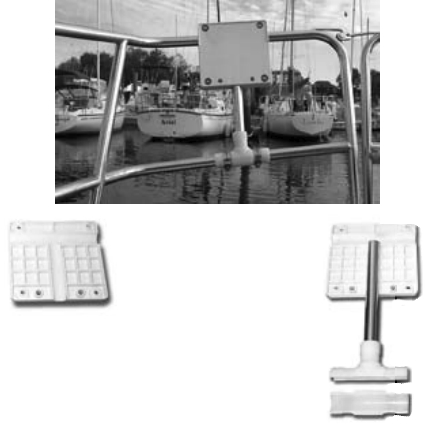
When coastal cruising, I like to tow the dinghy but with its small outboard mounted on the stern rail of the mother ship. This is more secure, and the dinghy tows much better. To mount the engine on the pushpit, I used the typical kicker pad, an inexpensive T-style molded mount, made to fit the 1-inch rails of the pushpit. The problem I encountered on my Pacific Seacraft Dana is that there are no verticals in the pushpit where I wanted to mount the pad. Lacking a vertical connection, the pad was free to rotate about the horizontal rail, making for a flimsy installation. I needed to find a way to add the needed vertical support without cutting into the pushpit railing or resorting to one of the many unsatisfactory approaches I’ve encountered — dowel and duct tape, for instance.
I solved the problem using a length of 1-inch stainless rail tubing and a 1 1⁄4-inch nylon T insert commonly used in plumbing applications for connecting hose. Using a hacksaw, I cut through the nylon fitting, opening it into two sections, which could then be closed around the pushpit rail and secured using stainless hose clamps, effectively creating the needed T below the engine pad. Then I simply cut the surplus tubing to length for the vertical, inserted it into the T, and assembled the pad securely in place.
In looking through the plumbing supply fittings at the hardware store, I noted that a 3⁄4-inch T in PVC could also be used. The inside diameter is 1 inch with either fitting. I chose the nylon 1 1⁄4-inch T insert because the barbed openings (normally inserted into 1-inch ID hose) will keep the stainless hose clamps in place even if loosened.
Materials
- One 1 1⁄4-inch nylon T insert for hose or 3⁄4-inch PVC T connection, both available from plumbing supply stores.
- 1-inch stainless tubing — available by the foot from Defender Industries (http://www.defender.com/) and other marine stores.
Thank you to Sailrite Enterprises, Inc., for providing free access to back issues of Good Old Boat through intellectual property rights. Sailrite.com