A senior sailor undergoes a slow transition to power
Issue 43 : Jul/Aug 2005
Ever since childhood, machines have fascinated me, especially if they had big diesels in them. The sounds that emanate from these machines: the whirls, the pssst, the throbbing . . . well, they just seem alive. The mass and momentum, even when creeping along, mesmerize me.
Davenport, Iowa, was my home for some 1,000 days (but who was counting?) and the one thing that kept me entertained all summer was riding my bike down to Lock and Dam Number 15 to watch the big tows go through, usually on their way down the Mississippi River to New Orleans with cargoes of wheat, soybeans, and corn destined for some far-off country.
The five-story push boats and their barges would slowly glide into the lock, almost silently until it was time to stop. Then clouds of black smoke appeared from the stacks to the sounds of timpani and bass drums. The equivalent of many hundreds of truckloads quickly came to a stop as a seething caldron of water erupted at the rear of the boat.
It’s all done with such élan. I just hoped that if I ever got a boat (a dim prospect), I could do as well with 30 feet as opposed to 300-plus feet. It all seemed organic to me, as if large breathing and belching creatures had descended upon me. I would sit for hours in the warm sun on the banks of the river and just watch and dream.
I recently made a transition from sail to power, a transition that occupied a good decade of my life. I cannot remember when I saw my first small tug, one I could actually own. I cannot even remember if it was in person or a photo in an ad, but it certainly left an impression on my frontal cortex similar to the first Herreshoff design I gazed at in a big coffee-table book. Tugs are real boats designed to look and act the part. They come from an American tradition of working boats and not the imagination of some anonymous Euro-design team.
Before the Internet
This was happening to me in pre-Internet days. I wasn’t able to get gratification by typing “tug” into the search engine and having a few thousand images instantly available. While secretly looking at powerboat magazines, I saw an ad for a dealer selling tugs about half a day’s drive from my home. So one Saturday morning my wife, Charlotte, who had figured out my obsession by this point, and I took a ride to see these exotic creatures.
It could not have been more than 40 degrees outside, and it was drizzling and foggy by the time we arrived at the dealership. The sales staff was patient with us, considering that it would probably be another 15 years before we would have enough wherewithal to purchase one of these little ships.
I took a few pictures of the tugs and placed them on the refrigerator. Not on the front, which is reserved for family, friends, and more attainable goods, but on the side. Every day as I walked into the kitchen I would see these boats perched on their cradles and think about the possibility of actually owning one.
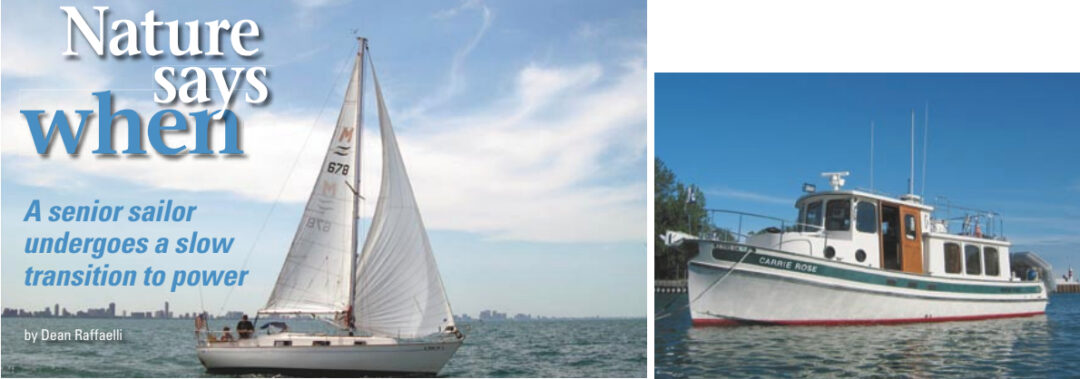
Time moved on. We became the owners of a superbly built 31-foot Swedish sloop, got a mooring in the harbor I had first started sailing in 30 years before, and hence fulfilled the dream of a lifetime. The next five years were spent rebuilding every system and learning to sail her properly. Another five years went by, and suddenly we had become middle-aged.
This was a shock to both of us. I think I first realized it when the top of my head got sunburned. Other clues, such as taking 30 minutes to straighten up each morning after sleeping in the V-berth and having to approach getting to the head in the middle of the night like a military campaign, brought home the inevitability of aging.
Simpler designs
So I started looking in earnest for a powerboat of the trawler type. I had never paid much attention to powerboat design, figuring it would be simple compared to sailboats. I think there is some truth to this but not enough to warrant ignorance of the subject.
I first looked to the powerboat magazines, but mainly I found boats that could sit in for the shuttles on the spaceship Enterprise and ads with young bodybuilder types or older gents with shocks of white hair each with the prerequisite bikinied blonde on their arms. There wasn’t much about boat design.
Little by little, I started to decipher the lingo and understand the differences between planing, semi-displacement, and displacement hull forms; the pros and cons of inboards and outboards; single screw vs. double screw; diesel vs. gasoline; and thruster vs. no thruster. I also started to come to grips with the concept of gallons per hour vs. gallons per season. I have paid much more attention to the price of crude oil since signing the contract for the tug.
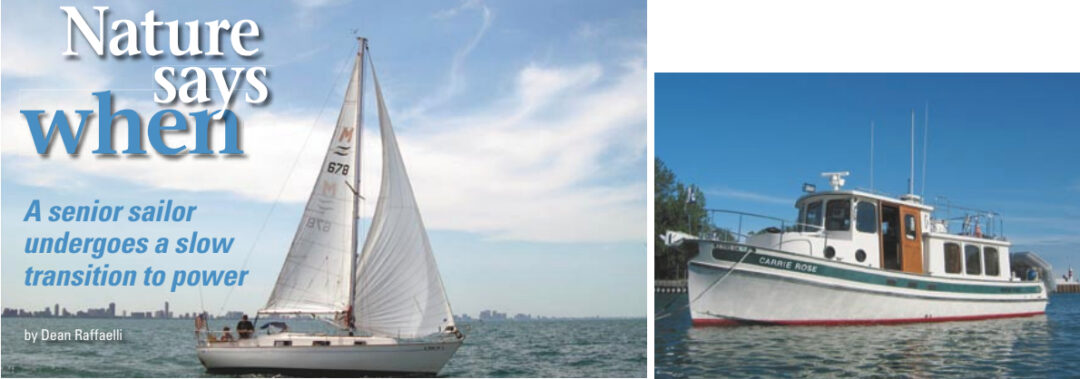
So, yes, we did go over to the dark side and are now the owners of a 1990 32-foot single-screw, semi-displacement tug renamed the Carrie Rose, after my wife’s grandmothers. We sold the sailboat to a guy in California who plans to sail the South Pacific, and our friends — though at first suspicious and wondering if I was also going to become a Republican — have been very gracious. I even think they are a looking forward to their first ride, just as I am, having been on a powerboat for less than five hours in my entire life.
So today, on this spring day with the cumulus clouds gently gliding overhead from the southwest, I am in my car parked at Montrose Harbor, looking out through the harbor entrance at downtown Chicago, trying to imagine what my mooring will look like with a stack and a pilothouse instead of a mast and a dodger.
I spent the last 10 years getting ready for this moment, but I think I will sign up as crew on the Wednesday night beer can races, just to keep my feet in the water as we heel over to the gust on Lake Michigan.
Thank you to Sailrite Enterprises, Inc., for providing free access to back issues of Good Old Boat through intellectual property rights. Sailrite.com