How an old wooden 25-foot gaffer found a new home
Issue 45 : Nov/Dec 2005
It was one of those days in Washington’s San Juan Islands, early January 2002. One of those cheerful Seattle gray-sky days, one of those air-eerie-with-mist days, one of those not-quite-cold-enough-for-a-winter-coat days.
“Let’s go buy a boat,” I said with a mixture of seriousness and a “Let’s see what he’ll say to that” playfulness. The New Year’s celebrations were over because we had run out of money to celebrate with, and we needed something to do that day. Let’s see what he’ll say to that.
I had hardly any sailing experience, didn’t know the difference between a traveler and a Bimini, didn’t have any money (having spent it all celebrating), and had been dating Aaron for less than six months.
Aaron had recently sailed from Beaufort, North Carolina, to Stavanger, Norway, via the Azores, Ireland, and the lochs of Scotland on a 1935 wooden Norwegian trawler that had been converted into a ketch, sans keel. Aaron had built boats, lived on boats, actually knew how to sail a boat. Let’s see what he’ll say to that.
“What an excellent idea” is what Aaron said. “What an excellent idea. Let’s go.”
Suddenly we were in the car driving to a marina to “buy a boat.” Aaron asked me what our boat would look like.
“Well,” I stammered because the whole situation I now found myself in was based on what Aaron would say about buying a boat, not what Aaron would do about buying a boat. “She’ll be green, probably about 28 feet long. I think a wooden boat would be nice.” That’s how much I knew about boats: I wanted a wooden one.
Tree climber
Since we had only been dating for six months, we still enjoyed talking with each other and spun ourselves a conversation about trees. Aaron, a professional tree climber, told me his favorite tree was the madrona. Indigenous to the Pacific Northwest, madrona trees are curvy like live oaks, have red bark, and like to grow on rocky outcrops.
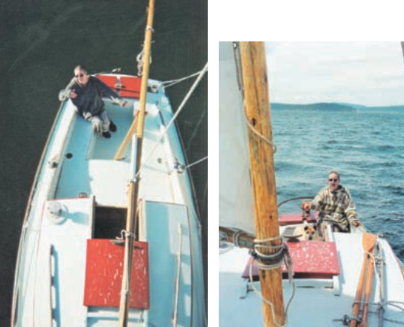
We pulled into the marina and there she was. A 25-foot, wooden, gaff-rigged Seabird cutter with a green hull and a “For Sale” sign. Her rudder post was the perfect likeness of a winking owl carved in yew; her rudder was the size of a small pony. The tiller was a sexy curve of cherry, and solid spruce spars graced her white decks. Down below she resembled a hobbit hole, complete with a tiny wood-burning stove and a gigantic 25-hp Atomic 4 engine. She had been well built and well looked after. Her name was Madrona.
The owner met us at the marina that January afternoon. After rebuilding Madrona in 1988, he cruised the San Juan Islands, teaching his children how to sail. Now his children were grown, and he’d moved on to the world of fiberglass and bigger boats. Arrangements were made to launch Madrona the next morning.
Splash! After being in dry-dock for 18 months, Madrona swelled up in a matter of hours, taking on a few gallons of water and then nothing. She floats, but does she sail? The wind was blowing about 15 knots, just about perfect for that clunky gaffer. The sun was shining. We motored out of the marina, raised the sails, and off we went.
I didn’t know much about sailing that day. Aaron will argue that I still don’t know much about sailing, but after two-and-a-half years together, I rarely listen to him anymore. But I do know how that little wooden boat felt the first time we sailed her, how she felt happy, how solid and content she was. How sailing her felt holy. Aaron and I made an offer soon after that glorious sail.
Sometimes I wonder if we found Madrona or if she found us. It was as if that little wooden boat, both serious and playful, became an animate object, negotiating the whole deal between us, three mere mortals.
Thank you to Sailrite Enterprises, Inc., for providing free access to back issues of Good Old Boat through intellectual property rights. Sailrite.com