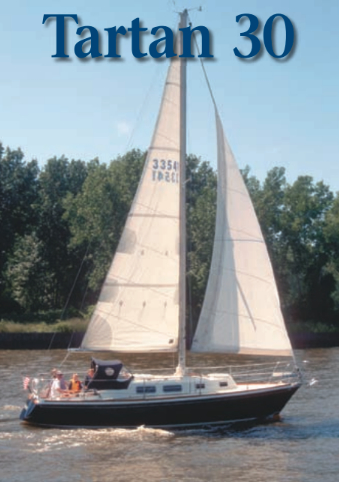
A pedigreed and still-successful racer/cruiser from the 1970s
Issue 45 : Nov/Dec 2005
Douglass & McLeod, Inc. of Grand River, Ohio, was the partnership formed by Gordon (Sandy) Douglass and Raymond McLeod Sr. in the late 1940s. It was also the seed organization that has blossomed into what we know today as Tartan Yachts, located across the Grand River in Fairport Harbor, Ohio. Originally, Ray McLeod was a marina owner and builder of wooden commercial fishing boats, while Sandy Doug- lass was the designer and fabricator of small plywood sailboats, including the Scotsman, International 14, and Thistle. Under their combined talents, they introduced the Great Lakes 21 (now known as the International 21) and the Highlander.
The partnership lasted about a decade. In 1957, Sandy was bought out and eventually went on to design and build the 19-foot Flying Scot. In the early 1960s there was considerable interest in and a switch to fiberglass. Another company was formed, Douglass & McLeod Plastic Corporation, as well as another partnership, this time with Charlie Britton, an experienced sailor with financial means. It was Charlie’s involvement that led to Douglass & McLeod’s switch to auxiliaries. The newly formed company commissioned naval architects Sparkman & Stephens to design the Tartan 27. Not only was the Tartan 27 Douglass & McLeod’s first auxiliary, it was Sparkman & Stephens’ first design for fiberglass. The boat was an instant success. In 1966, Douglass & McLeod introduced the Ted Hood-designed Blackwatch 37. Soon after came the Tartan 34, which began a long string of Sparkman & Stephens designs, including the Tartan 30. (For more Tartan history, see the November 2003 issue of Good Old Boat.)
Destroyed by fire
Shortly after the Tartan 30’s introduction, fire destroyed the facility. And the following year, Ray McLeod Sr. died of cancer. Ray Jr., who had swept the floors when he joined the company in 1941 but who was now part-owner, soon sold his share of Douglass & McLeod Plastic Corporation to Charlie Britton, while retaining ownership of the original separate company, Douglass & McLeod, Inc. Douglass & McLeod Plastic Corporation, renamed Tartan Marine, continued to build progressively larger boats and successfully underwent several ownership changes, mergers, and bankruptcies. Today, it is a vibrant builder of quality sailboats under the Tartan and C&C nameplates. Ray McLeod Jr., under the Douglass & McLeod, Inc. name, continued to build the Thistle, Highlander, and the Sparkman & Stephens-designed D&M 22 for quite some time. He’s no longer in the boatbuilding business and concentrates on his marina, winter storage, repair, and surveying business.
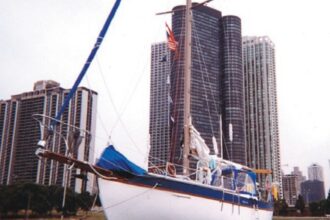
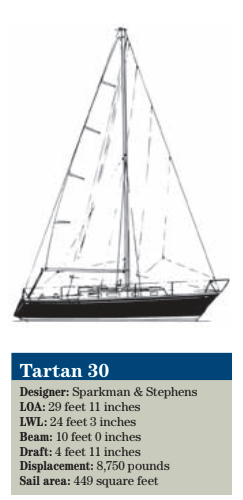
Introduced in 1971 by Douglass & McLeod Plastic, the Tartan 30 was produced until 1980, with a total of 602 boats being built. It is an excellent example of a solidly built 1970s racer/cruiser. It has a length overall of 29 feet 11 inches, a waterline length of 24 feet 3 inches, a beam of 10 feet, a draft of 4 feet 11 inches, and a displacement of 8,750 pounds.
Design and construction
The design of the Tartan 30 was, in part, a response to the Midget Ocean Racing Club (MORC) rules. In the early 1970s this class was quite popular, and several production boats were designed to meet the 30-foot maximum length requirement. However, none was as striking nor has been as enduring as the Tartan 30. The exterior design is based on the traditional but features such contemporary touches as high topsides, a reverse transom, and the absence of large overhangs, giving her a long waterline relative to overall length.
The boat was built with heavy scantlings. The hull is hand-laid and comprises woven roving and mat fiberglass. The deck of the Tartan 30 is balsa-cored and joined to the hull on an outward flange, which is protected by the rubrail. Under water there is a relatively short fin keel and a tiller-controlled, skeg-mounted rudder.
On deck
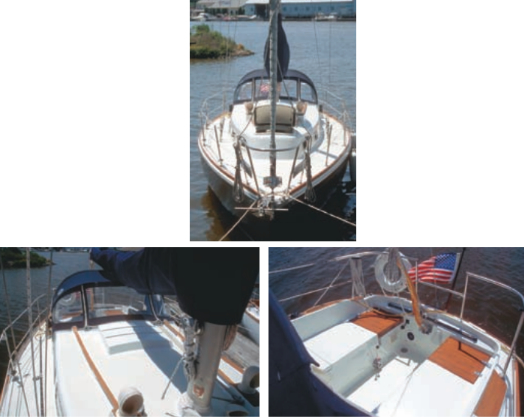
With the forward hatch located on the turtle-shell-shaped cabintop, the foredeck is clutter-free and makes a good working platform for the crew. The stem is capped with an aluminum stemhead fitting and is flanked by a pair of cleats and pair of chocks. There’s a non-skid deck surface, teak toerail, a bow pulpit, and dual lifelines for safety. The sidedecks are a generous 20 inches wide, although they are a bit obstructed by the chainplates.
Forward, on the cabintop, there is an opaque, fiberglass hatch. Abaft the hatch and on either side of the cabintop is a short section of teak handrail, followed by a Dorade vent, which is followed by a long section of teak handrail. Inboard and adjacent to the port Dorade vent is the engine blower exhaust port. The sliding companionway hatch is fitted with a proper sea hood, and the aft cabintop has been sculpted to accommodate a dodger.
The cockpit features a pair of aft sail bins with teak tops. While their openings are small, both bins are quite deep. The port bin also houses the engine instrument panel, while the speed and transmission controls are located on the starboard side of the cockpit. Also on the starboard side, but forward, is cockpit access to the galley’s icebox. The teak-capped coamings are straight and offer good back support. Surprisingly, there is no bridge deck to protect the cabin from water cascading from a pooped cockpit. With the Tartan being tiller-controlled and the mainsheet traveler on the transom, the cockpit is clutter-free. A manual bilge pump is located on the starboard portion of the transom. A stern pulpit has a centerline swim ladder and a pair of cleats and associated chocks.
Belowdecks
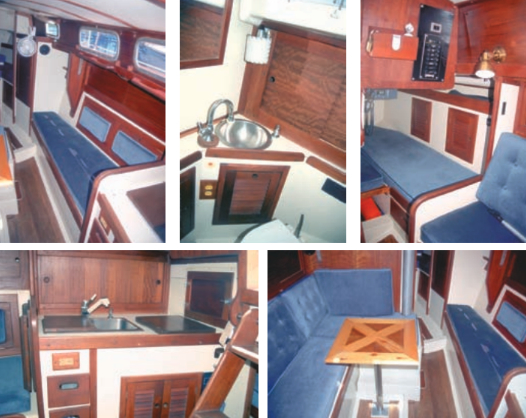
Below, even with standing headroom taller than 6 feet, the accommodations can be considered a bit cramped. The V-berth’s measurements of 76 inches long by 72 inches wide (with insert) may sound adequate; however, the sharpness of the bow reduces its maximum width rapidly. Stowage and a holding tank are beneath, with fiddled shelves above and outboard. Overhead is the forward hatch and to each side is an opening port. A pair of reading lamps light up the area at night. Directly abaft and to port is the head compartment. This challenging space contains a single stainless-steel sink, a hand-held shower that drains to the bilge, a head, and a couple of lockers with louvered doors. The door to the head also swings across the passageway to provide the V-berth with privacy. For ventilation and light there are a Dorade vent and an opening port. Across from the head compartment is a hanging locker with shelf above, as well as another opening port and Dorade.
Moving aft, the passageway is offset slightly to starboard due to the amidship placement of the engine. This also complicates the main saloon’s accommodations. The Tartan 30 was available in two layouts, one with the galley amidships along the starboard side and the other with an aft galley to starboard. The first layout provides for a pair of quarter berths, while the second leaves room for a starboard settee/berth. In either case, the port settee/berth/dinette is L-shaped (the small part of the L housing the engine) and converts into a double. When not in use, the pedestal table is stowed in a handy bracket that’s located overhead of the port quarter berth. Our review boat was configured with the aft galley layout. Its starboard settee/berth is 72 inches long, its port settee/berth is 78 inches long, and its quarter berth is cavernous, especially since the one on our review boat has been extended beneath the cockpit sole by the current owner and now bisects the large open stowage area common to both layouts.
More stowage
Above the settees are full-length lockers with sliding doors. Additional stowage can been found beneath and behind the settees. There is stowage beneath the quarter berth plus a full-length shelf and a pair of shallow lockers out-board. Four large fixed ports plus three reading lamps illuminate the main saloon. The quarter berth has its own reading lamp. The AC/DC fuse panel is located on the aft bulkhead, on the port side, just above the quarter berth.
The starboard aft galley is adequate for a boat of this size. It has a double stainless-steel sink (pressurized hot and cold water has been added to the review boat); a pressurized alcohol two-burner stovetop; a side-opening icebox that extends beneath the starboard cockpit seat, with cockpit access; a couple of drawers; three lockers with doors; and a dry stowage bin.
The interior is painted and accented with teak and teak-veneered plywood. The cabin sole is also teak (earlier models had a cork sole). There are four teak handrails overhead in the saloon.
The rig
The rig, as designed by Sparkman & Stephens is practically indestructible. It is a single-spreader, keel-stepped, masthead sloop, with a fairly high-aspect ratio. Total sail area is 449 square feet. The standing rigging comprises a headstay, upper and lower shrouds, and a single backstay. All spars are anodized aluminum. The halyards are double-braided polyester, internal, and their winches and cleats are located on the mast. Performing the work on our review boat was a pair of Lewmar #8 single-speed winches.
Headsail sheets are led aft through cars on the almost 10 feet of genoa track situated on each sidedeck. Our review boat was equipped with two additional 6-foot tracks located on the toerails to port and starboard. The headsail’s winches and cleats are located on the cockpit coamings. On our review boat a pair of Barient #21, two-speed, self-tailing winches and 6-inch cleats easily handled the task.
The mainsail is equipped with jiffy reefing. Our review boat had two reef points. For control, end-boom sheeting is led to a traveler on the transom.
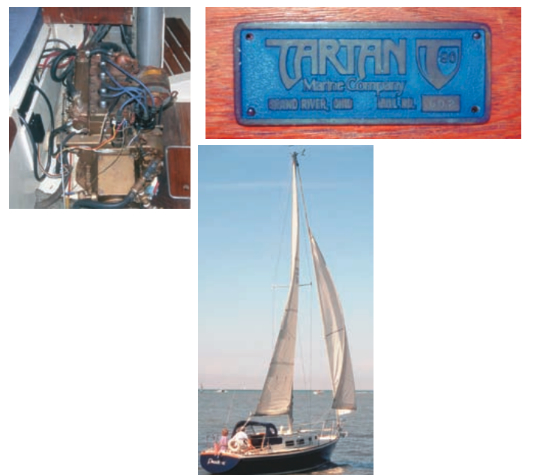
The Atomic 4 was the original auxiliary power plant used in the Tartan 30 and most of the boats were equipped that way. However, by the mid-1970s, the two-cylinder Farymann diesel was being offered as an option. Regardless of the make, the engine is located amidships and is offset a few degrees, positioning the propeller in a nearly ideal position. Access for maintenance is excellent.
Under way
The Tartan 30 sails well. In moderate-to-heavy air, it’s at its best. Light air is not to its liking. It would benefit from a large genoa (larger than 150 percent) and the optional tall rig. To windward it is stable and downwind it’s reasonably comfortable. On a reach the boat can develop significant weather helm, depending upon conditions. It can be a wet boat, above and belowdecks. The quarter berths and aft galley are vulnerable to spray; without a bridge deck, the low companionway sill allows water from a flooded cockpit to pour below.
Things to check out
Common to all boats with a balsa-cored deck is the potential for delamination. Check carefully around the chainplates, as they are prone to leaking. Gelcoat crazing is common on the Tartan 30. Many boats have undergone some form of fairing and painting to minimize this cosmetic flaw. With the mast being keel-stepped, examine the mast butt and step for signs of corrosion. While in the bilge, check out the support timbers, especially fore and aft of the keel. While rot is easily uncovered, weakening due to groundings may not be as readily apparent. Take your time. Have a mechanic look over the Atomic 4. If the boat is equipped with a Farymann, do the same, and remember that parts for it are less common and more expensive.
Summing up
The Tartan 30 is an attractive-looking and solid boat. It sails very well as a cruiser and is a competitive racer. Its rig is almost bulletproof.
With such a long production run, there are always several boats on the market from which to choose. Originally, a 1971 Tartan 30 sold for $17,700. Prices today range from $12,000 to $24,000, with the high teens being common for a mid- to late-1970s vintage boat.
Thank you to Sailrite Enterprises, Inc., for providing free access to back issues of Good Old Boat through intellectual property rights. Sailrite.com