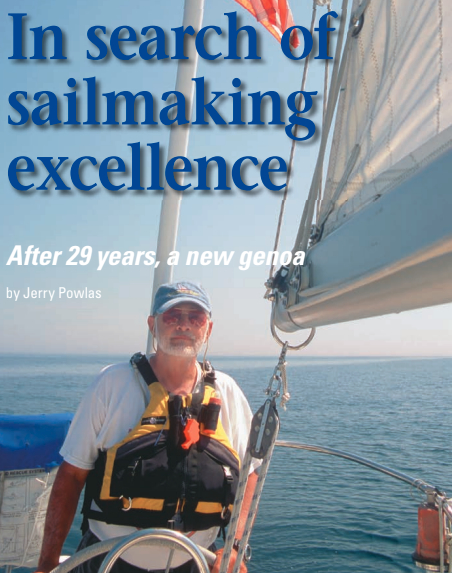
After 29 years, a new genoa
Issue 47 : Mar/Apr 2006
Mystic’s 150-percent genoa was made in 1976, as near as I can tell. We’ve made repairs to it in most of the 14 years we’ve owned the boat. I even sewed in a foot reef a few years ago. All that attention was worth it. The sail was in service for 29 years. Granted, we carry four headsails, so no one sail has to do all the work. But still, 29 years is a long time. This is particularly so in my case.
I used to buy a new suit of sails every two years when I raced dinghies. That was as often as the class rules allowed. Even though I don’t race anymore, I’m still not one to give away a tenth of a knot on a 6-knot boat. Do that very many times and you have a 5-knot boat. The old genny held her place in the inventory because she kept her shape and pulled nearly as well as I’d expect a new sail to pull. But ultraviolet rays finally had their way.
Shopping for sails is interesting. You can shop for price, although I’ve never done that. You can also shop for various designs, cuts, shapes, and features. I’ve always looked for sailmakers who respect my skills and experience and make reference to how I use my boat. I also want a sailmaker who knows more about sails than I do. In such matters I’m not actually an easy person to deal with. Some might say I’m often not easy to deal with, but even so, sails are a special case. I’d probably choose a sailmaker with more care than I’d choose a surgeon.
The guy I selected this time did it all right. He grilled me about how I intended to use the sail. You can often tell more about people by the questions they ask than the answers they give. Sails today are all designed by computers. He fired up his laptop and worked with draft location and depth. We worried twist into the shape. We called Sailrite, which made our mainsail. They checked their records and gave us the draft location and depth on the main so the new genny could be cut to work well with it.
I gave the sailmaker our venerable old 150 to look at along with 10 pages of instructions about what I wanted in the new sail. He took these with good grace, and I had the sense that he had higher expectations for the new sail than I did. That ain’t easy. We will see in the spring.
That is the process of custom sail design and construction. It’s not about trying to hang something white in the foretriangle at the lowest possible cost. Instead, it’s about balancing a large number of variables to make something that is a nearly perfect compromise.
Thank you to Sailrite Enterprises, Inc., for providing free access to back issues of Good Old Boat through intellectual property rights. Sailrite.com