An affordable coastal cruiser in three editions
Issue 48 : May/Jun 2006
During the 1960s and ’70s, Southern California was home to the world’s largest builders of fiberglass sailboats. While Columbia, Cal (Jensen Marine), and Islander (Wayfarer Yacht Corp.) dominated the market, a number of smaller builders also cashed in on the fiberglass revolution. Among them was Capital Yachts, builder of the Newport model line, ranging from the Newport 16 daysailer to the big Newport 41.
East Coast origins
For close to 10 years, Bill Smith and Jon Williams had been retail sailboat dealers in the Greater Santa Monica Bay area. Both were accomplished sailors and racers and, as part of their retail businesses, each performed commissioning and warranty repairs. Also, both were sailing and selling Newport sailboats manufactured by Elgin National Industries, headquartered in Chicago, Illinois, with a manufacturing facility in New York State.
Bill and Jon believed they could improve on Elgin’s quality yet still offer customers a line of open-water sailboats that would sell at a low, fair-market price. The odds for success weren’t in their favor. However, their experiences and desire, coupled with the aid of their banker, Sandy Greenberg, made their dream a reality.
Wanting to concentrate on engineering, mining, and industrial manufacturing, Elgin National Industries elected to divest itself of its sailboat subsidiary. In 1971, Bill and Jon formed Capital Yachts, Inc. and bought the tooling for the Newport fleet from Elgin.
They moved the manufacturing process to Harbor City, California, and contracted the design firms of Cuthbertson & Cassian (see Good Old Boat, September 2002 for the full story of C&C) and Gary Mull (Good Old Boat November 2002) to develop designs for a new and updated fleet of Newport sailboats. Their first year’s production was pre-sold and, initially at least, they had a large and steady backlog. Along with the Newport line, Capital Yachts Corporation went on to build Neptune and Gulf sailboats. But boatbuilding is a tough business, and their good fortune did not last. In 1996, Bill Smith and Jon Williams were forced to close the doors.
Gary Mull design
After several false starts, designer Gary Mull made it big as a naval architect. A few of his credits include the Santana 22, 27, and 37; the Ranger 22, 23, 26, 32, 33, and 37; the Freedom Independence 28, 30, 36, 42, and 45; and the Newport 30 and 33. He died in 1994 at the age of 55.
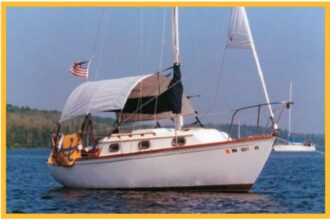
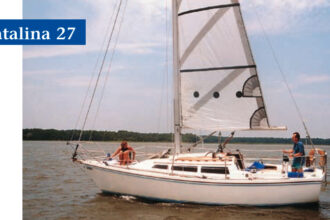
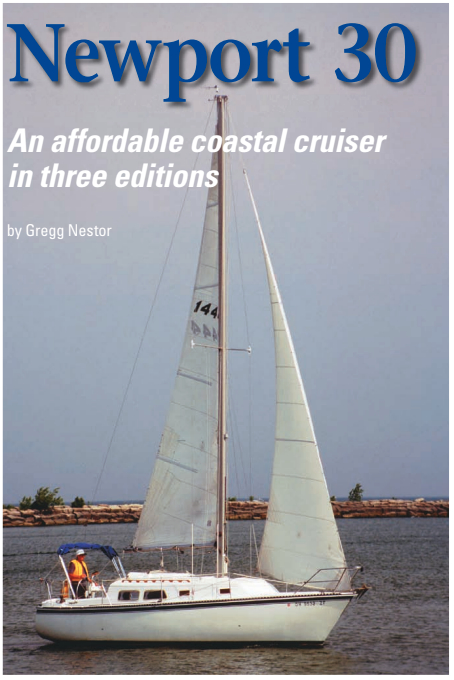
Introduced in 1973, the popular Newport 30 went through several design modifications during its production run, which lasted from 1973 well into the 1980s. While not intended or built as an offshore boat, with reasonable refitting the combination of the Newport 30’s fast hull and roomy interior makes for a competitive and rewarding coastal cruiser and club racer.
As originally designed, the Newport 30 displays a rather straight sheer that harmonizes well with the boat’s sharp stem and straight stern. The cabintop carries its lines forward to the stemhead, while the portlights are sized to match the roof height. These two features, along with the cove stripe, work together to deepen the curve in this flattish sheer, making it look more traditional. Underwater, the powerful hull carries a scimitar-shaped keel and rudder, which at the time were thought to be most efficient.
This initial design was in production from 1973 to about 1975. Modest changes were then made, and the Mk II version was offered from 1976 to 1985.
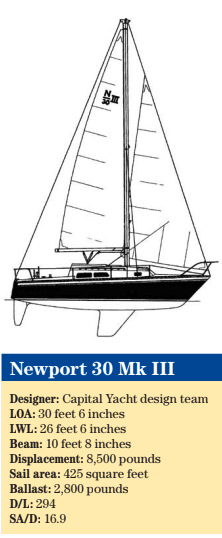
In 1986, the Newport 30 Mk III was introduced. While the original Newport 30 and the Mk II designs were drawn by Gary Mull, the Mk III is listed as being designed by the Capital Yacht design team. That means a member of the in-house design team reworked the original lines. Nevertheless, the boat is obviously very similar to its predecessors. The scimitar-shaped keel and rudder gave way to more modern high-aspect-ratio appendages (see drawing on Page 10) and the ballast was slightly reduced. Instead of an inward flange hull-to-deck joint, the Mk III’s joint was changed to an outward-facing flange. This probably accounts for the Mk III having 3 inches more beam than the previous two editions.
Construction
Construction of the Newport 30 is straightforward and typical of the era. Both the hull and deck are hand-laid, as opposed to being laminated with a chopper gun. The hull is solid and is comprised of up to seven layers of multidirectional mat and 24-ounce woven roving, a heavy fabric used for quickly building laminate thickness. The deck is cored with a synthetic material called Glasspack. In areas that require both sheer and compression strength, the Glasspack was replaced by marine plywood. The hull-to-deck joint was mechanically fastened with aircraft rivets on 6-inch centers and the seam sealed with fiberglass mat and resin.
To reduce labor costs, the Newport 30 has a fiberglass pan that incorporates basic furniture, like berth foundations. The pan’s horizontal surfaces are cored with marine plywood and the unit is bonded to the hull with fiberglass roving. Earlier models featured a molded fiberglass headliner with teak accent battens and trim, while later editions came standard with a padded vinyl headliner. The latter makes it possible to tab the bulkheads to the deck with fiberglass fabric, which is not possible with the fiberglass headliner. According to Bob Johnson, a former Newport dealer and owner of our review boat, Valkyrie, some boats with the padded vinyl headliner had bulkheads tabbed to the deck, while on others they were not.
The keel is made of lead. In addition to being epoxied to the hull, the keel is fastened to the boat by means of galvanized-iron keel bolts. Completing the process, resin-saturated fiberglass cloth covered the joint. Inside, a resin and asbestos mixture was poured into the hull’s keel recess, covering the keel bolts and permanently locking them in place.
On-deck features
Situated between the forward mooring cleats is a very deep anchor locker, capable of storing at least two anchors and rodes. Also conveniently located in the locker is the deck-fill plate for the 70-gallon potable water tank nestled beneath the forward end of the V-berth. The anchor locker’s hatch is fitted flush for obstruction-free footing, however it lacks any means with which to lock it when closed.
The sidedecks are 14 inches wide and, like all the deck’s horizontal surfaces, feature a molded-in non-skid pattern. However, the inboard-mounted chainplates and the headsail tracks clutter the sidedecks a bit.
Forward on the cabintop is a flush-mounted opaque fiberglass hatch. Just forward and to port of the mast is an optional small hatch over the head compartment. And just aft of the mast is a flush-mounted smoked Plexiglas hatch, followed further aft by the sea hood. There are four opening portlights, two forward on each side, followed aft by four larger fixed portlights, two per side.
For safety, there are double lifelines, a stainless-steel bow pulpit, and a stern pulpit with centerline swim ladder. A pair of teak handrails mounted on the cabintop and a slotted aluminum toerail complete the picture.
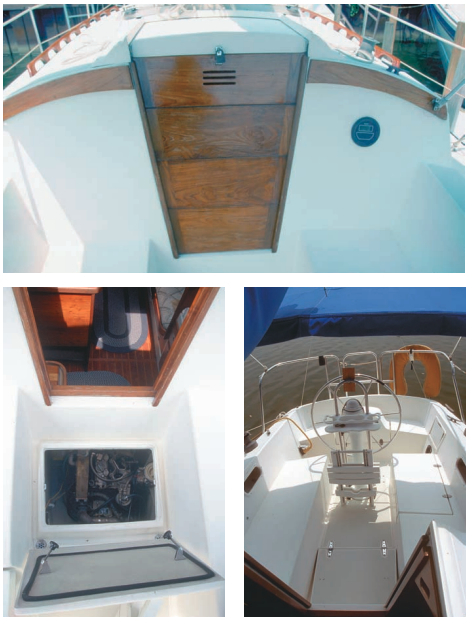
The Newport 30 featured a T-shaped cockpit with tiller steering as standard equipment. Wheel steering was offered as an option. If fitted with a wheel, the emergency tiller attachment fixture, located directly underfoot, can be a tripping hazard for the helmsman.
The seatbacks are 12 inches high, including coamings, and provide fair back support and bracing. For stowage, there’s a lazarette with access beneath the helmsman’s seat and a port cockpit seat locker, which also provides access to the engine and packing gland. The companionway is large. There’s no bridge deck to prevent a pooped cockpit from emptying water below. Four small scuppers are provided to clear water out of the footwell.
Belowdecks
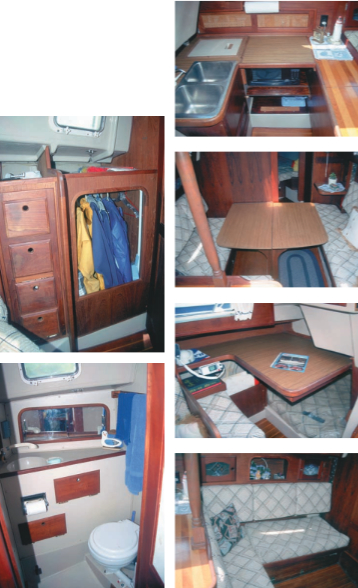
The forward compartment of the Newport 30 features a generous V-berth with insert. The port portion of the berth is 7 feet 8 inches in length, while the starboard portion is only 6 feet long. This shorter side allows for the placement of a four-drawer locker just forward of the large starboard hanging locker. Spanning the tops of both is a convenient bureau top. The door to the hanging locker is oversized and can be swung out across the passageway to create a stand-up changing area and to give the forward cabin some privacy. There are lockers beneath each leg of the V-berth and a pair of outboard shelves. The forward hatch and two opening ports ventilate this cabin.
On the port side, just aft of the V-berth and across from the hanging locker, is the very roomy head compartment with a molded fiberglass sink, head, several stowage lockers, and a shower sump with teak grating. The handheld shower performs the dual duty of showerhead and sink spigot. While many Newport 30s have been upgraded to include pressurized hot and cold water, it came standard with manual cold water. An opening port provides illumination and ventilation and a teak door closes the space for privacy.
The saloon is configured with a straight settee to starboard and an L-shaped settee to port. While the starboard settee functions as a single berth, the port settee converts into a double by lowering the bulkhead-mounted table and rearranging the settee cushions. A pair of teak handrails is overhead for safe maneuvering. Behind the port settee is a pair of lockers with leaded-glass doors and a book cubby. On the starboard side are three book cubbies and a novel TV shelf with a pair of stowage bins. Along with the holding tank on the port side and the batteries to starboard, additional stowage can be found beneath the settees. An opening port, the overhead hatch, and the companionway provide the saloon with good air flow.
The U-shaped galley is aft to port, separated from the saloon by means of a unique and convenient serving island. Located outboard is a three-burner gimbaled alcohol stove with oven. Next is a top-loading icebox with teak grate and an aft-facing double sink with manual foot pump. The galley has adequate stowage for provisions, pots, and dinnerware. It includes a trash chute in the forward portion of the port cockpit locker.
Directly across from the galley on the starboard side is the aft-facing navigation station with its own seat. When not in use, the chart table can be slid aft out of the way and stowed above the starboard quarter berth. The quarter berth itself is quite roomy and is naturally illuminated by means of a translucent panel located in the starboard footwell of the cockpit’s T. There’s chart stowage beneath the chart table as well as general stowage in the form of bins and a full-length shelf. The boat is blessed with lots of stowage.
All cabinets, drawers, handrails, and trim are solid teak, while the bulkheads, doors, and large surfaces are veneered with teak. The sole is of teak and holly, and there’s 6 feet 4 inches of headroom throughout.
The rig
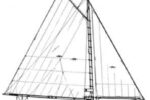
The Newport 30 is a masthead sloop with a 43-foot 7-inch mast stepped on deck. Both the mast and the boom incorporate internal sail tracks. The mast features a single pair of airfoil spreaders and is supported by a pair of cap shrouds, dual lower shrouds, a headstay, and a split backstay. Sail area is 425 square feet, giving it a sail area/displacement ratio of 16.9, which is typical of coastal cruisers.
The mainsail came standard with one reef point and jiffy reefing. The original halyards were external wire/rope. A pair of mast-mounted Lewmar single-speed winches provides the mechanical advantage for hoisting sails. Our review boat was fitted with the optional cabintop-mounted halyard winch.
The tracks and cars for the genoa are on the sidedecks and lead to a pair of Lewmar #30 2-speed primary winches on the cockpit coamings. For ease of handling, our review boat was upgraded with Lewmar #40 self-tailers. The main is sheeted mid-boom and is fastened to a cabintop traveler.
Underway
The Newport 30 is a very capable coastal cruiser and respectable club racer. Typical of trends in yacht design at the time, the mainsail is relatively small, so in light air you’ll have to set a large genoa to get the boat moving. Under 10 knots of breeze, a 150- to 170- percent genoa will make a big difference in boat speed. Above 10 knots, things start to get exciting and it performs well. Weather helm becomes a concern at around 15 knots, and at 18 knots the main needs to be reefed in order to balance the boat.
Auxiliary power is furnished by a 2-cylinder, freshwater-cooled Universal diesel. Depending upon the year of manufacture, the horsepower rating can vary from 15 to 18. With the 13-inch sailing propeller as standard equipment, this power plant pushes the boat along at a tad over 6 knots. The 30-gallon fuel tank is located beneath the starboard quarter berth. Access to the engine is above average to very good and can be gained from behind the companionway steps, from the cockpit hatch, which is prone to leaking, and from both sides.
Things to check out
In addition to the typical age-related concerns, three areas of importance require close scrutiny. The first is hull blistering. Several cases of moderate-to-severe osmotic blistering have been reported by owners. If you find a boat whose hull appears to be in pristine condition, question the owner about what was done to correct or protect it. If blistering is present, determine whether the asking price has been adjusted accordingly. As always, seek guidance from a competent marine surveyor.
The second area of concern is the hull-to-deck joint. The outward-facing flange is prone to damage, failure, and subsequent leakage as a result of a “hard docking.” Examine the toerail and investigate any areas that are damaged or distorted. This can be a tough repair job.
Lastly, while great pains were taken to make the hull-to-keel joint permanent, galvanized iron bolts can corrode, and resin-encased bolts are impossible to examine. Check for telltale signs of groundings and examine the joint for breaks in the fiberglass. Water seepage will corrode the bolts. This is another tough area to fix.
Conclusion
A comfortable, roomy interior married to a fast hull is always a good combination for sailing fun, and the Newport 30 is just that. Like all boats, the Newport 30 has its shortcomings, but with a little thought and modification it will perform well. By the way, it’s not a bad looker! On the used boat market, a Newport 30 sells for $10,000 to $25,000, depending upon year and condition.
Thank you to Sailrite Enterprises, Inc., for providing free access to back issues of Good Old Boat through intellectual property rights. Sailrite.com