My life with Jane Duck
Issue 48 : May/Jun 2006
There has never been another boat like her, not before nor since. I remember crossing Rosario Straits, leaving Lopez Island bound for Deception Pass with the air-cooled Lister spewing warm air against my legs on a cold rainy morning. I remember plowing through the short choppy seas of summer bone in her teeth with Rinky Dink poppling along behind . . . it was always a treat.
My love affair started when a student of mine in Liverpool said his dad had a sailboat. His description didn’t match anything I could recognize. They sailed it in the Irish Sea . . . “The best boat in the world,” his dad had said. Her home was a mud berth up a North Country estuary surrounded by buttercups and daffodils until the tide brought in the sea twice a day.
But a tidal bore swept the young student’s father overboard and drowned him. The boat was taken to a shed in Bolton where she sat on her muddy trailer through many summers, trying to be forgotten under rusting steel trusses amidst broken Massey Fergusons and a Morris Minor or two.
I climbed a ladder to sit in her cockpit and looked over the cabintop blister past the mast lying in a bed of coiled and twisted rigging. I sat and wondered what it would be like to raise the main and rush back to the cockpit, grabbing the whipstaff and feeling her tense up while beginning to move on her own. I sat there looking down into the cabin at a mass of gear and equipment and at the winches incongruously attached to a steel bulkhead. There were sailbags, a few tools, and no sign of berths.
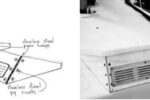
A man wearing a flat hat, a pin-striped suit coat over bib overalls, and a rumpled scarf appeared at the ladder, scowling and saying something I didn’t quite catch. I moved out of his way as he came aboard. He lifted the cockpit sole that I held against my knees as he slammed the gearbox lever and throttle control back and forth.
Dropping down to the cabin, he cranked the engine. He cranked and muttered and cranked some more until it shuddered into life, shaking the boat, plates, pots and pans, the hatch cover, and me. Smoke filled the shed as he raced the engine. We smiled at each other, the boatman and I, and I heard him shout over the roaring Lister in a rich Lancashire accent, “Just like tha ol’ Massey, matey!”
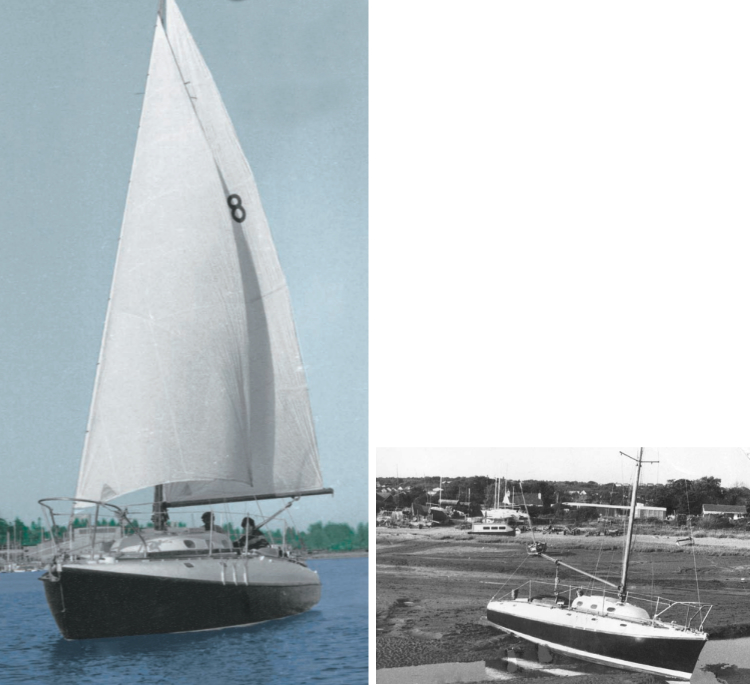
One thing led to another, and I became the second owner of Jane Duck, Fairey Atalanta No. 158, the most unusual and unforgettable boat I’ve ever owned.
The Fairey Atalanta
During World War II, too many aviators were losing their lives bobbing about in tiny rubber infl atables that pitched to the mercy of rampaging seas until the men either starved or died of exposure. At that time, the great British yacht designer, Uffa Fox, served as design consultant to Fairey Marine Ltd., a subsidiary of the Fairey Aviation Company. Uffa designed many things including survival clothing, small sails, and paddles to aid fliers shot down over the North Sea and English Channel. Frustrated at the helplessness of airmen who had no way at all of getting home, Uffa got the idea of designing a lifeboat to be carried under the fuselage of a bomber and dropped by parachute to ditched aircraft. This would certainly be an improvement over ping-pong paddles and downwind handkerchiefs.
The design’s beginnings
In his 1966 book Joys of Life, Uffa recalled how his notion for the life-saving boat came about. “I had the idea at one of our daily tea parties with the office staff in my office and . . . I made the first model with thick drawing paper and strawberry jam. Immediately after tea I went up to the drawing office . . . and then went on with boat builders and engineers to make a wooden [scale] model of . . . the boat. We also designed the parachutes, and as the drawing-office was on the top floor of [the] Medina Yard, at midnight, when it was all complete, we threw the model out of the window to a draftsman waiting below. The parachutes opened and unfolded the boat on the way so that the man in the roadway below had no difficulty in catching the complete boat with its parachutes.”
The original folding boat idea gave way to a rigid hull form with watertight compartments, wooden daggerboards, and retractable rudders. The boats fitted snuggly against the underside of a Lockheed Hudson medium bomber. Later, larger aero dynamically sleek versions were fitted to four-engine Avro Lancasters and B-17 Flying Fortresses. The lifeboats were light but tough enough to survive the impact forces of a parachute landing in the often-choppy English Channel. They were self-righting and could be rowed, sailed, or motored back home to England. The idea worked and saved many lives, British and American. After the war, Alan Vines of Fairey Marine, who had helped in the development of the airborne lifeboats, was intrigued with the notion of a yacht based on the airborne lifeboat concept. With Uffa’s encouragement, he led the development of the Atalanta 26, the name coming from an early Fairey flying boat.
Jane Duck was in generally good condition when I found her, but she needed work. Atalantas were built on the hot-molding method developed during WW II and used to construct such aircraft as the de Haviland Mosquito. The hot-molding process involved placing several layers of thin (5⁄64-inch) agba planks diagonally over a solid wood mold. A resorcinol-type glue was used which required the application of heat and pressure to set. This was done under a rubber bag placed over the newly glued-up hull. A vacuum was applied until the bag was stretched skin-tight over the hull under pressure. The whole assembly was then cooked in an autoclave at more than 212o F.
It was thought that the synthetic resins used as adhesives were proof against fungus and bacteria and that under heat and pressure they impregnated the laminations to make the hull resistant to water penetration and teredo attack. In 1980, when I began my restoration, Jane Duck was about 25 years old. I inquired at Fairey and received a flood of technical help, including repair instructions and a bundle of agba mahogany strips. When I started probing with my knife I found only small pockets of rot, usually in the way of solid wood and the places where fresh water collected. There was no delamination.
Deep and shallow draft
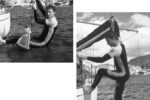
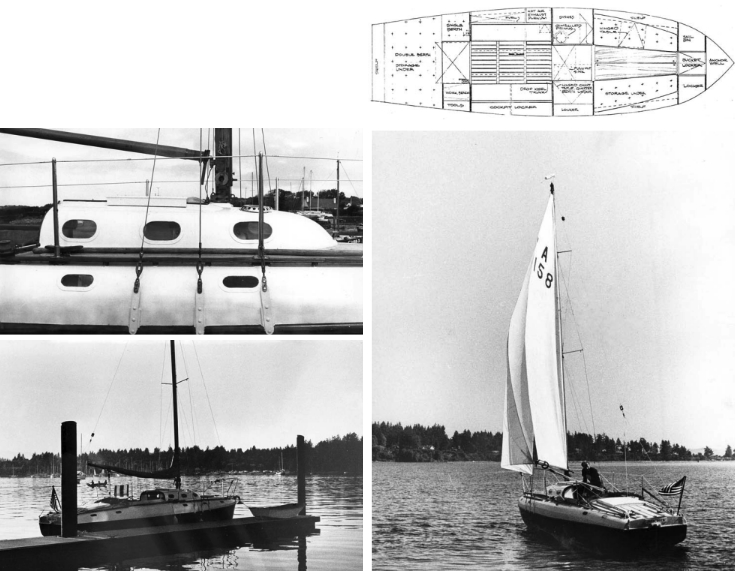
Twin retractable keels, each weighing 475 pounds, drop vertically through the boat’s bottom and produce a rather striking resemblance to the legs of a duck. They are worked by standing in the galley area, facing forward, and simultaneously cranking two winches — a very athletic and, to me, a supremely satisfying activity. The retracting keels can be locked in any position, singly or doubly, by a sort of disc brake mechanism. Upon striking a submerged object, the brake friction is overcome, the keels lift into their trunks and fall back again when the obstacle has been passed. All the forces generated when sailing are taken by the steel-reinforced bulkhead to which the keels are attached, thus relieving the light wooden shell of the ringing stresses normally associated with a keel boat.
Whenever I’d leap below to grab those brass winch handles in both hands and shift the half-ton of iron ballast in her keels up and down, I felt I was back at submarine school operating machinery of extremely serious purpose. I knew I was doing important work. The lifting aluminum rudder is operated with an uphaul and a downhaul that are connected with shock cord to absorb accidental or intention- al groundings.
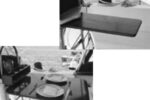
Because many Atalanta owners completed the hulls, accommodation differs from boat to boat, but Jane Duck’s plan is typical of those I’ve seen. Two berths are located in the main cabin just abaft the sail locker and anchor well in the forepeak. A steel-reinforced bulkhead separates this sleeping area from a small portside galley that gives access to a quarter berth. Opposite the galley, a navigation table with sliding sink below lifts to provide access to another quarter berth. The after cabin contains a queen-sized berth athwartships, a small settee, and a compact work- bench with vise and tool locker.
With only an 18-inch draft (keels up) and robust construction, Atalantas can be beached or worked up shallow streams well away from crowded anchorages. I lived on Jane Duck one summer at the village of Heswall on the Dee Estuary where I anchored a hundred yards or so offshore behind a grassy sand bank that disappeared twice a day, alternating my view from beach to the open sea.
There were a dozen or so of us out there in the sand, mud, and water ruts of Heswall: keelboats, centerboarders, barge yachts, twin-keelers, and boats standing to wooden legs . . . all tough little boats in various stages of uprightness at low tide. Arrivals and departures were timed so we could either walk to our boats or take dinghyloads of supplies. I built a William Atkin-designed flat-bottomed dinghy, Rinky Dink, that I hauled up on the afterdeck where she rode most comfortably and attractively.
A new home
Eventually, I was obliged to ship Jane Duck from Liverpool to Seattle. She was chained to the deck of a container ship and, in heavy seas that would have meant little to her if she had been free to make her own way across the Atlantic, she shifted, separating the transom and hull. When I saw the damage after she arrived in Seattle, I was bitterly disappointed. However a Lloyd’s agent made a cash settlement on the quayside, and I set off in good spirits to repair her in the Shilshole Yard.
I had a happy week of good work, which resulted in a transom every bit as strong as the original construction, thanks to the wonders of epoxy. When we launched her and I backed off the brakes, however, the keels wouldn’t drop. Good English mud had dried and cemented them to their trunks. After a couple of hours the concretized mud softened, the two keels dropped with resounding thuds into the waters of Elliot Bay, and we began sailing in Puget Sound and the surrounding archipelagos.
How does she sail?
In light winds, the Atalanta sails like a barge: slowly and gracefully. A cruising chute helps . . . but not a lot. The narrow range of headings possible under this sail rather negates the advantages. As winds increase to about 15 or 20 knots, she stiffens and begins to gain on the reefed-down boats that passed her so smugly in lighter air earlier. Under certain conditions of strong wind and small waves, she planes most dramatically, but this doesn’t happen often.
She sails comfortably with a minimum angle of heel and feels like a much heavier boat. She is not very close-winded and is happiest under started sheets. Varying the angles of the keels — together or separately — provides an infinity of adjustment of the center of lateral resistance and center of gravity as well as plenty of exercise. Atalantas are said to be self-righting if the keels are kept 15 degrees up from full down. Cruising logs record dry boats after violent knockdowns at sea.
The whipstaff or vertical tiller is connected to the rudder head with a system of aircraft cables. I find it an excellent steering method — comfortable and convenient — and it frees up the cockpit space.
The air-cooled engine
Jane’s engine is a 2-cylinder, air-cooled 12-horsepower Lister diesel. It’s noisier than more modern, water-cooled engines but in my view is entirely in keeping with the boat it serves. I never saw fit to replace or repair the erratic electric starter. I preferred to wind the huge flywheel by hand, cranking slowly at first, then faster and faster until the momentum took hold (more good exercise). I then engaged the injectors one at a time and listened as the single explosions merged into a continuous roar. I enjoyed starting that engine almost as much as I did feeling the wind fill Jane’s sails later on.
Jane was a good motorboat and held her course well. She moved astern predictably. Being designed, essentially, for keeping the sea along tempestuous British coasts, but now sailing in the much lighter winds and narrow, fast-running channels of Puget Sound and the San Juans, meant that I motorsailed a lot; I could leap down to the crank and have her going in seconds.
Not requiring a battery to start the engine, I used a kerosene anchor light and read by a faithful, hissing Tilley lamp during long summer evenings at anchor. Freedom from electrical power gave me an increased feeling of independence from things I didn’t understand, and that seems to me to be at the core of my enjoyment of small boats. The modest sail plan and mighty tumblehome always provided a great sense of security in the Irish Sea, but I gradually gained the feeling that she never took to the summer winds of the Pacific Northwest. She had everything in reserve — waiting to deal with some catastrophe — waiting to serve some higher purpose. Gunkholing, birdwatching, digging for littleneck clams, and picking oysters was never quite her style.
My life had taken some shifts and turns that made it difficult to commute to Seattle from Liverpool every summer. So — as has often happened just when a boat was nearing a perfection of form and function — when I found that I knew all of her idiosyncrasies, every quirk and hidden pleasure, I put her up for sale.
A young man appeared at the dock on Bainbridge Island in answer to my ad. He examined her from stem to stern, on deck and below, and I could tell within minutes that Jane and I were to part. He said nothing, caught as he was in the headlights of seduction. As we took her out for a trial sail in Eagle Harbor, he followed the whipstaff and keel lifting operation. He watched fascinated as I ratcheted the bronze roller-reefing gear that wound the spruce boom round and round, lowering the main, and he smiled broadly tending the sheets with the Tufnol, bottom handle winches. Returning to the slip, he said he’d take her — plus my foulweather gear, metal bucket decorated with grebes and California gulls, navigation instruments, binoculars, and just about everything else I couldn’t wear.
I left with my suitcase, and I’ve missed the boat ever since.
A postscript
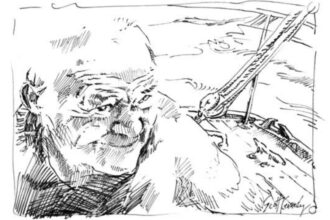
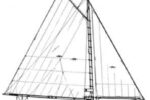
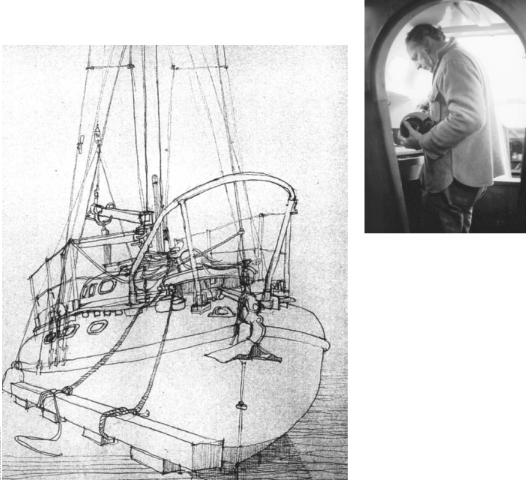
Within this memoir, I would be remiss if I did not mention a less tangible connection with a much-loved boat. Shortly after I sold her, a dear friend and architect, Peter Richardson, gave me a drawing that he’d done of Jane Duck for my birthday.
Pete had sailed in her one summer and missed her as I did. It’s a beautiful drawing, as fresh and lively as Uffa Fox’s jam and paper model of the prototype must have been, and I’ve kept it near my desk for more than 20 years.
Eventually, Pete found his own Atalanta, sailed her, and died in her one night in Caernarfon Harbor in the north of Wales. Pete’s Atalanta is now in the capable hands of his trapeze artist/sailor daughter and her fire-eating/sailor husband who, with any luck, will sail her once again into the Menai Straits and out into the seas beyond.
Thank you to Sailrite Enterprises, Inc., for providing free access to back issues of Good Old Boat through intellectual property rights. Sailrite.com