A 1970s trailersailer that sails well and still looks modern
Issue 50 : Sept/Oct 2006
The trailersailer revolution began in the early 1970s, when there was a widespread public consciousness about protecting the environment. The first Earth Day in 1970 was celebrated by millions. The effect on the boating industry was profound. Fueled by the OPEC oil embargo of 1973 that drove gas prices up, a lot of powerboaters did the unthinkable and took a turn at the helm of a sailboat. The relatively inexpensive trailersailers — mostly 20 to 26 feet in length — were the logical way to jump in. They could be stored in the driveway, thereby avoiding high yard and marina bills; their outboard motors sipped fuel; and their systems were so simple the average handyman or woman could take care of the few maintenance chores.
Some of the more popular models were the Catalina 22, O’Day 22 and 23, Ericson 25, Venture 21 and 22, and Cal 21. There were dozens more, including the Paceship PY23 and PY26, two of the best.
Design
A total of 28 known versions of sailboats and dinghies, ranging in length from 7 to 32 feet and designed by no less than seven naval architects, were produced by Paceship Yachts. The first Paceship 23 sailboat was designed by Cuthbertson & Cassian (see the September 2002 issue of Good Old Boat for the story of C&C). However, the Paceship PY23 came from the boards of another well-respected naval architectural fi rm: C. Raymond Hunt Associates. John Deknatel, now president of C. Raymond Hunt Associates, drew the actual lines of the PY23 sometime during the late 1960s or early 1970s. The “PY” designation is associated solely with Paceships designed by C. Raymond Hunt Associates. (Numerous builders also were involved over the years; see related story on Page 58.)
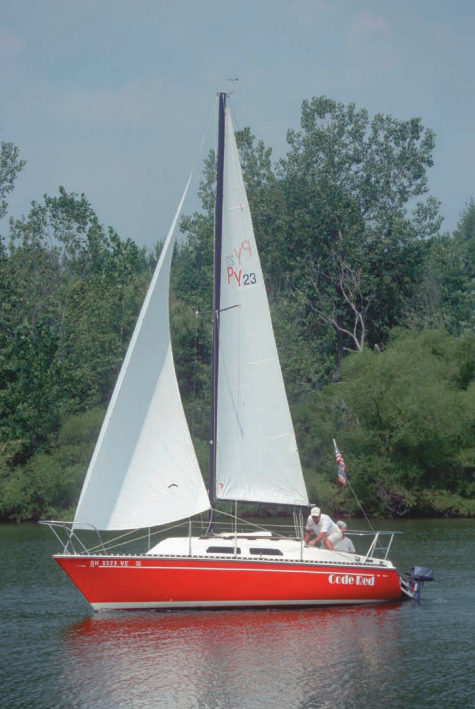
The silhouette of the PY23 shows an aggressively raked bow, a rather flat sheer, and a reverse transom. The forward end of the cabin has considerable slope and comes together on centerline in a wedge with a sharp vertical line, which is unusual and distinctive. The cockpit coamings begin near the top of the aft end of the cabin and slope aft to the transom. Combined with moderate freeboard, these design elements give the boat the appearance of forward movement, whether at rest or under way.
Unlike a lot of trailersailers, the PY23 does not have a swing keel, in which all ballast hangs on a single pin. Instead, a weighted centerboard pivots into a stub keel. The only real disadvantage is that the ballast isn’t centered as low as with a fixed or swing keel.
The displacement/length ratio of 151 is a bit misleading because of the small size of this boat. Add 1,000 pounds of crew and supplies to a boat with a 19-foot waterline and performance quickly sags; add 1,000 pounds to a 35-footer and it’ll hardly be noticed.
Construction
The hull, deck, and interior pan are all hand-laid fiberglass laminates, which incorporate combinations of mat, roving, and polyester resin. While the hull and pan are solid laminates, the deck is a sandwich of two layers of fiberglass with a core of end-grain balsa wood. Balsa is extremely light and, when sandwiched in this manner, adds structural rigidity. It also adds good insulation against heat, cold, and sound. Unfortunately, there is a downside. Constant flexing of cored decks can break the bond between the two fiberglass layers and the core. Also, any water that might find its way beneath the fiberglass skin can turn the core into mush. A spongy feel beneath your feet or the sound of a dull thud when struck with a mallet indicates, at the very least, a partially delaminated deck. On a well-built boat, the core has been removed wherever there are through-deck penetrations, such as cleats and stanchions.
The hull-to-deck joint is a simple lap joint, often referred to as a box joint, where the deck fits over the hull much like the lid of a shoebox. The joint is glued together and mechanically fastened with pop rivets every 2 inches. For both protection and cosmetics, the joint is covered by a two-piece vinyl rubrail.
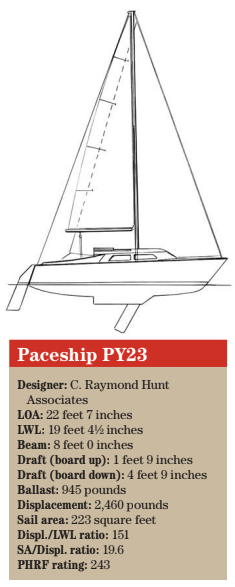
Underwater, the PY23 features a shoal-draft keel comprised of 945 pounds of cast-iron ballast that is externally bonded to the hull. Incorporated in the design is a fiberglass centerboard weighted with 45 pounds of lead shot. The centerboard is easy to raise or lower by hand without the aid of a winch. When raised, the centerboard is completely housed within the keel. In this position, the boat draws a mere 21 inches, as compared with 4 feet 9 inches when fully extended. The transom-mounted, tiller-controlled spade rudder is made of fiberglass with a foam and plywood core and is designed to kick up in the event of a grounding. This shoal keel/rudder design combination makes gunkholing possible.
Alcort/Paceship also offered what it referred to as a “high performance MORC [Midget Ocean Racing Club] version.” This boat was given the designation PY23K. It is non-trailerable and features a 3-foot 9-inch fixed keel and a solid fixed rudder. The ballast was reduced to 900 pounds. All other specifications are identical to the PY23.
Deck features
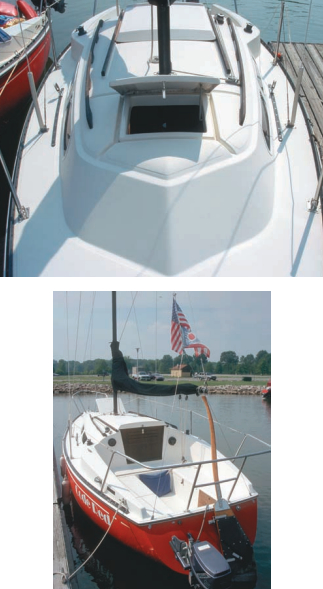
Forward there are a shallow anchor locker with hasp, a pair of open-throat cleats, and a stainless-steel bow pulpit. The rest of the foredeck is uncluttered. Footing is good, due to an aggressive molded-in non-skid pattern. Port and starboard slotted aluminum toerails run the length of the boat, as does a single lifeline on 24-inch stanchions. The sidedecks are 11 inches wide with inboard chainplates and headsail tracks.
On the cabintop are a flush-mounted, opaque forward hatch, a pair of 78-inch-long teak handrails, and the hinged tabernacle for the deck-stepped mast. There is no sea hood. The cabin sides feature four, fixed oblong-shaped portlights, two per side.
The cockpit easily accommodates six adults and is protected by generous coamings that transition from a forward height of 16 inches to 8 inches at the transom. Cockpit seat lockers are port and starboard. Both are quite deep and are separated from the cabin below. The port locker also houses the 12-volt battery for the electrical system. Located aft on the starboard side is a dedicated gas tank locker that can accommodate a standard 6-gallon portable tank. To help keep water from pouring below, there’s a deep bridge deck and a single cockpit drain.
A stainless-steel stern pulpit, a pair of open-throat cleats, and a transom-mounted motor mount on the port side complete the on-deck features.
Belowdecks
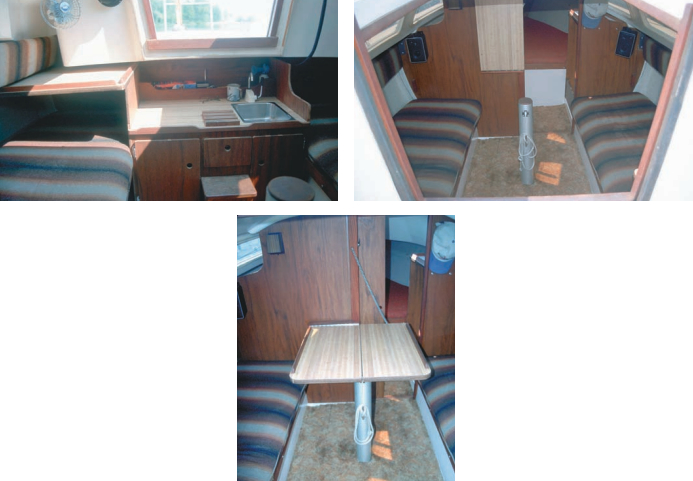
Below, the PY23 is surprisingly roomy for a 23-foot pocket cruiser. Headroom is about 5 feet throughout. While the fiberglass pan terminates at approximately seat level, where it is bonded to the hull, a padded vinyl hull liner continues on and transitions to a textured fiberglass headliner, giving the interior its finished look. The bulkheads, cabinetry, and sliding door are teak-veneered plywood; the countertop and dining table are surfaced with a white or wood-grained plastic laminate. All other wood trim, inside and out, is teak. The cabin sole is carpeted.
The accommodations are straight-forward and functional. In the forward cabin there’s a V-berth that measures 6 feet 2 inches long by 7 feet 4 inches wide. Full-length shelves are situated port and starboard against the hull, with additional stowage lockers beneath the berth itself. Aft and to starboard is a hanging locker with a shelf above. To port is space for a portable toilet or the optional recirculating chemical toilet. The forward hatch and portions of the two forward fixed portlights illuminate the head. A sliding door completely closes it off from the main cabin and gives privacy to both areas.
The main cabin features opposing settee/berths 6 feet 2 inches long. The aft ends of each extend beneath the cockpit seats. For dining, there’s a bulkhead-mounted drop-leaf table that accommodates four adults. Stowage can be found beneath the settee/ berths and on the outboard shelves.
Rising roughly 2 feet from the cabin sole and situated directly in the cabin’s center is the centerboard pendant tube. This novel item serves a triple function: it houses the centerboard pendant; it acts as the pedestal for the dining table; and, with the table in the stowed position, it’s a tripping hazard!
The galley is located aft, under the companionway and bridge deck, where there’s space for the optional compact galley unit. This unit includes an icebox, a single stainless-steel sink with hand pump, a 12-gallon potable water tank, a locker for galleyware and dry goods, and space for a two-burner cooktop. A portion of the galley countertop also serves as one of the companionway steps.
The rig
The PY23 is a masthead sloop with 223 square feet of sail area. Jiffy reefing is standard. Both spars are black anodized aluminum extrusions with internal sailtracks. The black spar seems to be an AMF/Paceship signature. The mast is stepped on deck by means of a hinged tabernacle. There is no compression post underneath the tabernacle. Instead, the bulkhead framing and the bulkhead itself act as the supporting structure. There’s a single pair of spreaders, and the standing rigging includes a headstay, a pair of cap shrouds, a pair of lower shrouds, a split backstay, and a topping lift. The shrouds are fastened to chainplates mounted to the forward bulkhead.
Halyards are run internally. While the mainsail halyard is double-braided polyester, the jib halyard is wire-to rope. An easy upgrade would be to switch out the wire-to-rope for a modern, low-stretch line such as those with Technora, Spectra, or Vectran fibers. Our review boat was fitted with the optional Lewmar #6 single-speed halyard winch mounted on the port, aft edge of the cabintop.
Headsail sheets are run aft through cars and 3-foot tracks located on the sidedecks and led to Lewmar #6 single-speed winches and associated cleats situated forward on the cockpit coamings. The main tackle runs from the boom about a foot forward from the end to a traveler conveniently mounted on the bridge deck. Because the boom is so short, this is a nearly vertical drop.
Under way
The PY23 is a very satisfactory first cruiser. It is comfortably at home in relatively protected waters and makes a great gunkholer. Like all trailerable boats, the PY23 is a bit tender; when the wind picks up it can develop significant weather helm. At about 13 to 15 knots, take a tuck in the main. This should balance the boat nicely and allow it to cruise at hull speed. In higher winds, reduce the headsail area to maintain balance. When going to windward, keep the centerboard down. This will help the boat point better. On a run, lift up the board to reduce drag and increase speed.
Performance Handicap Racing Fleet (PHRF) ratings for the PY23 average 243 seconds per mile, just 3 seconds per mile slower than the keel model at 240. For comparison, an O’Day 23 rates the same, 243, and a Catalina 22 rates a sluggish 270.
Things to check out
In addition to the problems caused by poor maintenance and age, a few potential other areas of concern are unique to the PY23.
The forward bulkhead not only acts as the compression/support structure for the mast but also the point of attachment for the chainplates. Look for signs of cracking, bending, or movement. If the sliding door is difficult to move, this is an indication of a bigger problem. Carefully examine where the chainplates are mounted to the bulkhead. Discoloration or delamination is a sign of water seepage and can result in rig failure. The best way to check for bulkhead rot or hole enlargement is to remove the chainplates . . . after lowering the mast, of course!
The box flange hull-to-deck joint is prone to damage from a collision or a “hard docking.” Look for cracks or a waviness in the gunwale suggesting that such an impact has taken place. Also, stains in the hull liner near the joint are an indication of water leakage.
The PY23’s keel is cast iron and is prone to corrosion. Protect it with a barrier coating and judicious use of antifouling paint. Don’t apply a copper-based bottom paint directly to bare iron.
Lastly, both the centerboard and the rudder have hollow sections that are prone to water penetration, delamination, and subsequent failure. With a little effort, these two appendages can be rebuilt better than new.
Conclusion
The Paceship PY23 is an inexpensive, adequately equipped and appointed pocket cruiser. It’s designed for cruising in relatively protected waters. It’s a good weekender for two adults and maybe two small children. While it does come with some baggage that needs to be addressed, it’s a fun boat to sail. Best of all, hitch it up to the old SUV and your sailing destinations are almost unlimited. Prices, which usually include boat, outboard motor, and trailer, range from $3,500 to $7,500, depending upon condition and equipment.
Thank you to Sailrite Enterprises, Inc., for providing free access to back issues of Good Old Boat through intellectual property rights. Sailrite.com