Garbage out, good used stuff in; the saga begins
Issue 50 : Sept/Oct 2006
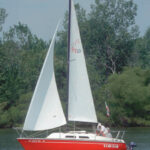
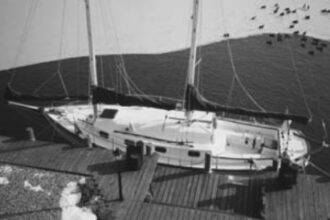
The game plan for Maruska would have to be aggressive to meet a June departure. My primary goal was to make her seaworthy and reliable for the long trip home. Havre de Grace, Maryland, to Norfolk, Virginia, would be her shake-down. The offshore passage from Norfolk to Sandy Hook, New Jersey, would put her sailing systems to the test, and the Erie Canal route through New York would require a very reliable driveline. Keeping in mind that this trip would be a sizable undertaking for any well-prepared sailboat, my to-do list for Maruska’s 30-year-old systems grew by the hour. A float plan of more than 1,000 nautical miles would mean things had to be done right the first time.
With the papers signed and the check accepted, the deal was done. The first work weekend started with a thorough cleaning of the accumulated parts, pieces, and gear from the boat. One pile to keep, one destined for eBay, one to trash, and one conspicuously set by the marina dumpster. This last pile was made up of items too good to throw out. These disappeared one by one as the weekend progressed.
I tried to diminish the rank mixture of rancid bilge water and diesel fuel by spraying everything I could reach with a pump-up orchard sprayer filled with a mint-scented cleaning solution. This was like throwing perfume on a pig; there was no denying it: Maruska stank!
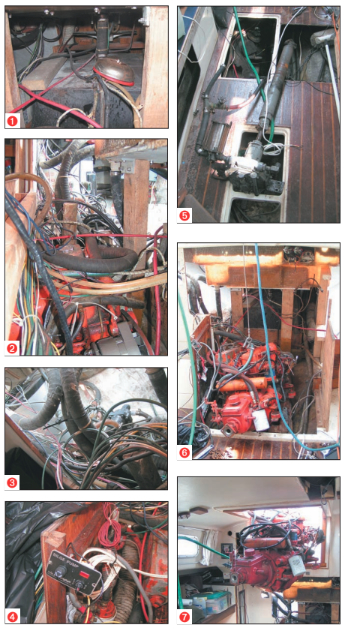
It was difficult to stay focused on any one task. Everywhere I looked, there was something different to think about. Repair, replace, or just remove . . . the choices seemed endless. “When in doubt, throw it out” became the motto of the day. The ground around Maruska was littered with garbage bag after garbage bag of old wiring, exhaust system, hoses, and obsolete gear. The electrical system was a concoction of each previous owner’s interpretation of what boat wiring should be, interlaced with the original Pearson factory wiring. Stranded wire, telephone cable, solid conductor house wire (Romex), and lots of lamp cord tangled its way from one end of the boat to the other. Hoses of all sizes and other materials started nowhere and ended nowhere. Stainless hose clamps with carbon-steel screws failed with the slightest pressure; others were so loose they rotated freely about the hose with the mere insertion of a screwdriver. The plastic through-hull for the bilge pump snapped as I tried to remove its surrounding hose. The view of the parking lot stones below through the exposed hole was a stark reminder of what could happen if I missed the slightest detail.
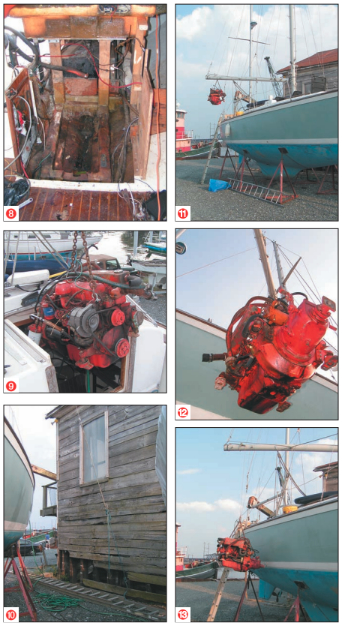
Removal of the Walter V-Drive and the engine drive shaft were welcome diversions as I uncramped from lengthy bouts in the cockpit lockers. I spent several wasted minutes trying to decipher the engine wiring harnesses. Like everything else, it was a tangled illogical mess and was eventually removed with the yank-and-snip method. The hoses were “adjusted” with a hacksaw, and the engine rose from its beds dangling from the mainmast halyard strung through the end of the main boom. The engineer in me thought through the overhanging weight of the engine and transmission at the end of the main boom swung over the side. Just to be sure, I decided to secure a check stay to the foundation of a nearby building. I worked well past dark that first day building a shipping cradle for the engine for the long ride home on the utility trailer. Cushions, bags of sails, and parts and pieces piled high must have left quite an impression with passing motorists.
By the end of the first weekend, the engine and driveline had been removed, as well as 8 percent of the wiring and about 50 percent of the plumbing. When I wasn’t fishing for bilge surprises and hauling bags to the dumpster, I collected model numbers and manufacturers’ information from everything I could find. I made dimensioned sketches of what was left of the interior, took pictures, and made notes of every aspect of the project. These items became priceless 370 miles away as I scoured catalogs and the web for additional information on the equipment I had, as well as for what I needed to replace or upgrade. The ride home that first weekend proved invaluable as I thought through the events of those two action-packed days. Then I scribbled pages of notes as I formulated a game plan and schedule for the upcoming months. The cosmetics could follow down the road, but at all costs the boat must be seaworthy and reliable for her trip home.
I developed many lists. One was composed of those items that I knew would be difficult to locate at a price I could afford. These items would be the basis for the long-term “wanted list” that consisted of such things as a high-amp alternator, refrigeration unit, new electrical panels, quick-release inner forestay lever, and so on. To acquire these items I became an eBay junkie like never before. I scoured eBay morning, noon, and night. Whatever I could not procure used, I would eventually have to purchase new when the rebuild schedule required it. It is amazing what gear you can find used if you are diligent. I have been on a first-name basis with my local chandlery, Obersheimers Sailor Supply, for several decades, but this project ratcheted it up a notch. One of the other lists was the “wish list.” You know the one: the if-money-were-not-an-issue list.
Besides hunting items in the time between boat visits, selling items to raise cash became a big activity. Fundraising took on a whole new meaning. I scoured the house and garage and sold and auctioned items that were no longer being used. Reflecting on the boat stuff alone, I must have sold 10 bags of sails from boats that I never owned or would never own. The selling price was not the issue; the goal was to generate cash. As long as I could keep the money coming in ahead of the money going out, the Maruska project could continue.
Thank you to Sailrite Enterprises, Inc., for providing free access to back issues of Good Old Boat through intellectual property rights. Sailrite.com