Builder of classic cruisers
Issue 55 : Jul/Aug 2007
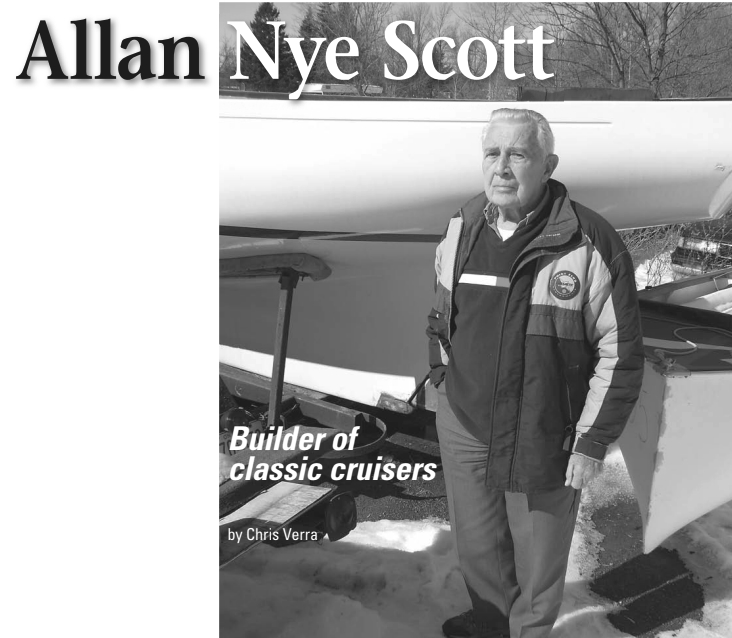
Just about any weekday morning after 10 you can find Allan Nye Scott behind his desk at the offices of Nye Boat Works in Foxboro, Ontario. Long past the normal retirement age, Allan no longer owns the business. He has taken on a consultant role. Despite the fact that he is in his 82nd year, he mirrors the tenacity, dependability, and endurance of the vessels he helped create, vessels such as the Contessas and several Albergs. The list of boats he built reads like the Who’s Who of “small boats to choose for an ocean crossing.”
First boats
Allan was born August 15, 1924, in Montréal, Québec. He was introduced to boats early in life at Boy Scout camp. Later, during World War II, he served as an Able Seaman doing radar control aboard the cruiser H.M.C.S. Prince Robert of the Royal Canadian Navy on convoy duty in the South Pacific. The ship was present for the handover of Hong Kong after the Japanese surrender in 1945, the final military action of the war.
After the war Allan returned to Montréal to study chemistry at McGill University. He loved to sail and, as an undergraduate student, purchased his first sailboat, a 16-foot daysailer.
Shortly after graduation he was hired by Union Carbide, a chemical company in Montréal. While there he was involved in the development of epoxy coatings. When he wasn’t working, he often could be found at the Royal St. Lawrence Yacht Club. Little did he know that working with epoxy coatings all day and messing with boats all weekend were good preparation for what was to come.
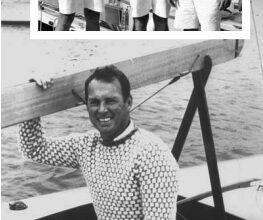
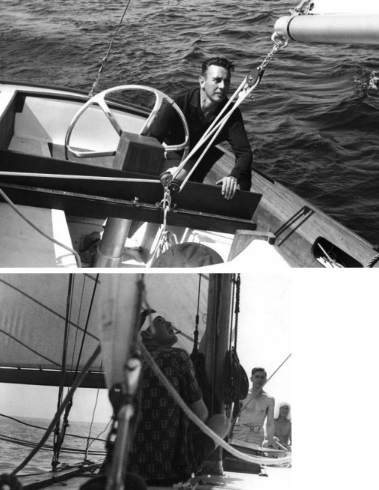
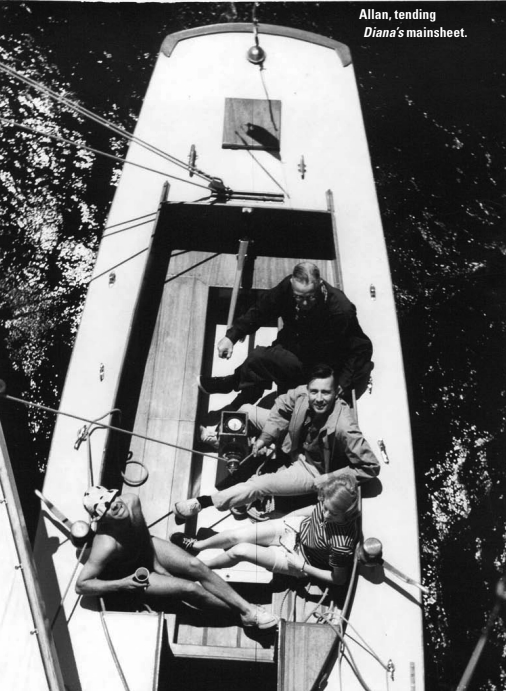
Allan was described in a 1970 Toronto Life Magazine article as having a “nomadic, just-give-me-a-place-to-hang-my-hat attitude.” His work took him from Montréal to Toronto many times during the decade after the war. Perhaps it was inevitable that he would one day join the National Yacht Club (NYC) in Toronto. That day came in 1951. While there he served on the board and as rear commodore and moved up through the racing ranks. In 1962 his romance with the R-class boat Diana began. At that time, there was a fleet of six R-boats at NYC. With Diana he honed his sailing skills, winning practically every cup around the lake. This wooden Universal Rule boat remains one of his favorites to this day.
Allan’s ownership of Diana is tied to the beginning of his relationship with the late Swedish yacht designer, Carl Alberg. Allan and four other sailors asked Carl to design for them a seaworthy boat similar to his Triton design being built by Pearson Yachts. Carl agreed and for $100 the Alberg 30 was born (see Good Old Boat, March 2006). Kurt Hansen of Whitby Boat Works, builder of the Great Lakes Folkboat, was commissioned to build the first five. Before production began, however, Allan decided to pass on the deal and instead bought Diana.
In 1967, Allan again made a tentative advance into boatbuilding when he and four other sailors from the NYC contacted Olin Stephens of Sparkman & Stephens to design a boat. In Allan’s words, “We wanted a boat we couldn’t afford.” The Hughes 38 was the result. Howard Hughes (no, not that Howard Hughes) of Hughes Boat Works was contracted to build it. (For a bit of Hughes history, see the Hughes 25 article, Good Old Boat, July 2006.) Many hulls and decks were delivered to sailors’ backyards. Some were completed at the factory. Allan had his delivered to the yacht club and finished it there.
This boat, named Diana of York, went on to prove her mettle on the racecourse, although Allan tells the story of his disappointing first race: “Jack Currie of National Yacht Club had purchased the original Diana from me. At the start of the race Jack sailed up behind me and passed us on the leeward side. As he went by Jack yelled over, ‘Good looking boat!’ and sailed on.” The Hughes 38 went on to be one of the great success stories of the boatbuilding world and continues to be a respected and capable vessel. Wild Card, one of the better known Hughes 38s, is sailed today by cruising writer and sailing broadcaster Cap’n Fatty Goodlander.
J. J. Taylor & Sons
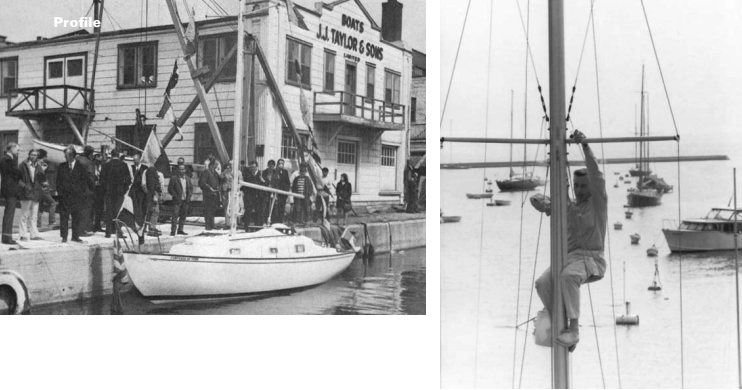
Evenings and weekends were spent building the systems and interior of the new Diana. Allan was working on his new Hughes in the yard at NYC the spring of 1968 when he was visited by Jack Martin, owner of a Toronto auto plant. Jack was interested in buying a boat company — J. J. Taylor & Sons — and asked Allan to negotiate its purchase and then manage it. J. J. Taylor & Sons had been building boats in Toronto since 1904 and had been kept busy during the war with military contracts. After the war, the firm built vessels for the Canadian Coast Guard, Royal Canadian Mounted Police, and anyone else it could get to sign a contract. In its heyday J. J. Taylor & Sons built boats from 10 to 134 feet. Working primarily in wood, the company was ready for a change. Under the leadership of Allan Nye Scott and Jack Martin, the company looked to fiberglass sailboat production.
At the age of 45, Allan put down roots in Toronto, due in no small part to the fact that he had gotten himself engaged to Evelyn Jonas, a young English teacher from Toronto and former lieutenant in the Royal Canadian Naval Reserve. His temporary address, as of November 1969: S/V Diana of York.
Over the course of his first year with J. J. Taylor & Sons, Allan searched for the right boat to take into production. The wrong decision at this critical juncture could bury a small business. He sought a sturdy little pocket cruiser and found it in the Contessa 26. A company called Rogers and Sadler had been building the 26 in Lymington, United Kingdom, since 1966. Allan had a hull and deck shipped to Toronto to make the molds and began production. The boat was a success: more than 350 hulls were laid up in the first three years. By the time J. J. Taylor & Sons closed in 1990, more than 400 had left the plant.
The Contessa 26, and later the Taylor 26, are considered by many to be the ultimate big-water pocket cruisers. Tania Aebi, the youngest woman to solo circumnavigate, did so in a Contessa 26 named Varuna. She was 20 when she finished her voyage. Tania told her story eloquently in her book, Maiden Voyage, which further promoted this capable little boat.
Because of the success of the 26, Allan returned to Lymington where Jeremy Rogers was building the big fin-keel sister of the 26, the Contessa 32. Again a hull and deck were shipped to Toronto in order to have molds made. Canadian production began in 1973. The design proved itself in the deadly 1979 Fastnet Race, in which it was the smallest boat in the fleet to finish. In 1996, long after Allan had left the company, 20-year-old B. J. Caldwell completed a solo circumnavigation on a Contessa 32, officially becoming the youngest person to do so. By 1990 when the plant closed, 87 Contessa 32s had been built.
New ventures
In 1974, one year after acquiring the Contessa 32 rights for J. J. Taylor & Sons, Allan left to strike out on his own. He set his sights on Belleville, Ontario, a small town on the shore of the Bay of Quinte at the east end of Lake Ontario. Belleville is home to the oldest continually run yacht club in North America, the Bay of Quinte Yacht Club. What better place to build sailboats?
Belleville also had the advantage of being the former production center for the venerable 31-foot Cuthbertson & Cassian-designed Corvette. Allan set up his new company, Nye Yachts, in the old building where Ian Morch’s Belleville Marine Yard (one of the founding four partners of C&C Yachts profiled in Good Old Boat, September 2002) had produced the Corvette. For his next boat Allan turned to Carl Alberg. A seaworthy pocket cruiser had worked for him in the past; perhaps he would hit gold again. Nye Yachts began production of the Alberg 22 in 1974. The molds came from DouglasMarine of Port Stanley, Ontario. Douglas had been producing the 22 under the name Douglas 22 because it never had the rights to use the Alberg name. After Douglas declared bankruptcy, Nye Yachts managed to get both the molds and permission to use the Alberg moniker.
By 1977 Nye Yachts was looking to add to its line. The first was the Carl Alberg-designed Alberg 29, of which around 70 where built. It remains one of Allan’s favorites. “Those were our best years,” he says. “The 29s were great vessels to sail.” The design was a more modern approach to the classic Alberg designs. Though it has a full keel and keel-hung rudder, the beam is wider and carried farther aft. And it was one of the first boats of this size to have propane lockers as standard equipment. Imagine, propane on a boat?!
The 29 was followed by the Alberg 34 in 1979, but only six were built. Things were looking up for the young company. As was the case with so many boatbuilders at that time, optimism was rampant. In 1982 Allan moved the company to a larger facility in Bloomfield, Ontario. The new 20,000-square-foot plant would give the company room to grow.
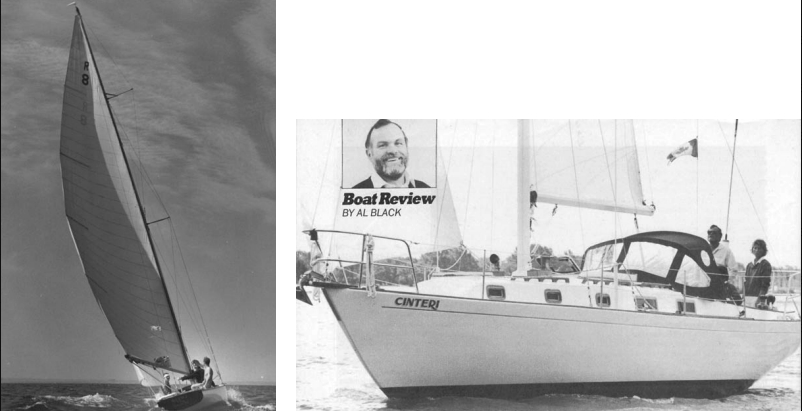
From 1983 until 1984 Allan had 22 workers completing one boat almost every seven days. But in the mid-1980s the boat market went soft. Builders all over North America were closing their doors. Allan managed to get an order to build 10 26-foot Dragonfly trimarans. The customer who commissioned the boats had the molds shipped from Denmark where the boat first had been built by Quorning Boats. Nye Yachts immediately began production on the new multihull. Two were completed before Allan was informed that the buyer could not take the order. He had more than $50,000 invested in the project, more than his company could afford to lose in a slow year. Nye Yachts closed its doors for good.
Not to be dissuaded, Allan returned to Belleville, where he set up Nye Boat Works. As is the case with most forward thinkers, Allan was able to see opportunity in the shrinking new boat market. He began doing repairs and restorations on used boats. The glut of vessels that had sunk the new boat market would provide him opportunity for years to come.
Retirement
Today Nye Boat Works is thriving in the village of Foxboro, north of Belleville. The new owner, Nathan Bresett, says the company continues to do repair and restoration work: “We are capable of doing any repair on boats up to 40 feet, but we specialize in Albergs and Contessas.” Allan can be found there most mornings, coffee in hand, a fresh smile on his face. “All I do is have a desk here,” he says. It is easy to suspect he does a lot more.
Allan and Evelyn currently live near Belleville, Ontario. Their only child (also Allan) is a professor of civil engineering in Fredericton, New Brunswick. Allan Sr. spends many of his summer evenings on his boat in the Bay of Quinte. Diana of Hastings, a fiberglass replica of his original R boat, is a contender under his command in the Bay of Quinte racing fleet.
Looking at Allan’s life makes one think he might just be the Forrest Gump of the sailing world. Like the movie character, he was fortunate to move through an era of change, playing a behind-the-scenes role in each event that defined that era, all the while oblivious to how significant those events would become. To steal a phrase from the movie, “Life is like a box of chocolates; you never know what you are going to get.” It’s likely Allan Nye Scott still has a few bonbons up his sleeve. The sailing world can only hope so.
Thank you to Sailrite Enterprises, Inc., for providing free access to back issues of Good Old Boat through intellectual property rights. Sailrite.com